
Introduction
Unit 3 of the new PECTAA Class 10 Mathematics book introduces matrices and determinants. A matrix is a neat rectangular arrangement of numbers in rows and columns. Matrices are used to store and organize information such as school timetables, flight schedules, and business records, and they are widely used in engineering, economics, computer graphics, and physics.
🎓 Online Classes with Experienced Experts
In this unit, students learn to perform operations on 2 × 2 matrices, find determinants and inverses, and solve pairs of linear equations. These notes follow the new book for session 2026-27 and suit students of all Punjab boards.
What You Will Learn
By the end of this unit, students will be able to:
- display information in matrix form and identify the order of a matrix;
- add, subtract, and multiply matrices, and multiply a matrix by a scalar;
- evaluate the determinant of a 2 × 2 matrix;
- find the adjoint and the multiplicative inverse of a non-singular matrix;
- solve two simultaneous linear equations by matrix inversion and Cramer’s rule;
- apply matrices to real-world problems.
Key Topics Explained
1. Matrices and Their Order
Matrices are named with capital letters, and their entries are called elements. Horizontal lines of entries are rows, and vertical lines are columns. A matrix with m rows and n columns has order m-by-n. Two matrices are equal only if they have the same order and equal corresponding elements.
2. Types of Matrices
The unit covers row, column, zero (null), square, diagonal, scalar, and identity matrices. It also covers the transpose, which is formed by interchanging rows and columns. A square matrix is symmetric if it equals its transpose, and skew-symmetric if it equals the negative of its transpose.
3. Addition and Subtraction
Matrices can be added or subtracted only when they have the same order. The operation is done element by element. Addition is commutative and associative, the zero matrix is the additive identity, and every matrix has an additive inverse.
4. Multiplication
The product AB exists only when the number of columns of A equals the number of rows of B. Each element of the product is found by multiplying a row of A by a column of B and adding the results. Matrix multiplication is generally not commutative, so AB and BA are usually different.
5. Determinant, Adjoint, and Inverse
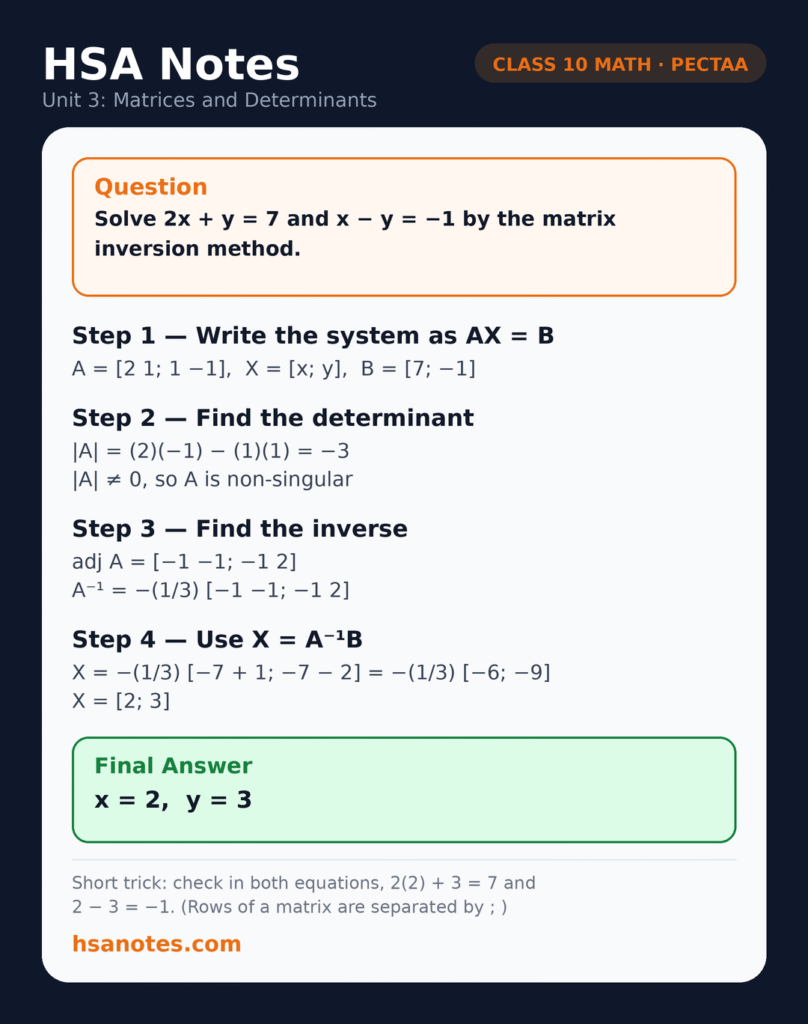
For a 2 × 2 matrix with rows (a, b) and (c, d), the determinant is |A| = ad − bc. If |A| = 0, the matrix is singular and has no inverse. If |A| ≠ 0, it is non-singular. The adjoint swaps a and d and changes the signs of b and c. The inverse is A⁻¹ = (1 ÷ |A|) × adj A.
6. Solving Simultaneous Equations
Two linear equations can be written in matrix form AX = B. In the matrix inversion method, the solution is X = A⁻¹B. In Cramer’s rule, x = Δx ÷ Δ and y = Δy ÷ Δ, where each determinant is formed by replacing a column with the constants.
Worked Examples
In each matrix below, rows are separated by a semicolon.
Example 1 (Addition): If A = [1 2; 3 4] and B = [5 6; 7 8], then A + B = [6 8; 10 12].
Example 2 (Multiplication): Let A = [1 2; 3 4] and B = [2 0; 1 3].
AB = [1×2 + 2×1, 1×0 + 2×3; 3×2 + 4×1, 3×0 + 4×3] = [4 6; 10 12].
BA = [2 4; 10 14]. So AB ≠ BA.
Example 3 (Singular matrix): For A = [3 6; 1 2], |A| = 6 − 6 = 0, so A is singular.
Example 4 (Inverse): Find the inverse of A = [2 1; 5 3].
|A| = 6 − 5 = 1 and adj A = [3 −1; −5 2], so A⁻¹ = [3 −1; −5 2].
Example 5 (Cramer’s rule): Solve x + y = 5 and 2x − y = 1.
Δ = −1 − 2 = −3, Δx = −5 − 1 = −6, Δy = 1 − 10 = −9.
So x = −6 ÷ −3 = 2 and y = −9 ÷ −3 = 3.
Important Formulas at a Glance
| Concept | Formula |
|---|---|
| Order of a matrix | m-by-n (rows by columns) |
| Determinant of [a b; c d] | ad − bc |
| Adjoint of [a b; c d] | [d −b; −c a] |
| Inverse | A⁻¹ = (1 ÷ |A|) adj A |
| Matrix inversion method | X = A⁻¹B |
| Cramer’s rule | x = Δx ÷ Δ, y = Δy ÷ Δ |
Exercises in Unit 3
| Exercise | Main Focus |
|---|---|
| 3.1 | Rows, columns, order, and equality of matrices |
| 3.2 | Types of matrices |
| 3.3 | Addition and subtraction |
| 3.4 | Multiplication of matrices |
| 3.5 | Determinant, singular matrices, adjoint, and inverse |
| 3.6 | Simultaneous equations and real-world problems |
| Review Exercise 3 | MCQs, short and long questions |
Exam Tips
- Check the order of the matrices before adding or multiplying.
- Never assume AB = BA, and always calculate both when asked.
- Compute the determinant first, since a zero determinant means no inverse.
- Verify your inverse by checking that A × A⁻¹ gives the identity matrix.
About HSA Notes
HSA Notes is a free educational platform for secondary and higher secondary students in Pakistan. It publishes solved notes, model papers, and study material aligned with the NBF, PECTAA, PCTAA, and FBISE curricula, covering Mathematics, Physics, Chemistry, Biology, Computer Science, and English. Our solutions are written by our own team, giving students clear, original, step-by-step help.
Online Classes
Students who want guided learning can join our online classes run by Hamdard Science Academy. The classes follow the new PECTAA book unit by unit, so Unit 3 concepts, examples, and exercises are taught in a clear order alongside these notes. To ask about the schedule, fees, or admission, email hsanotes48@gmail.com.
Conclusion
Matrices and Determinants is a scoring unit for students who practice regularly. With careful calculation and steady exercise work, it can become one of your strongest units. Free solved exercises and PDF notes are available on HSA Notes for all Punjab boards, and online classes are there if you need extra support.


1 thought on “Unit 3: Class 10 Math PECTAA Notes New Book”