
Introduction
Unit 2 of the new PECTAA Class 10 Mathematics book is about quadratic equations, one of the most useful ideas in algebra.
🎓 Online Classes with Experienced Experts
A quadratic equation has the standard form ax² + bx + c = 0, where a ≠ 0. Such equations appear in physics, engineering, business, and everyday problems, from the height of a thrown ball to the price that gives the greatest profit. It is also rich in numerical questions, so it matters in the board exam. These notes follow the new book for session 2026-27 and suit students of all Punjab boards.
What You Will Learn
By the end of this unit, students will be able to:
- solve quadratic equations by factorization, completing the square, the quadratic formula, and graphs;
- find points of intersection of linear and quadratic functions graphically;
- relate the roots of an equation to its coefficients and form equations from given roots;
- use the discriminant to identify the nature of the roots;
- solve quadratic inequalities and fractional equations that reduce to quadratics;
- change the subject of a formula and apply quadratics to real problems.
Key Topics Explained
1. Solving Quadratic Equations
There are four methods. Factorization uses the zero product property: if (x + p)(x + q) = 0, then x = −p or x = −q. Completing the square rewrites the equation as a perfect square and then takes square roots on both sides. The quadratic formula, x = (−b ± √(b² − 4ac)) ÷ 2a, works for every quadratic. The graphical method finds the points where the parabola crosses the x-axis. A parabola opens upward when a is positive and downward when a is negative. The unit also solves fractional equations by multiplying through by the LCM of the denominators, which turns them into quadratic equations.
2. Points of Intersection
Students find where a line meets the coordinate axes, where two lines meet, and where a line meets a parabola. In each case, both graphs are drawn on the same axes and the common points are read from the graph.
3. Roots and Coefficients
If α and β are the roots of ax² + bx + c = 0, then the sum of roots is α + β = −b/a and the product is αβ = c/a. In reverse, an equation with given roots can be written as x² − (sum of roots)x + (product of roots) = 0.
4. Discriminant and Nature of Roots
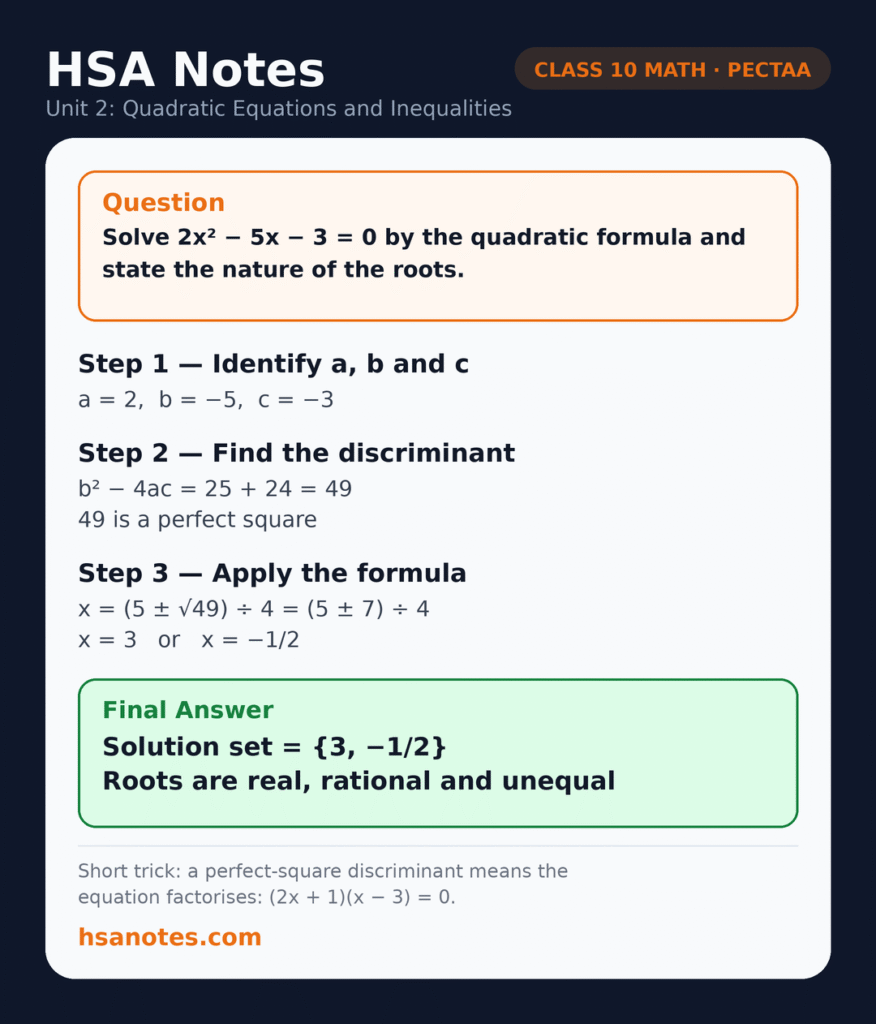
The expression b² − 4ac is called the discriminant. If it is positive and a perfect square, the roots are rational and unequal. If it is positive but not a perfect square, the roots are irrational and unequal. If it is zero, the roots are real and equal. If it is negative, the roots are complex.
5. Quadratic Inequalities
Solve the related equation first to find the critical points. These points divide the number line into intervals. Test one point from each interval to see which intervals satisfy the inequality.
6. Changing the Subject and Applications
Making a variable the subject of a formula means rearranging the formula so that variable stands alone. The unit ends with applications such as maximum height in projectile motion and maximum profit, both found at the vertex of a parabola.
Worked Examples
Example 1 (Factorization): Solve 2x² + 7x + 3 = 0.
2x² + 6x + x + 3 = 0, so (2x + 1)(x + 3) = 0. Hence x = −1/2 or x = −3.
Example 2 (Quadratic formula): Solve x² − 4x − 1 = 0.
a = 1, b = −4, c = −1. The discriminant is 16 + 4 = 20, so x = (4 ± 2√5) ÷ 2 = 2 ± √5.
Example 3 (Discriminant): Find k so that x² + kx + 9 = 0 has equal roots.
Set b² − 4ac = 0, so k² − 36 = 0 and k = ±6.
Example 4 (Forming an equation): Form the equation whose roots are 3 and −4.
Sum = −1, product = −12, so the equation is x² + x − 12 = 0.
Example 5 (Inequality): Solve x² − x − 6 < 0.
(x − 3)(x + 2) < 0, with critical points −2 and 3. The test points show the solution is −2 < x < 3.
Important Formulas at a Glance
| Concept | Formula |
|---|---|
| Standard form | ax² + bx + c = 0, a ≠ 0 |
| Quadratic formula | x = (−b ± √(b² − 4ac)) ÷ 2a |
| Sum of roots | −b/a |
| Product of roots | c/a |
| Equation from roots | x² − Sx + P = 0 |
| Discriminant | b² − 4ac |
Exercises in Unit 2
| Exercise | Main Focus |
|---|---|
| 2.1 | Standard form and solving by different methods |
| 2.2 | Points of intersection using graphs |
| 2.3 | Roots and coefficients, forming equations |
| 2.4 | Discriminant and nature of roots |
| 2.5 | Quadratic inequalities |
| 2.6 | Changing the subject of a formula |
| 2.7 | Real-life applications |
| Review Exercise 2 | MCQs, short and long questions |
Exam Tips
- Bring every equation to standard form before choosing a method.
- Write a, b, and c clearly when using the formula, and watch the signs.
- Check the discriminant first when a question asks about the nature of the roots.
- In inequalities, test a point from every interval instead of guessing.
About HSA Notes
HSA Notes is a free educational platform for secondary and higher secondary students in Pakistan. It publishes solved notes, model papers, and study material aligned with the NBF, PECTAA, PCTAA, and FBISE curricula, covering Mathematics, Physics, Chemistry, Biology, Computer Science, and English. Our solutions are written by our own team, giving students clear, original, step-by-step help.
Online Classes
Students who want guided learning can join our online classes run by Hamdard Science Academy. The classes follow the new PECTAA book unit by unit, so Unit 2 methods, examples, and exercises are taught in a clear order alongside these notes. To ask about the schedule, fees, or admission, email hsanotes48@gmail.com.
Conclusion
Quadratic Equations and Inequalities is a high-value unit for students who practice regularly. With the right method, careful signs, and steady exercise work, it can become one of your strongest units. Free solved exercises and PDF notes are available on HSA Notes for all Punjab boards, and online classes are there if you need extra support.
1 thought on “Unit 2: Class 10 Math PECTAA Notes New Book”