Introduction
Unit 7 of the new NBF Functional Mathematics Grade 9 FBISE textbook introduces Coordinate Geometry, the branch of mathematics that connects algebra and geometry using a coordinate plane. This unit, inspired by the work of Rene Descartes, lets students find distances, midpoints, slopes, and equations of straight lines using only the coordinates of points.
🎓 Online Classes with Experienced Experts
These ideas have real applications in aviation, navigation, landscaping, map reading, and reading longitude and latitude. These notes follow the new NBF book for session 2026-27.
What You Will Learn
By the end of this unit, students will be able to:
- derive and apply the distance formula to find the distance between two points;
- calculate the midpoint of a line segment;
- find the gradient (slope) of a straight line from two points, and from its inclination;
- find the gradient of parallel and perpendicular lines;
- find the equation of a straight line in slope-intercept form, point-slope form, and two-point form;
- find the angle between two coplanar intersecting straight lines, and calculate angles of a triangle from the slopes of its sides;
- apply coordinate geometry concepts to real-world problems.
Key Topics Explained
1. The Distance Formula
Given two points A(x₁, y₁) and B(x₂, y₂), the distance between them is d(A, B) = √[(x₂ − x₁)² + (y₂ − y₁)²]. This formula comes directly from the Pythagorean theorem applied to a right triangle formed by drawing perpendiculars from each point to the axes. It is used to prove whether points are collinear, or whether given points form special shapes like a square, rectangle, or parallelogram.
2. The Midpoint Formula
The midpoint of a line segment joining A(x₁, y₁) and B(x₂, y₂) is ((x₁ + x₂)/2, (y₁ + y₂)/2). This formula is often used to prove that the diagonals of a quadrilateral bisect each other.
3. Inclination and Gradient (Slope)
The inclination of a line is the angle θ it makes with the positive x-axis, measured anti-clockwise. A horizontal line has an inclination of 0°, and a vertical line has an inclination of 90°. The gradient (slope) of the line is m = tan θ. Given two points A(x₁, y₁) and B(x₂, y₂) on a line, the gradient is m = (y₂ − y₁) ÷ (x₂ − x₁), and it is undefined for a vertical line.
4. Gradient of Parallel and Perpendicular Lines
Two lines are parallel if and only if their gradients are equal: m₁ = m₂. Two lines are perpendicular if and only if the product of their gradients is −1: m₁ × m₂ = −1.
5. Equations of Straight Lines
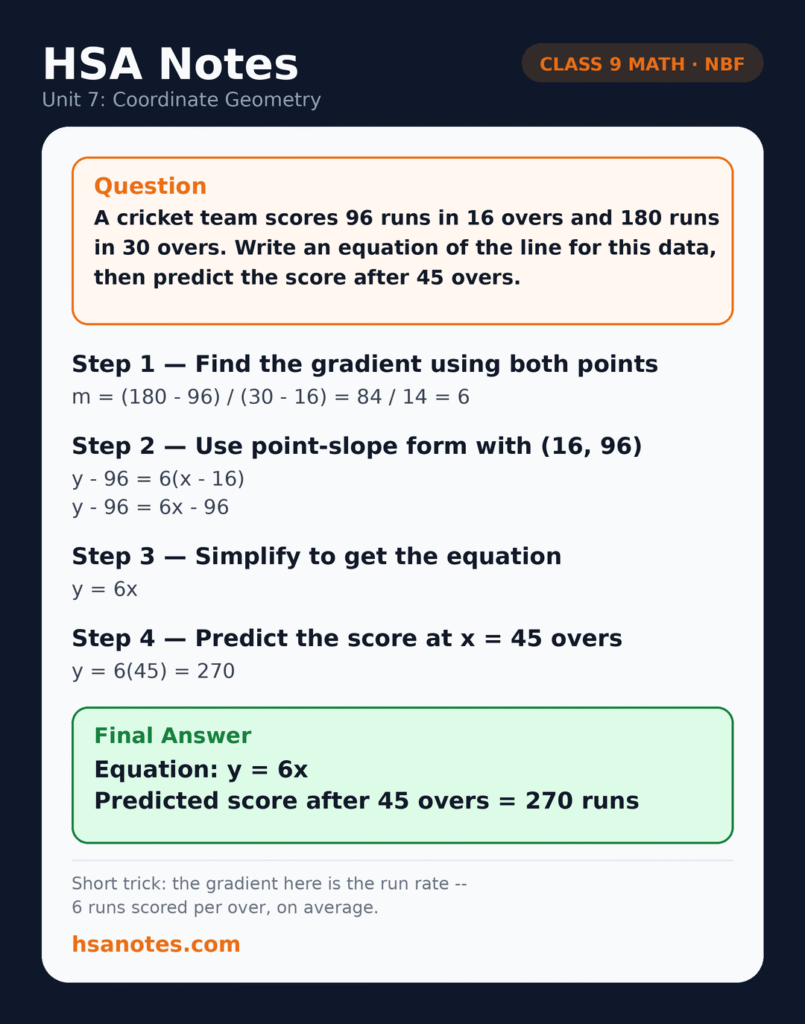
A line parallel to the x-axis has the equation y = b, and a line parallel to the y-axis has the equation x = a. The point-slope form of a line through A(x₁, y₁) with slope m is y − y₁ = m(x − x₁). The two-point form of a line through A(x₁, y₁) and B(x₂, y₂) is (y − y₁)/(y₂ − y₁) = (x − x₁)/(x₂ − x₁). Any linear equation ax + by + c = 0, where a and b are not both zero, represents a straight line.
6. Angle Between Two Lines
The angle θ between two lines with gradients m₁ and m₂ is given by tan θ = (m₂ − m₁) ÷ (1 + m₁m₂). This formula is also used to calculate the interior angles of a triangle when the slopes of its three sides are known.
7. Real-World Problems
Coordinate geometry models everyday linear relationships: bus or taxi fares that depend on distance travelled, electricity bills that depend on units consumed, cricket scores that depend on overs bowled, and the relationship between Celsius and Fahrenheit temperature scales, where the slope and y-intercept of the resulting line carry real meaning.
Worked Examples
Example 1 (Distance and collinearity): Prove that A(3, 2), B(4, 4), and C(5, 6) are collinear.
AB = √[(4−3)² + (4−2)²] = √5. BC = √[(5−4)² + (6−4)²] = √5. AC = √[(5−3)² + (6−2)²] = √20 = 2√5.
Since AB + BC = √5 + √5 = 2√5 = AC, the points are collinear.
Example 2 (Midpoint): If (1, 4) is the midpoint of the segment joining (6, b) and (a, 2), find a and b.
Using the midpoint formula: (6+a)/2 = 1 and (b+2)/2 = 4.
So 6 + a = 2, giving a = −4; and b + 2 = 8, giving b = 6.
Example 3 (Gradient and perpendicular lines): Lines AB and CD with A(0, 3), B(2, 8), C(3, 10), D(8, k) are perpendicular. Find k.
Gradient of AB = (8−3)/(2−0) = 5/2. Gradient of CD = (k−10)/(8−3) = (k−10)/5.
Since perpendicular, m₁ × m₂ = −1: (5/2) × [(k−10)/5] = −1, so (k−10)/2 = −1, giving k − 10 = −2, so k = 8.
Example 4 (Equation of a line, two-point form): Find the equation of the line through (1, 4) and (2, 1).
Using two-point form: (y−4)/(1−4) = (x−1)/(2−1), so (y−4)/(−3) = (x−1)/1.
−3(y−4) = −1(x−1), giving −3y + 12 = −x + 1, so x − 3y + 11 = 0.
Example 5 (Real-life application): A bus fare is y = 1.12x + 8, where x is distance in km. Find the fare after 50 km.
y = 1.12(50) + 8 = 56 + 8 = Rs. 64.
Important Formulas at a Glance
| Concept | Formula |
|---|---|
| Distance formula | d = √[(x₂−x₁)² + (y₂−y₁)²] |
| Midpoint formula | ((x₁+x₂)/2, (y₁+y₂)/2) |
| Gradient | m = (y₂−y₁)/(x₂−x₁) |
| Parallel lines | m₁ = m₂ |
| Perpendicular lines | m₁ × m₂ = −1 |
| Point-slope form | y − y₁ = m(x − x₁) |
| Two-point form | (y−y₁)/(y₂−y₁) = (x−x₁)/(x₂−x₁) |
| Angle between two lines | tan θ = (m₂−m₁)/(1+m₁m₂) |
Exercises in Unit 7
| Exercise | Main Focus |
|---|---|
| 7.1 | Distance formula, collinearity, classifying triangles |
| 7.2 | Midpoint formula and its applications |
| 7.3 | Gradient (slope), inclination, parallel and perpendicular lines |
| 7.4 | Equations of straight lines in various forms |
| 7.5/7.6/7.7 | Angle between lines, angles of a triangle, real-world problems |
| Review Exercise 7 | MCQs, short and long questions |
Exam Tips
- Always identify which points are A and B, and substitute carefully into the distance or midpoint formula.
- To prove collinearity, show that the sum of two shorter distances equals the longest distance.
- Check m₁ = m₂ for parallel lines, and m₁ × m₂ = −1 for perpendicular lines, before writing the equation of a new line.
- Choose point-slope form when you have one point and the slope, and two-point form when you have two points.
- In real-world problems, identify which variable is x and which is y before writing the equation.
About HSA Notes
HSA Notes is a free educational platform for secondary and higher secondary students in Pakistan. It publishes solved notes, model papers, and study material aligned with the NBF, PECTAA, PCTAA, and FBISE curricula, covering Mathematics, Physics, Chemistry, Biology, Computer Science, and English. Our solutions are written by our own team, giving students clear, original, step-by-step help.
Online Classes
Students who want guided learning can join our online classes run by Hamdard Science Academy. The classes follow the new NBF book unit by unit, so Unit 7 concepts, examples, and exercises are taught in a clear order alongside these notes. To ask about the schedule, fees, or admission, email hsanotes48@gmail.com.
Conclusion
Coordinate Geometry links algebra with visual geometry through distance, midpoint, and slope. With steady practice on each formula and plenty of diagrams, this unit becomes a very approachable source of marks. Free solved exercises and PDF notes are available on HSA Notes, and online classes are there if you need extra support.