Unit 6 of the NBF Functional Mathematics book for Grade 9 (FBISE, 2026-27) is about linear equations and inequalities in one variable. It starts with ordinary equations, adds fractions, square roots and absolute values, does the same for inequalities, and finishes with word problems about ages, money and distance. The solved notes PDF is below.
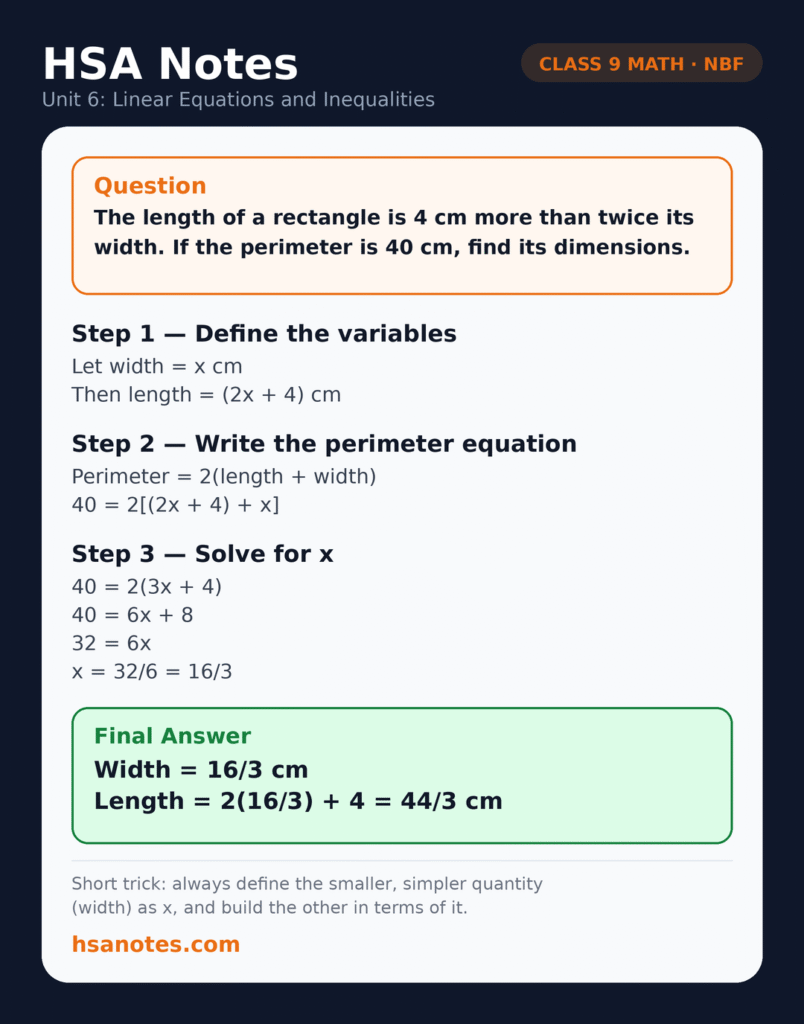
Linear equations
A linear equation in one variable can be written as ax + b = 0 with a ≠ 0. The variable is only ever to the power 1. You solve it by doing the same thing to both sides until x is on its own. Equations with the same solution are called equivalent.
With fractions: multiply every term by the LCM of the denominators first. The fractions disappear and you are left with an ordinary equation.
With a square root: get the root on its own, then square both sides. Squaring can produce an extraneous root, an answer that does not work in the original equation, so always substitute back and check.
With absolute value: |x| is the distance of x from 0, so it is never negative. |ax + b| = c with c > 0 splits into two equations, ax + b = c and ax + b = −c. If c = 0 there is one solution; if c is negative there is none.
Linear inequalities
An inequality such as ax + b < 0 is solved almost exactly like an equation, with one rule to remember: if you multiply or divide both sides by a negative number, flip the sign. Show the answer on a number line.
Two inequalities joined by “and” need both to be true, so the answer is where the two solution sets overlap (intersection). Joined by “or”, either one will do, so you combine them (union).
Worked examples
1. Fractions. (2x/5) − 1 = x/2 + 1/4. Multiply by 20: 8x − 20 = 10x + 5, so −2x = 25 and x = −25/2.
2. Square root. √(x + 3) = 7. Squaring gives x + 3 = 49, so x = 46. Check: √49 = 7.
3. Absolute value. |2x + 5| = 11. Either 2x + 5 = 11, so x = 3, or 2x + 5 = −11, so x = −8. Solution set {3, −8}.
4. Inequality. 3(−4 + 5y) ≤ −8(1 − 2y) + 6 expands to −12 + 15y ≤ 16y − 2, so −y ≤ 10. Dividing by −1 flips the sign: y ≥ −10.
5. Ages. Ali is 5 years older than his brother and their ages add to 25. If the brother is x, then x + (x + 5) = 25, so x = 10. The brother is 10 and Ali is 15.
Rules to remember
| Situation | What to do |
|---|---|
| ax + b = 0 | Get x alone; a ≠ 0 |
| Fractions | Multiply through by the LCM |
| Square roots | Isolate, square, then check the answer |
| |ax + b| = c, c > 0 | Solve ax + b = c and ax + b = −c |
| × or ÷ by a negative | Reverse the inequality sign |
| “and” | Intersection of the two sets |
| “or” | Union of the two sets |
Exercises in this unit
| Exercise | Topic |
|---|---|
| 6.1 | Linear equations, including fractions |
| 6.2 | Equations with radicals |
| 6.3 | Absolute value equations |
| 6.4 | Inequalities and compound inequalities |
| 6.5 | Word problems |
| Review 6 | MCQs, short and long questions |
Exam advice
- Substitute every answer to a square-root equation back in. An extraneous root left in costs the mark.
- Write both cases of an absolute value equation, even if one turns out to have no solution.
- Circle the step where you divide by a negative, and flip the sign there.