Unit 8 of the NBF Functional Mathematics book for Grade 9 (FBISE, 2026-27) is about similar figures, shapes that are the same shape but a different size, and what happens to area and volume when you scale them up or down. It is the maths behind maps, scale models and enlarged photos. The solved notes PDF is below.
When are two figures similar?
Two figures are similar (written ~) when their matching angles are equal and their matching sides are in the same ratio. Either condition gives you the other. For triangles, it is also enough if two pairs of sides are in proportion and the angle between them is equal.
Converting units of area and volume
Length conversions get squared for area and cubed for volume. 1 m = 100 cm, so 1 m² = 100 × 100 = 10,000 cm² and 1 m³ = 100³ = 1,000,000 cm³. 1 cm = 10 mm, so 1 cm² = 100 mm² and 1 cm³ = 1,000 mm³. Going to a smaller unit, multiply; going to a larger unit, divide.
The two rules of the unit
Areas: if two figures are similar and matching lengths are ℓ₁ and ℓ₂, then A₁/A₂ = (ℓ₁/ℓ₂)². This holds for any similar shapes: triangles, circles, any polygon.
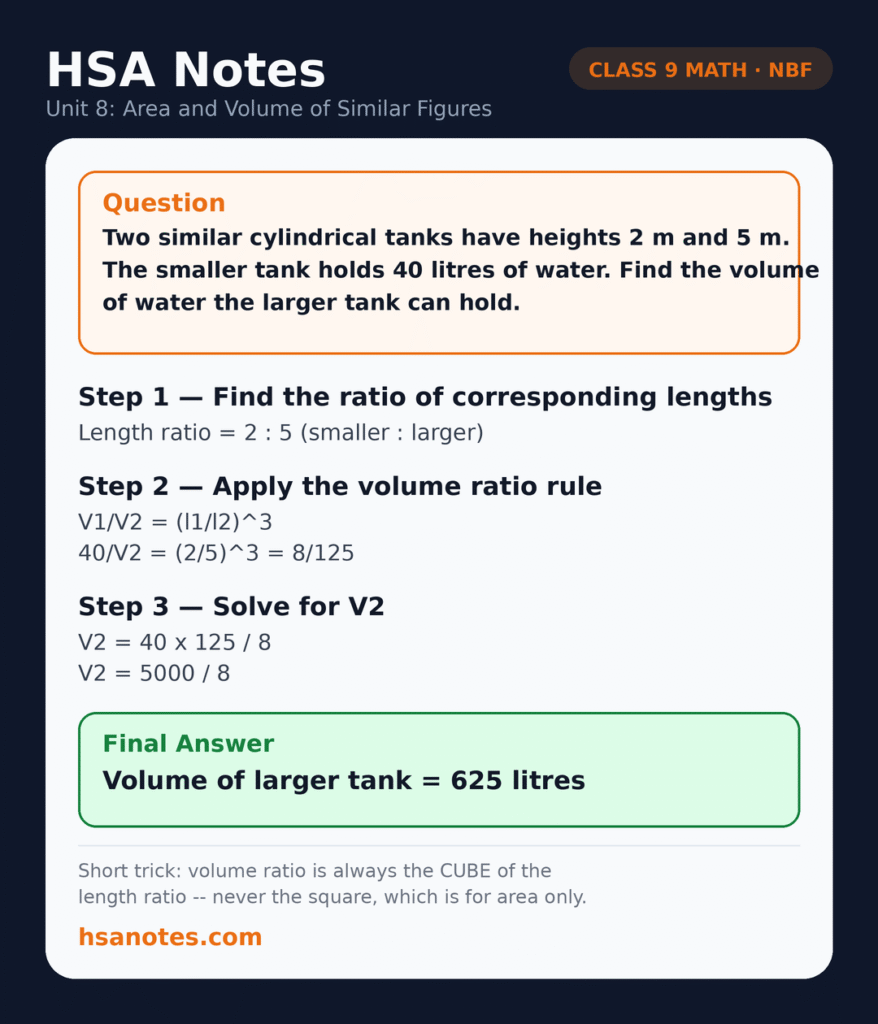
Volumes: for similar solids (cubes, cuboids, cylinders, cones, spheres), V₁/V₂ = (ℓ₁/ℓ₂)³. If both solids are made of the same material, their masses are in the same ratio as their volumes.
Double the lengths and the area goes up 4 times, the volume 8 times. Most mistakes in this unit come from squaring when you should cube, or the other way round.
Worked examples
1. Missing side. ΔABC ~ ΔDEF with AB = 6 cm, BC = 9 cm and DE = 4 cm. AB/DE = BC/EF gives 6/4 = 9/EF, so EF = 6 cm.
2. Circles. Radii 2 cm and 3 cm. The areas are 4π and 9π, a ratio of 4:9, which is (2/3)².
3. Cylinders. Two similar cylinders have base areas in the ratio 9:4 and the smaller base is 240 cm². The larger base is (9/4) × 240 = 540 cm². The heights are in the ratio √(9/4) = 3:2.
4. Solids. Matching lengths 2 cm and 4 cm. Volume ratio = (4/2)³ = 8, so the larger solid holds 8 times as much.
5. Scale model. A 1:10 model of a water tank holds 2 litres. Every length of the real tank is 10 times longer, so it holds 10³ = 1000 times as much: 2000 litres.
Formulas to remember
| Conversion or rule | What to do |
|---|---|
| m² to cm² | × 10,000 |
| cm² to mm² | × 100 |
| m³ to cm³ | × 1,000,000 |
| cm³ to mm³ | × 1,000 |
| Areas of similar figures | A₁/A₂ = (ℓ₁/ℓ₂)² |
| Volumes of similar solids | V₁/V₂ = (ℓ₁/ℓ₂)³ |
| Masses, same material | m₁/m₂ = V₁/V₂ |
Exercises in this unit
| Exercise | Topic |
|---|---|
| 8.1 | Similar polygons and missing sides |
| 8.2 / 8.3 | Area units and area ratios |
| 8.4 | Volume units and volume ratios |
| Review 8 | MCQs and mixed problems |
Exam advice
- Check the figures really are similar before using either rule.
- Find the length ratio first. Square it for area, cube it for volume.
- If you are given an area ratio and need lengths, take the square root; from a volume ratio, take the cube root.