Introduction
Unit 10 of the new PECTAA Class 10 Mathematics book is a practical geometry unit, built entirely around constructions with a compass, ruler, and pencil rather than algebraic calculation.
🎓 Online Classes with Experienced Experts
Students learn to locate the centre of a circle, draw a circle through three given points, complete a circle from part of its arc, and construct tangents from different positions of a point. These skills connect directly to real-world designs such as athletic tracks, Ferris wheels, recreational parks, and mechanical machines. These notes follow the new book for session 2026-27 and suit students of all Punjab boards.
What You Will Learn
By the end of this unit, students will be able to:
- locate the centre of a given circle using chords and their right bisectors;
- draw a circle passing through three given non-collinear points;
- complete a circle when part of its circumference is given, both by finding the centre and without finding it;
- draw a tangent to a given arc at its middle point, at its end, or from a point outside the arc, without using the centre;
- draw a tangent to a circle from a point on the circumference or outside it;
- draw two tangents to a circle that meet at a given angle.
Key Topics Explained
1. Locating the Centre of a Circle
Given a circle with no marked centre, draw any two chords. The right bisector of a chord always passes through the centre of the circle. Draw the right bisectors of both chords; the point where they intersect is the centre.
2. Circle Through Three Non-Collinear Points
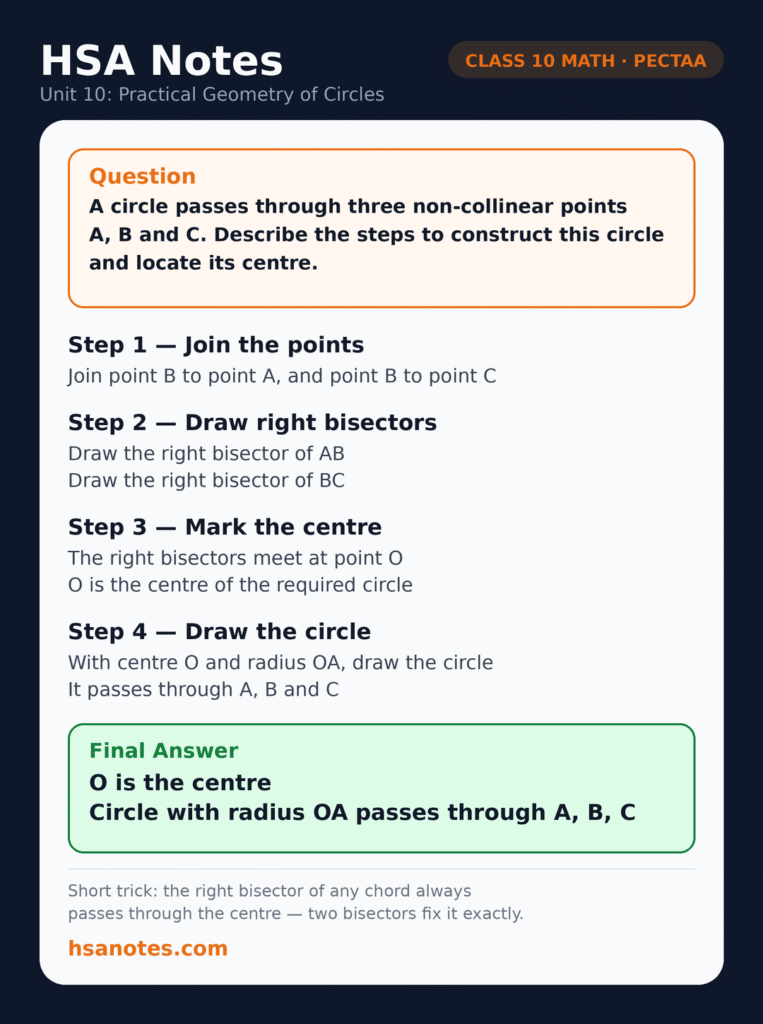
Given three non-collinear points A, B, and C, join AB and BC. Draw the right bisectors of both AB and BC. Their point of intersection is the centre of the required circle, and the distance from this centre to any of the three points is the radius.
3. Completing a Circle
When only part of the circumference (an arc) is given, the circle can be completed in two ways: by first locating the centre using the chord-and-bisector method above, or by using geometric arcs and constructions that reconstruct the missing part without ever finding the centre.
4. Tangent to an Arc Without Using the Centre
Three cases are covered. When point P is the middle point of the arc, a tangent is drawn using the property that the tangent at the midpoint of an arc is parallel to the chord joining the ends of the arc. When P is at the end of the arc, the tangent is constructed using the angle in the alternate segment. When P is outside the arc, an auxiliary construction locates the correct point of contact before drawing the tangent.
5. Tangent to a Circle from a Point
When point P lies on the circumference, the tangent is drawn perpendicular to the radius at that point. When P lies outside the circle, a semicircle is constructed on OP as diameter, where O is the centre; the points where this semicircle cuts the original circle are the points of tangency, giving two possible tangents from P.
6. Two Tangents Meeting at a Given Angle
To draw two tangents to a circle that meet each other at a given angle, the angle between the two radii to the points of contact is first found, since it is related to the given angle by a supplementary relationship. The construction then places the two tangents accordingly.
Illustrative Steps
Construction 1 (Locating the centre):
- Draw any two chords AB and CD of the circle.
- Construct PQ as the right bisector of AB.
- Construct RS as the right bisector of CD.
- Mark the point O where PQ and RS intersect.
- O is the centre of the circle.
Construction 2 (Circle through three points):
- Join point B to points A and C.
- Draw the right bisector of AB.
- Draw the right bisector of BC.
- The intersection of these two bisectors is the centre of the circle through A, B, and C.
Construction 3 (Tangent from an external point P):
- Join the centre O to the external point P.
- Draw a semicircle on OP as diameter.
- Mark the points where this semicircle cuts the given circle.
- Join P to each of these points; these lines are the required tangents.
Key Facts at a Glance
| Statement | Use |
|---|---|
| Right bisector of a chord | Passes through the centre of the circle |
| Tangent at point of contact | Perpendicular to the radius |
| Tangent at the midpoint of an arc | Parallel to the chord joining the arc’s ends |
| Semicircle on OP as diameter | Locates the points of tangency from an external point P |
Exercises in Unit 10
| Exercise | Main Focus |
|---|---|
| 10.1 | Locating the centre, circle through three points, completing a circle |
| 10.2 | Tangents to an arc and to a circle from different positions of a point |
| Review Exercise 10 | MCQs, short and long questions |
Exam Tips
- Always use a sharp pencil and keep your compass steady, since accuracy is marked in construction questions.
- Label every point, line, and angle clearly as you draw each step.
- Write the steps of construction in words alongside the diagram, since this is often required for full marks.
- Practice constructions on plain paper first before attempting them in the exam.
About HSA Notes
HSA Notes is a free educational platform for secondary and higher secondary students in Pakistan. It publishes solved notes, model papers, and study material aligned with the NBF, PECTAA, PCTAA, and FBISE curricula, covering Mathematics, Physics, Chemistry, Biology, Computer Science, and English. Our solutions are written by our own team, giving students clear, original, step-by-step help.
Online Classes
Students who want guided learning can join our online classes run by Hamdard Science Academy. The classes follow the new PECTAA book unit by unit, so Unit 10 constructions are demonstrated step by step alongside these notes. To ask about the schedule, fees, or admission, email hsanotes48@gmail.com.
Conclusion
Practical Geometry of Circles is a hands-on unit that rewards neat, careful work rather than long calculations. With regular practice on each type of construction, it can become one of the quickest units to score full marks in. Free solved exercises and PDF notes are available on HSA Notes for all Punjab boards, and online classes are there if you need extra support.