Introduction
Unit 9 of the new PECTAA Class 10 Mathematics book continues circle geometry, moving from chords and arcs to tangents and angles.
🎓 Online Classes with Experienced Experts
A tangent is a line that touches a circle at exactly one point. This unit proves and applies key theorems about tangents, central and inscribed angles, and cyclic quadrilaterals, and it introduces arc length and sector area using radian measure.
These ideas appear in architecture, monuments, pyramids, and engineering design. These notes follow the new book for session 2026-27 and suit students of all Punjab boards.
What You Will Learn
By the end of this unit, students will be able to:
- identify a tangent and prove it is perpendicular to the radius at the point of contact;
- prove that two tangents drawn from an external point to a circle are equal in length;
- relate the distance between the centres of two circles to their radii when the circles touch;
- apply theorems on central angles, angles in the same segment, and angles in a semicircle;
- prove that opposite angles of a cyclic quadrilateral are supplementary;
- find the arc length and area of a sector using angles in degrees and radians.
Key Topics Explained
1. Tangent to a Circle
A line that touches a circle at only one point is a tangent, and that point is the point of contact. If a line is drawn perpendicular to a radius at its outer end, that line is a tangent to the circle at that point. Equivalently, the radius drawn to the point of contact is always perpendicular to the tangent.
2. Two Tangents from an External Point
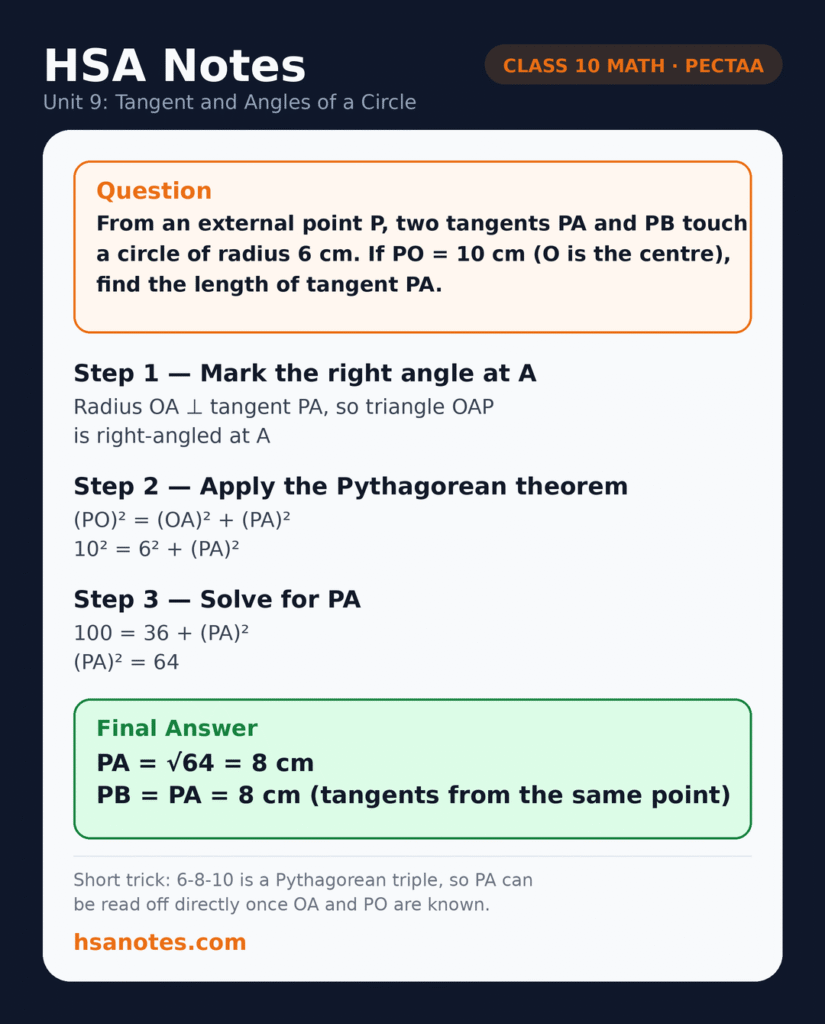
If PA and PB are two tangents drawn from an external point P to a circle with centre O, then PA = PB. This result is proved using congruent right triangles formed with the radii OA and OB.
3. Circles Touching Internally or Externally
If two circles touch each other externally, the distance between their centres equals the sum of their radii. If they touch internally, the distance between their centres equals the difference of their radii.
4. Central Angle and Inscribed Angle
The central angle of a minor arc is double the angle subtended by the same arc at any point on the major arc (the inscribed angle). Any two angles in the same segment of a circle are equal.
5. Angle in a Semicircle and Segments
The angle in a semicircle is a right angle. An angle in a segment greater than a semicircle is less than a right angle (acute), and an angle in a segment smaller than a semicircle is greater than a right angle (obtuse).
6. Cyclic Quadrilaterals
A quadrilateral inscribed in a circle, with all four vertices on the circle, is called a cyclic quadrilateral. Its opposite angles are supplementary, meaning each pair adds up to 180°.
7. Arc Length and Area of a Sector
Using radian measure, arc length ℓ = rθ, where r is the radius and θ is the central angle in radians. The area of a sector is A = ½r²θ. A sector is the region enclosed by two radii and the arc between them.
Worked Examples
Example 1 (Tangent and Pythagoras): OQ is a tangent to a circle with centre P, at point Q, with radius 4 cm. It meets line PR so that PR = 8 cm. Find QR.
Since OQ ⊥ PQ, triangle PQR is right-angled at Q, so (PR)² = (PQ)² + (QR)². 64 = 16 + (QR)², so QR = √48 = 4√3 cm.
Example 2 (Two tangents from a point): From an external point P, two tangents PA and PB touch a circle, with PA = 7 cm. Find PB.
Since tangents from the same external point are equal, PB = 7 cm.
Example 3 (Central and inscribed angle): The central angle of a minor arc is 100°. Find the angle subtended by the same arc at a point on the major arc.
Central angle = 2 × inscribed angle, so 100 = 2 × inscribed angle, giving inscribed angle = 50°.
Example 4 (Cyclic quadrilateral): In a cyclic quadrilateral ABCD, angle A = 75°. Find angle C.
Opposite angles are supplementary, so angle C = 180° − 75° = 105°.
Example 5 (Arc length and sector area): The arc length of a sector is 5 cm and its area is 25 cm². Find the radius and the central angle.
Using ℓ = rθ and A = ½r²θ, divide: A ÷ ℓ = r/2, so 25 ÷ 5 = r/2, giving r = 10 cm. Then θ = ℓ/r = 5/10 = 0.5 radians.
Important Formulas at a Glance
| Concept | Formula or Rule |
|---|---|
| Tangent and radius | Perpendicular at point of contact |
| Two tangents from a point | Equal in length |
| Circles touching externally | Distance between centres = sum of radii |
| Circles touching internally | Distance between centres = difference of radii |
| Central angle vs inscribed angle | Central angle = 2 × inscribed angle |
| Cyclic quadrilateral | Opposite angles sum to 180° |
| Arc length | ℓ = rθ |
| Area of sector | A = ½r²θ |
Exercises in Unit 9
| Exercise | Main Focus |
|---|---|
| 9.1 | Tangent properties, two tangents from a point, touching circles |
| 9.2 | Central and inscribed angles, cyclic quadrilaterals, arc length, and sector area |
| Review Exercise 9 | MCQs, short and long questions |
Exam Tips
- Mark the right angle between the tangent and radius as your first step in tangent problems.
- Remember PA = PB whenever two tangents come from the same external point.
- Convert the angle to radians before using ℓ = rθ or A = ½r²θ.
- In cyclic quadrilateral questions, pair up opposite angles and use the 180° rule directly.
About HSA Notes
HSA Notes is a free educational platform for secondary and higher secondary students in Pakistan. It publishes solved notes, model papers, and study material aligned with the NBF, PECTAA, PCTAA, and FBISE curricula, covering Mathematics, Physics, Chemistry, Biology, Computer Science, and English. Our solutions are written by our own team, giving students clear, original, step-by-step help.
Online Classes
Students who want guided learning can join our online classes run by Hamdard Science Academy. The classes follow the new PECTAA book unit by unit, so Unit 9 theorems, examples, and exercises are taught in a clear order alongside these notes. To ask about the schedule, fees, or admission, email hsanotes48@gmail.com.
Conclusion
Tangent and Angles of a Circle brings together tangent properties, angle theorems, and sector formulas in one focused unit. With careful diagrams and steady practice, it can become one of the more satisfying units to master. Free solved exercises and PDF notes are available on HSA Notes for all Punjab boards, and online classes are there if you need extra support.