
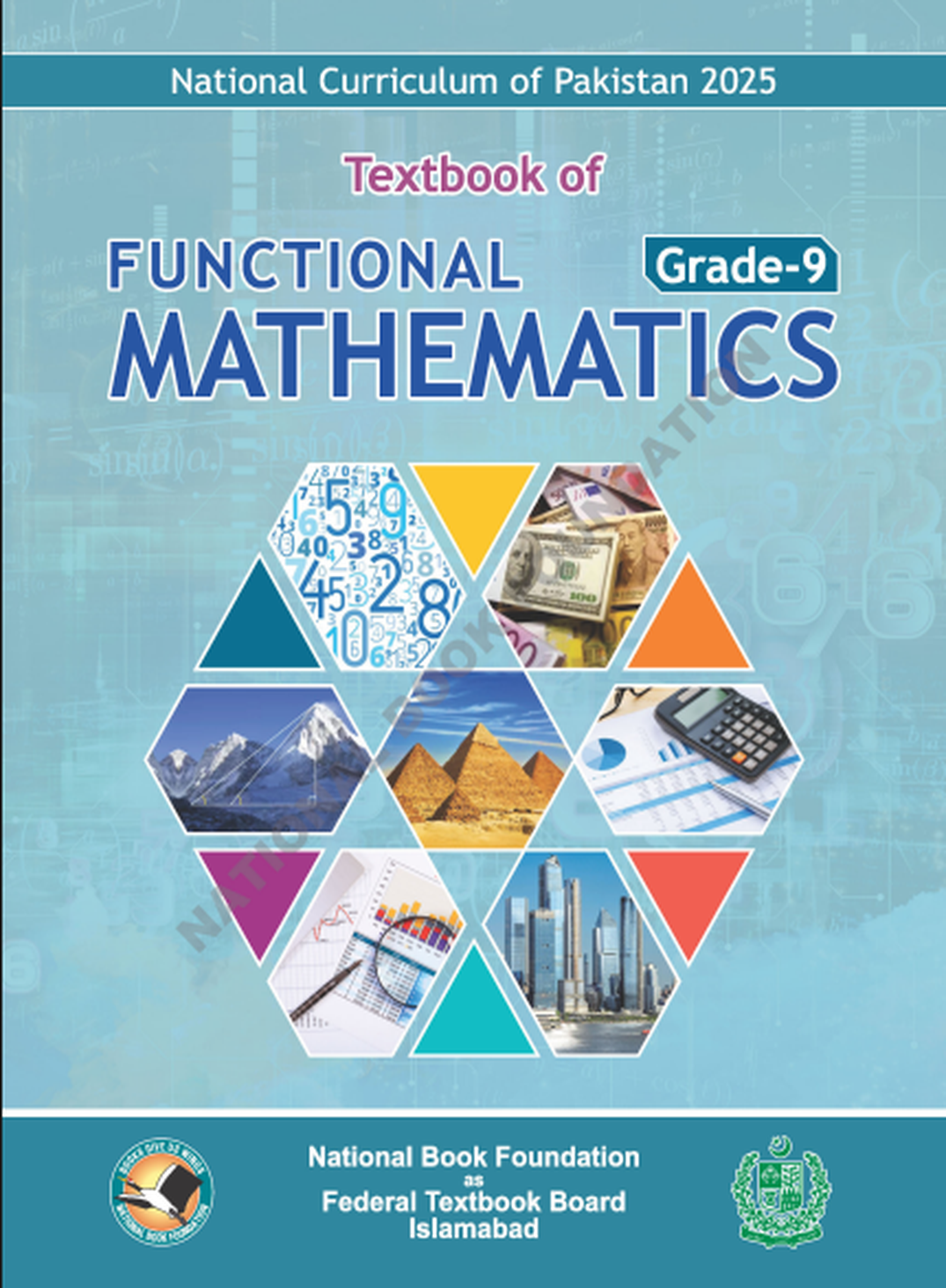
Unit 3 of the NBF Functional Mathematics book for Grade 9 (FBISE, 2026-27) is budgeting: planning money so that what goes out does not exceed what comes in. The maths is ratios, unit rates, percentages and a little algebra, but the habit is worth more than the marks. The solved notes PDF is below.
Ratios and proportion
A ratio compares two quantities of the same kind, with no units (water is hydrogen and oxygen in the ratio 2:1). A proportion says two ratios are equal. In a budget you use them to split a total between headings, such as marketing and salaries, and to see how the split changes when one heading grows.
Unit rates and hourly wages
A unit rate is the cost of one item: total cost ÷ number of items. An hourly wage works the same way: total pay ÷ hours worked. Once you have the rate you can price any quantity, and it is the fairest way to compare two offers: whichever has the lower cost per item is the better deal.
Income, spending and saving
If income is x, spending is y and savings are z, then x − y = z. Knowing any two gives you the third.
Percentage change
Percentage increase = increase ÷ original × 100%. Percentage decrease = decrease ÷ original × 100%. Always divide by the original value, not the new one.
Looking ahead
A simple linear projection guesses next year from past years: collect the past figures, see whether they are rising or falling, find the average change per year, and add it on.
When spending is more than income
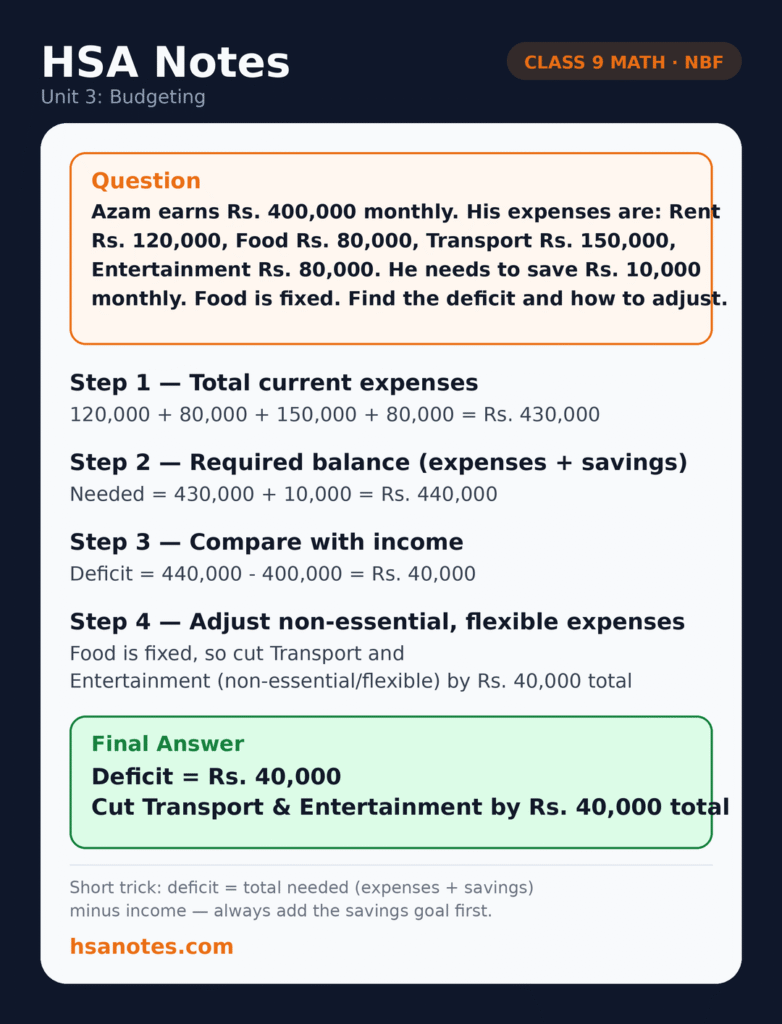
The shortfall is the deficit: spending − income. Split spending into essentials (rent, food, bills) and non-essentials (outings, hobbies). Cut the non-essentials first, look for cheaper ways to cover the essentials, and see whether income can be raised.
Worked examples
1. Splitting a budget. A business has Rs. 200,000 and gives 2/5 to marketing and 3/10 to salaries. Marketing gets Rs. 80,000 and salaries Rs. 60,000, leaving Rs. 60,000.
2. Unit rate. 12 bottles of juice cost Rs. 900, so one costs Rs. 75 and 20 cost Rs. 1,500.
3. Percentage decrease. Monthly spending falls from Rs. 20,000 to Rs. 18,000. The drop is Rs. 2,000, and 2,000 ÷ 20,000 × 100% = 10%.
4. Projection. A workshop earned Rs. 40,000, Rs. 42,000 and Rs. 44,000 in three years: Rs. 2,000 more each year. Next year’s estimate is Rs. 46,000.
5. Deficit. Yahya earned Rs. 160,000 a month and spent Rs. 140,000. His income falls to Rs. 120,000. His deficit is 140,000 − 120,000 = Rs. 20,000, which he needs to cut, starting with non-essentials.
Formulas to remember
| Quantity | Formula |
|---|---|
| Unit rate | total cost ÷ quantity |
| Savings | income − spending |
| % increase | increase ÷ original × 100% |
| % decrease | decrease ÷ original × 100% |
| Deficit | spending − income |
| Projection | last value + average change |
Exercises in this unit
| Exercise | Topic |
|---|---|
| 3.1 | Ratios, unit rates, wages, income and spending |
| 3.2 | Percentage change, projection, fixing a deficit |
| Review 3 | MCQs, short and long questions |
Exam advice
- Turn all fractions and percentages into rupees of the same total before comparing headings.
- For a unit rate, divide by the quantity.
- In deficit questions, work out the deficit first, then explain which spending you would cut and why. The reasoning earns marks.

1 thought on “Unit 3: Class 9 Functional Math NBF Notes New Book”