Introduction
Unit 9 of the new NBF Functional Mathematics Grade 9 FBISE textbook introduces Trigonometry, the branch of mathematics that studies the relationships between the sides and angles of triangles. When a direct measurement is difficult or unsafe, such as the height of a tree or a tall building, trigonometry provides an indirect method using angles.
🎓 Online Classes with Experienced Experts
This unit covers measuring angles in degrees and radians, standard position, trigonometric ratios, solving right triangles, and angles of elevation and depression. These notes follow the new NBF book for session 2026-27.
What You Will Learn
By the end of this unit, students will be able to:
- convert an angle from one system of measurement to another;
- identify angles in standard position, including coterminal and quadrantal angles;
- find the trigonometric ratios of an acute angle in a right triangle;
- find the values of trigonometric ratios at quadrantal angles, and identify their signs in each quadrant;
- use Pythagoras’ theorem and trigonometric ratios to find unknown sides and angles in a right triangle;
- find angles of elevation and depression, and solve real-life problems involving them.
Key Topics Explained
1. Measuring an Angle
An angle is the amount of rotation between two rays with a common endpoint. In the degree system, a circle is divided into 360 equal arcs, each subtending 1 degree at the centre; 1° = 60 minutes, and 1 minute = 60 seconds. In the radian system, one radian is the angle subtended at the centre by an arc equal in length to the radius. The relationship between the two systems is 2π radians = 360°, or π radians = 180°.
2. Standard Position, Coterminal and Quadrantal Angles
An angle is in standard position when its vertex is at the origin and its initial ray lies along the positive x-axis; the angle is measured anticlockwise as positive and clockwise as negative. Coterminal angles are two or more angles in standard position that share the same terminal side. A quadrantal angle is one whose terminal side lies exactly on the x-axis or y-axis, such as 0°, 90°, 180°, 270°, and 360°.
3. Trigonometric Ratios
In a right triangle with the right angle at C, acute angle θ at A, hypotenuse c, and legs a (opposite θ) and b (adjacent to θ), the six trigonometric ratios are: sin θ = a/c, cos θ = b/c, tan θ = a/b, and their reciprocals cosec θ = c/a, sec θ = c/b, cot θ = b/a.
4. Trigonometric Ratios of Special Angles
The ratios for 30°, 45°, and 60° are derived geometrically using isosceles and equilateral triangles inscribed in a unit circle. For 45°, sin 45° = cos 45° = 1/√2, and tan 45° = 1.
5. Signs of Trigonometric Ratios in the Quadrants
In the 1st quadrant, all ratios are positive. In the 2nd quadrant, only sin and cosec are positive. In the 3rd quadrant, only tan and cot are positive. In the 4th quadrant, only cos and sec are positive.
6. Solution of a Right Triangle
A triangle has six elements: three sides and three angles. If any three elements are known, with at least one being a side, the remaining elements can be found using the trigonometric ratios and Pythagoras’ theorem; this process is called “solving the triangle.”
7. Angles of Elevation and Depression
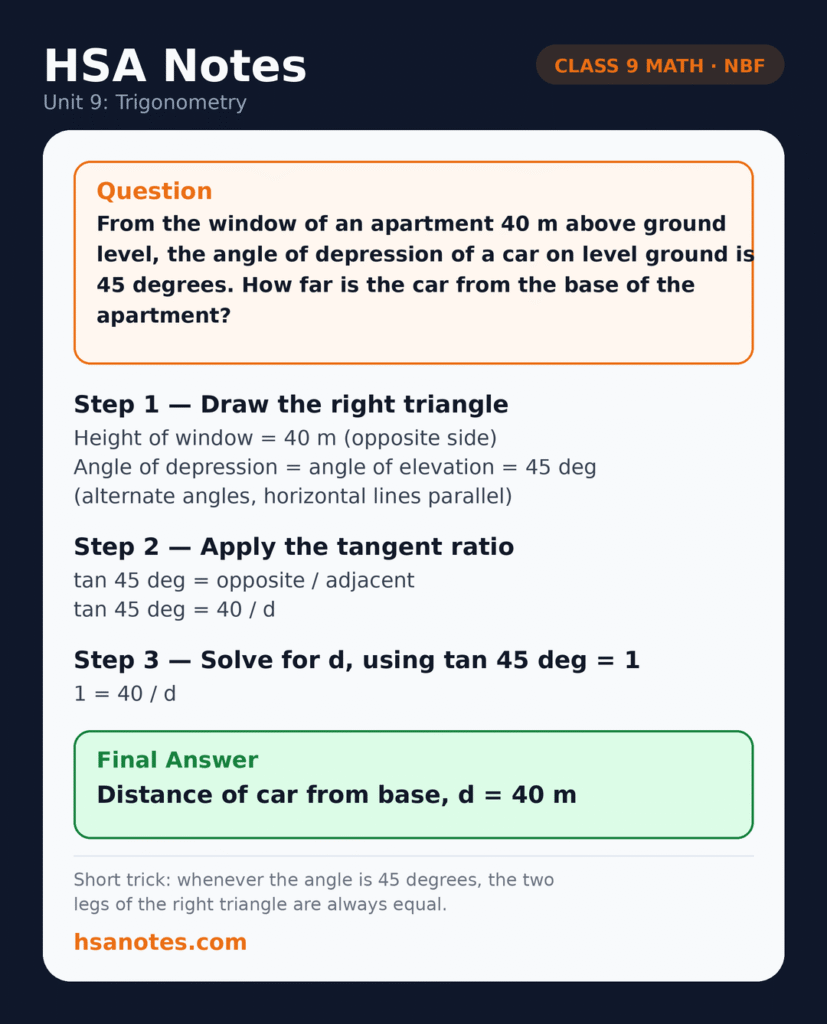
The line joining a point of observation to an object is the line of sight. If the object lies above the horizontal line through the observer, the angle between them is the angle of elevation. If the object lies below the horizontal line, the angle is the angle of depression. These concepts are used to find heights and distances that cannot be measured directly.
Worked Examples
Example 1 (Converting D°M’S” to decimal degrees): Convert 20°15′ into decimal degrees.
20°15′ = 20° + 15′ = 20° + (15/60)° = 20° + 0.25° = 20.25°.
Example 2 (Degrees to radians): Convert 30° into radians.
30° = 30 × (π/180) radians = π/6 radians ≈ 0.5236 radians.
Example 3 (Evaluate using known ratios): Evaluate sin 60° − cos 30°.
sin 60° = √3/2, cos 30° = √3/2. So sin 60° − cos 30° = √3/2 − √3/2 = 0.
Example 4 (Solving a right triangle): In ΔABC, ∠C = 90°, ∠A = 30°, a = 6 cm (side opposite A). Find side c (hypotenuse).
sin A = a/c, so sin 30° = 6/c, giving 1/2 = 6/c, so c = 12 cm.
Example 5 (Angle of elevation): From a point 20 m from a tree, the angle of elevation of its top is 30°. Find the height of the tree.
tan 30° = height/20, so height = 20 × tan 30° = 20 × (1/√3) ≈ 11.55 m.
Important Formulas at a Glance
| Concept | Formula |
|---|---|
| Degree-radian relation | π radians = 180° |
| sin θ | opposite/hypotenuse |
| cos θ | adjacent/hypotenuse |
| tan θ | opposite/adjacent |
| Pythagoras’ theorem | (hypotenuse)² = (base)² + (perpendicular)² |
| Angle of elevation | Angle above the horizontal line to an object |
| Angle of depression | Angle below the horizontal line to an object |
Exercises in Unit 9
| Exercise | Main Focus |
|---|---|
| 9.1 | Measuring and converting angles, standard position, coterminal and quadrantal angles |
| 9.2 | Trigonometric ratios, special angles, signs in quadrants |
| 9.3 | Solution of right-angled triangles |
| 9.4 | Angles of elevation and depression, real-life applications |
| Review Exercise 9 | MCQs, short and long questions |
Exam Tips
- Memorize the exact trigonometric ratios of 30°, 45°, and 60°, since they appear in almost every paper.
- Use the “ASTC” rule (All, Sin, Tan, Cos positive) to quickly recall the sign of a ratio in each quadrant.
- Draw a clear diagram labelling the right angle, the given angle, and the known side before solving a triangle.
- In elevation and depression problems, always identify the horizontal line first, then mark the correct angle.
About HSA Notes
HSA Notes is a free educational platform for secondary and higher secondary students in Pakistan. It publishes solved notes, model papers, and study material aligned with the NBF, PECTAA, PCTAA, and FBISE curricula, covering Mathematics, Physics, Chemistry, Biology, Computer Science, and English. Our solutions are written by our own team, giving students clear, original, step-by-step help.
Online Classes
Students who want guided learning can join our online classes run by Hamdard Science Academy. The classes follow the new NBF book unit by unit, so Unit 9 concepts, examples, and exercises are taught in a clear order alongside these notes. To ask about the schedule, fees, or admission, email hsanotes48@gmail.com.
Conclusion
Trigonometry builds a toolkit for measuring what cannot be measured directly, from angles and ratios to real heights and distances. With the special angle values memorized and steady practice on elevation and depression problems, this unit becomes one of the most rewarding in the book. Free solved exercises and PDF notes are available on HSA Notes, and online classes are there if you need extra support.