Introduction
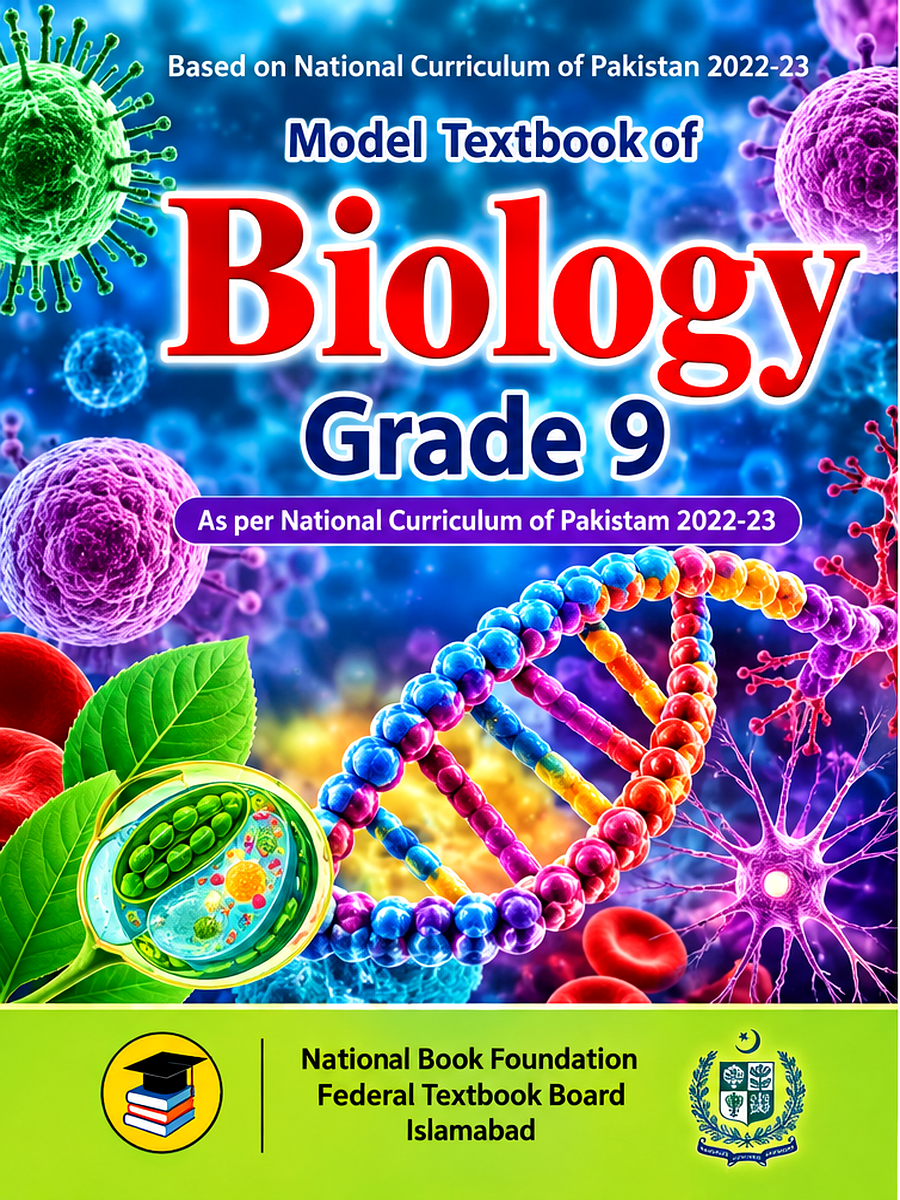
This Class 9 Biology study guide introduces the topics listed for the NBF book used by FBISE students. It contains chapter overviews, revision advice and original practice questions. Separate chapter solutions and a complete notes PDF are not available on this page. Check your textbook edition and the official syllabus for your examination session.
Want To Get Free Sample Papers?
Full Chapter List
| No. | Chapter | Separate chapter notes |
|---|---|---|
| 1 | The Science of Biology | Not published |
| 2 | Biodiversity | Not published |
| 3 | Cell | Not published |
| 4 | Cell Cycle | Not published |
| 5 | Tissues, Organ and Organ Systems | Not published |
| 6 | Molecular Biology | Not published |
| 7 | Metabolism | Not published |
| 8 | Plant Physiology | Not published |
| 9 | Plant Reproduction | Not published |
| 10 | Evolution | Not published |
How the Syllabus Is Organized
The ten chapters move from an introduction to Biology as a science and the diversity of life, into the structure and function of the cell and the cell cycle, before broadening out into tissues, organs, and organ systems.
From there, the syllabus covers Molecular Biology and Metabolism, before turning specifically to plants through Plant Physiology and Plant Reproduction, and closing with Evolution, which ties the earlier chapters on diversity and cellular processes together into a broader picture of how life has changed over time.
Official Youtube Channel: www.youtube.com/@FBISEOfficial
What Each Chapter Covers
Chapter 1, The Science of Biology
Introduces Biology as a science, covering its major branches, the scientific method, and how biological research is carried out.
It also explains how biologists observe, investigate, and use evidence to understand different forms of life.
Chapter 2, Biodiversity
Covers the classification of living things, the different kingdoms of life, and the variety of organisms found across different ecosystems.
Students learn how organisms are grouped according to their similarities, differences, and evolutionary relationships.
Chapter 3, Cell
Covers the structure and function of the cell, including cell organelles, the differences between plant and animal cells, and the basic unit of life.
It explains how different organelles work together to keep cells alive and perform essential life processes.
Chapter 4, Cell Cycle
Covers how cells grow and divide, including the stages of mitosis and meiosis and their importance in growth and reproduction.
Students learn how cell division helps organisms grow, repair damaged tissues, and produce reproductive cells.
Chapter 5, Tissues, Organ and Organ Systems
Covers how cells organize into tissues, tissues into organs, and organs into organ systems, building the foundation for understanding whole organisms.
It also explains how different organs and organ systems work together to perform important functions and maintain life.
Chapter 6, Molecular Biology
Covers the molecular basis of life, including nucleic acids, proteins, and the processes that occur at the cellular and molecular level.
Students explore how DNA, RNA, and proteins carry and use biological information to control cellular activities.
Chapter 7, Metabolism
Covers the chemical reactions that occur within living organisms, including how energy is captured, stored, and used.
It explains how metabolic reactions provide the energy and materials needed for growth, movement, repair, and other life processes.
Chapter 8, Plant Physiology
Covers how plants function, including processes such as photosynthesis, transport of water and nutrients, and plant growth.
Students learn how plants obtain resources from their surroundings and use them to grow, develop, and survive.
Chapter 9, Plant Reproduction
Covers the different methods of reproduction in plants, including both sexual and asexual reproduction.
It also explains the role of flowers, pollination, fertilization, seeds, and other structures in the continuation of plant species.
Chapter 10, Evolution
Covers the theory of evolution, the evidence supporting it, and how species change and adapt over long periods of time.
Students learn how variation, natural selection, and other evolutionary processes contribute to the diversity of life on Earth.
Why These Notes Are Useful
The overview helps you organise revision and connect related topics. It supplements the textbook and does not replace the full prescribed exercises.
Why a Full Chapter Breakdown Helps
Seeing all ten chapters listed together makes it easier to plan a realistic study schedule, since the early chapters on the cell and cell cycle build the foundation needed to understand later topics like Molecular Biology and Metabolism.
Having the plant focused chapters and Evolution positioned toward the end also helps students recognize how the syllabus builds from general biological principles toward more specific and integrative topics.
Original questions with explanations
1. Why is a cell called the basic unit of life?
A cell is the smallest structural and functional unit that carries out life processes. Unicellular organisms consist of one cell; multicellular organisms contain many cells with specialised roles.
2. Arrange cell, tissue, organ and organ system from simplest to most complex.
Cell, tissue, organ, organ system. Muscle cells form muscle tissue. Different tissues contribute to the heart, an organ. The heart works with blood vessels as part of the circulatory system. An organ is therefore more than a collection of only one tissue type.
3. How do mitosis and meiosis differ?
Mitosis normally produces two daughter cells with the same chromosome number as the parent cell. It supports growth and repair. Meiosis produces cells with half the parent cell’s chromosome number and contributes to sexual reproduction. Do not confuse chromosome number with the number of daughter cells.
4. Is pollination the same as fertilisation?
No. Pollination transfers pollen from an anther to a stigma. Fertilisation involves the fusion of male and female gametes. Pollination can enable the later process, but the two terms describe different events.
5. Do plants respire only at night?
No. Living plant cells respire during the day and night. Photosynthesis requires light and stores energy in organic molecules; respiration releases usable energy from organic molecules. Plants carry out both processes.
Try it yourself: Explain why a leaf is an organ. Answer: it contains different tissues working together, including tissues involved in photosynthesis, protection and transport. For each answer, use a definition followed by a specific example instead of memorising unrelated sentences.
Preparation Tips for Class 9 Biology
- Build a strong understanding of the cell and cell cycle early on, since these concepts reappear throughout Molecular Biology, Metabolism, and even Plant Physiology.
- Practice labelling diagrams regularly, particularly for chapters like Cell, Tissues, Organ and Organ Systems, and Plant Reproduction, since labelled diagrams are a common source of marks.
- Treat Molecular Biology and Metabolism as concept heavy chapters that benefit from repeated review rather than one time reading.
- Revise Plant Physiology and Plant Reproduction together, since both chapters share overlapping vocabulary and processes specific to plants.
- Finish your revision with Evolution, since it draws on concepts from Biodiversity and Cell Biology covered earlier in the syllabus.
Online Classes
For complete preparation and guidance, contact HSA Notes for online classes covering the full Class 9 Biology syllabus.
Contact: hsanotes48@gmail.com
Frequently Asked Questions
How many chapters are in the Class 9 Biology NBF syllabus? There are ten chapters in total, starting with The Science of Biology and ending with Evolution.
How do I check the syllabus? Compare the chapter list with your textbook and the official FBISE syllabus for your examination session.
How should I practise diagrams? Draw the structures from your textbook, label them from memory and check each label. Separate labelled-diagram notes are not available on this page.
Are the notes free to access? Yes, HSA Notes provides these Biology notes for free, with chapters being added progressively.
Conclusion
With all ten chapters of the Class 9 Biology NBF syllabus mapped out, from The Science of Biology through to Evolution, students have a clear roadmap for their board exam preparation. Notes for each chapter are being added progressively, so check back regularly as more units become available.
Best of luck for your Class 9 Biology exam!