
Unit 5 of the NBF Functional Mathematics book for Grade 9 (FBISE, 2026-27) is factorization: taking an expression apart into the pieces that multiply to make it. Once you can do that, HCF, LCM and square roots of algebraic expressions all follow. The solved notes PDF is below.
Start with the common factor
Factorizing is multiplication in reverse. Always look first for a factor that every term shares and take it outside a bracket: 6x + 9 = 3(2x + 3). Then see if what is left will factorize further.
Quadratics
x² + px + q: find two numbers that multiply to q and add to p, and split the middle term with them.
ax² + bx + c: find two numbers that multiply to ac (not just c) and add to b, split the middle term, then group in pairs.
Bi-quadratics
For a⁴ + a²b² + b⁴, add and subtract a²b² to make a perfect square, then use the difference of squares: a⁴ + a²b² + b⁴ = (a² + b² + ab)(a² + b² − ab). a⁴ + 4b⁴ is done the same way.
HCF and LCM
Factorize every expression completely first.
- HCF: multiply the factors that appear in all of them, each at its lowest power.
- LCM: multiply every factor that appears in any of them, each at its highest power.
For two polynomials, HCF × LCM = the product of the two polynomials. If you know three of these four things, you can find the fourth by division.
Square roots
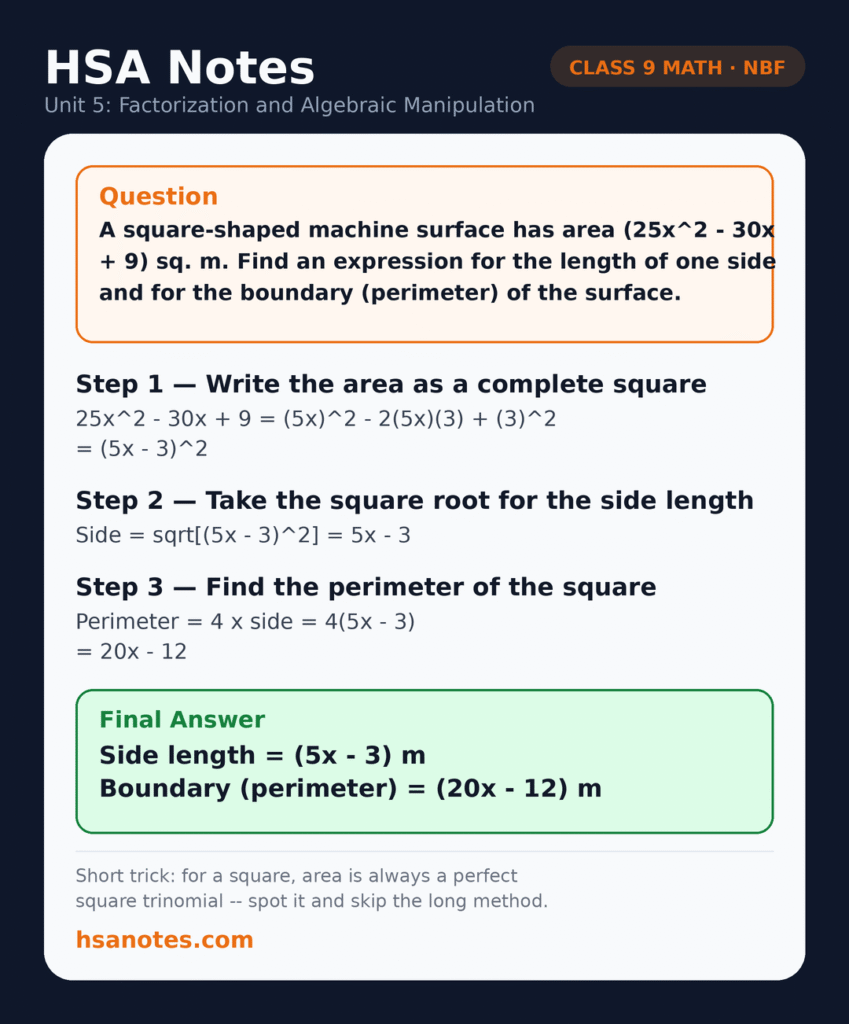
Write the expression as a perfect square, then take the root. The answer always has ± in front, because (2a + 3b)² and (−2a − 3b)² are the same.
Worked examples
1. 3x² + 22x − 16. Here ac = −48, and 24 and −2 multiply to −48 and add to 22. So 3x² + 24x − 2x − 16 = 3x(x + 8) − 2(x + 8) = (x + 8)(3x − 2).
2. HCF. 2m² − 2mn = 2m(m − n); 4m² − 4n² = 4(m − n)(m + n); 2m³ − 4m²n + 2mn² = 2m(m − n)². The factors common to all three are 2 and (m − n). m is not a factor of the middle one, so the HCF is 2(m − n).
3. Finding the other polynomial. P = x² − 5x + 6, HCF = x − 3, LCM = x³ − 9x² + 26x − 24. Factorizing, P = (x − 2)(x − 3) and the LCM = (x − 2)(x − 3)(x − 4). Q = HCF × LCM ÷ P = (x − 3)(x − 4) = x² − 7x + 12.
4. Square root. 4a² + 12ab + 9b² = (2a)² + 2(2a)(3b) + (3b)² = (2a + 3b)², so its square root is ±(2a + 3b).
5. Application. A cuboid’s volume is x³ − y³ = (x − y)(x² + xy + y²). Factorizing tells you possible expressions for its dimensions; one edge could be (x − y).
Rules to remember
| Expression or idea | Method |
|---|---|
| x² + px + q | Two numbers: product q, sum p |
| ax² + bx + c | Two numbers: product ac, sum b |
| a⁴ + a²b² + b⁴ | (a² + b² + ab)(a² + b² − ab) |
| HCF | Common factors, lowest powers |
| LCM | All factors, highest powers |
| Two polynomials | HCF × LCM = P × Q |
| Square root | Make a perfect square, answer ± |
Exercises in this unit
| Exercise | Topic |
|---|---|
| 5.1 | Quadratic and bi-quadratic expressions |
| 5.2 | HCF |
| 5.3 | LCM, and LCM by division |
| 5.4 | Square roots and applications |
| Review 5 | MCQs and mixed problems |
Exam advice
- Take out the common factor first, every time.
- For HCF, check each factor really divides every expression. That is the step most often got wrong.
- Multiply your factors back out to check them; it takes ten seconds.