
Introduction
Unit 1 of the new PECTAA Class 10 Mathematics book introduces complex numbers. Until now, students have learned that the square of a real number is never negative, so an equation like x² + 1 = 0 has no real solution.
🎓 Online Classes with Experienced Experts
Complex numbers solve this problem with the imaginary unit i, where i² = −1. This unit is also the starting point for FSc Mathematics, Physics, and Engineering, so a strong start here helps for years. These notes follow the new book for session 2026-27 and suit students of all Punjab boards.
What You Will Learn
By the end of this unit, students will be able to:
- identify complex numbers, their conjugates, and their modulus;
- add, subtract, multiply, and divide complex numbers;
- verify the additive and multiplicative identities and inverses;
- represent complex numbers on the Argand plane;
- find the real and imaginary parts of expressions such as (x + iy)ⁿ;
- solve simultaneous linear equations with complex coefficients.
Key Topics Explained
1. Complex Numbers and Their Forms
A complex number has the form z = x + iy, where x and y are real numbers. The number x is the real part, written Re(z), and y is the imaginary part, written Im(z). When x = 0, the number is purely imaginary, and when y = 0, it is a real number. Two complex numbers are equal only if both their real parts and their imaginary parts match. The powers of i repeat in a cycle of four: i, −1, −i, 1.
2. Algebraic Operations
To add or subtract complex numbers, combine the real parts and the imaginary parts separately. To multiply, use the distributive law and replace i² with −1. To divide, multiply the top and bottom by the conjugate of the denominator so that the denominator becomes a real number. Complex numbers follow the closure, commutative, associative, and distributive properties. They have an additive identity (0 + 0i) and a multiplicative identity (1 + 0i), and every non-zero complex number has both an additive and a multiplicative inverse.
3. The Complex (Argand) Plane
Each complex number x + iy corresponds to the point (x, y) on a plane. The horizontal axis is the real axis and the vertical axis is the imaginary axis. This picture makes addition and subtraction easy to visualize, and it shows the conjugate as the reflection of a point in the real axis.
4. Conjugate and Modulus
The conjugate of x + iy is x − iy, written z̄. A number multiplied by its conjugate always gives a real result. The modulus of z is |z| = √(x² + y²), the distance of the point from the origin. The unit proves several properties, including z̄̄ = z, the conjugate of a sum equals the sum of the conjugates, and z·z̄ = |z|².
5. Real and Imaginary Parts of (x + iy)ⁿ
Students find Re(z) and Im(z) for expressions such as (x + iy)⁻¹, (x + iy)², and (x + iy)⁻², and for quotients raised to a power. The usual method is to simplify with the conjugate until the answer is in the form a + ibo.
6. Simultaneous Linear Equations
Two equations with two unknowns and complex coefficients are solved by elimination or substitution, exactly like ordinary equations. The only difference is that every step uses complex arithmetic.
Worked Examples
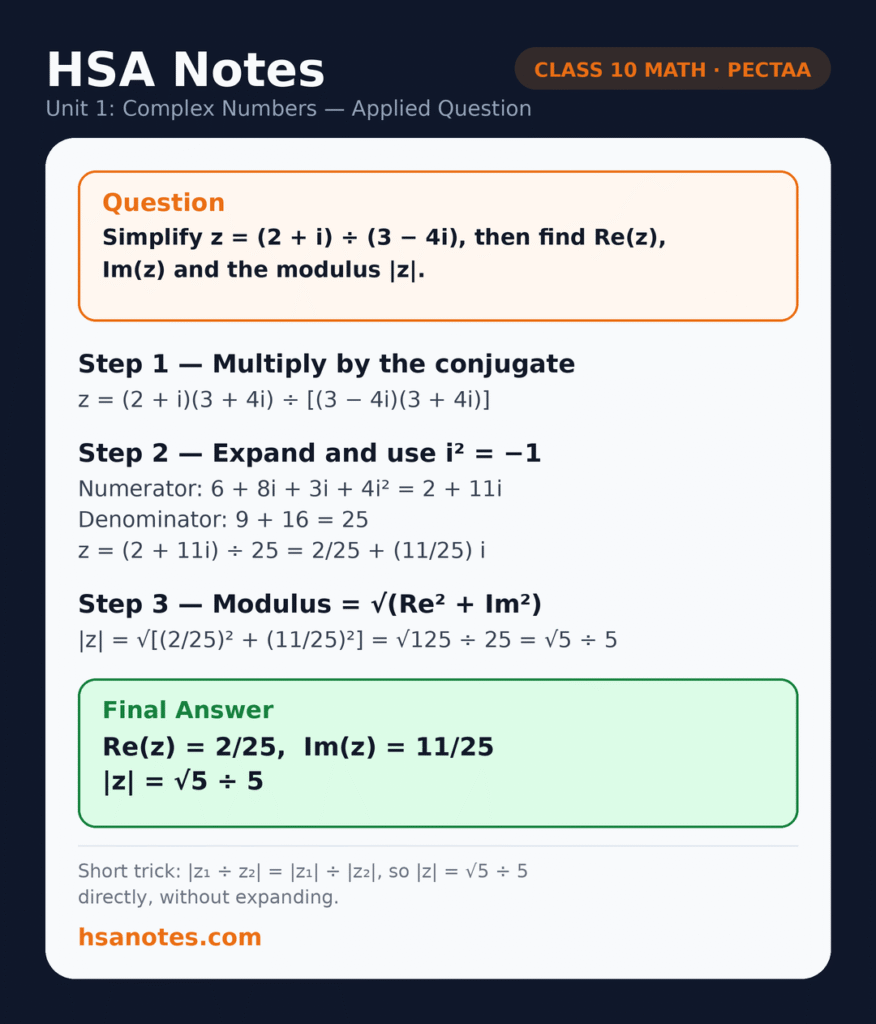
Example 1 (Multiplication): Find (2 + 3i)(4 − i).
(2 + 3i)(4 − i) = 8 − 2i + 12i − 3i² = 8 + 10i + 3 = 11 + 10i
Example 2 (Division): Simplify (3 + 2i) ÷ (1 − i).
Multiply top and bottom by 1 + i: (3 + 2i)(1 + i) ÷ 2 = (3 + 3i + 2i − 2) ÷ 2 = (1 + 5i) ÷ 2 = 1/2 + (5/2)i
Example 3 (Modulus): Find |3 − 4i|.
|3 − 4i| = √(9 + 16) = √25 = 5
Example 4 (Real and imaginary parts): Find Re(z) and Im(z) for z = (3 + 4i)⁻¹.
z = 1 ÷ (3 + 4i) = (3 − 4i) ÷ 25, so Re(z) = 3/25 and Im(z) = −4/25.
Important Formulas at a Glance
| Concept | Formula |
|---|---|
| Imaginary unit | i² = −1 |
| Conjugate of x + iy | x − iy |
| Modulus | |z| = √(x² + y²) |
| Conjugate product | z · z̄ = |z|² |
| Division | z₁/z₂ = z₁ z̄₂ / (z₂ z̄₂) |
Exercises in Unit 1
| Exercise | Main Focus |
|---|---|
| 1.1 | Powers of i, equality, and basic simplification |
| 1.2 | Operations, additive and multiplicative inverses |
| 1.3 | Conjugate and modulus properties |
| 1.4 | Real and imaginary parts, simultaneous equations |
| Review Exercise 1 | MCQs, short and long questions |
Exam Tips
- Learn the cycle of powers of i, since it appears in almost every paper.
- Write i² = −1 as its own step so you do not lose marks for skipped working.
- In division questions, multiply by the conjugate first.
- Practice the proofs of the conjugate and modulus properties, as they are common short questions.
- Attempt every MCQ in the Review Exercise to build speed.
About HSA Notes
HSA Notes is a free educational platform for secondary and higher secondary students in Pakistan. It publishes solved notes, model papers, and study material aligned with the NBF, PECTAA, PECTAA, and FBISE curricula. The subjects covered include Mathematics, Physics, Chemistry, Biology, Computer Science, and English. Our solutions to textbook questions are written by our own team, so students get clear, original, step-by-step help that they can use for revision and exam preparation. New chapters and PDFs are added regularly.
Online Classes
Students who want guided learning can join our online classes.
The classes follow the new PECTAA book unit by unit, so Unit 1 concepts, examples, and exercises are taught in a clear order alongside these notes. Students can practice with exam-style questions and get their doubts cleared by the teacher.
Online classes let you learn from home, and they fit well with self-study from the free notes on this website.
To ask about the class schedule, fees, or admission, email us at hsanotes48@gmail.com.
Conclusion
Complex Numbers is a scoring unit for students who practice regularly. With clear concepts, careful algebra, and steady exercise work, Unit 1 can become one of the most reliable units in the paper. Free solved exercises and PDF notes are available on HSA Notes for all Punjab boards, and online classes are there if you need extra support.
1 thought on “Unit 1: Class 10 Math PECTAA Notes New Book”