Introduction
Unit 10 of the new NBF Functional Mathematics Grade 9 textbook FBISE is a practical geometry unit on the Construction of Triangles, built around a ruler, protractor, and pair of compasses rather than algebraic calculation.
🎓 Online Classes with Experienced Experts
Students construct triangles from different combinations of given sides and angles, then draw and study the special lines of a triangle: angle bisectors, altitudes, perpendicular bisectors, and medians. These skills connect to real design and engineering work, much like the geometry used in the pyramids of ancient Egypt. These notes follow the new NBF book for session 2026-27.
What You Will Learn
By the end of this unit, students will be able to:
- construct a triangle when two sides and the included angle are given (SAS);
- construct a triangle when one side and two angles are given (SAA);
- construct a triangle when two sides and the angle opposite to one of them are given (the ambiguous case), considering all possibilities;
- draw angle bisectors, perpendicular bisectors, medians, and altitudes of a triangle and verify that each set is concurrent.
Key Topics Explained
1. Types of Triangles
Triangles are classified by side length as scalene (all sides different), isosceles (two sides equal), or equilateral (all sides equal), and by angle as acute-angled (all angles less than 90°), right-angled (one angle equal to 90°), or obtuse-angled (one angle greater than 90°).
2. Case I: Two Sides and the Included Angle (SAS)
Given two sides and the angle between them, draw the first side, construct the given angle at one endpoint, mark the second side’s length along the new ray, then join the remaining two points to complete the triangle. Exactly one triangle is possible in this case.
3. Case II: One Side and Two Angles (SAA)
Given one side and two angles, draw the side, construct both given angles at its two endpoints, and the point where the two new rays meet is the third vertex. Exactly one triangle is possible in this case.
4. Case III: Two Sides and a Non-Included Angle (Ambiguous Case)
When two sides and the angle opposite one of them are given, more than one triangle may be possible, or construction may be impossible altogether; this is called the ambiguous case. The construction draws the known side, constructs the given angle at one end, then uses the second given side’s length as a radius for an arc. Depending on the measurements, this arc may intersect the ray at one point, two points (giving two valid triangles), or not at all.
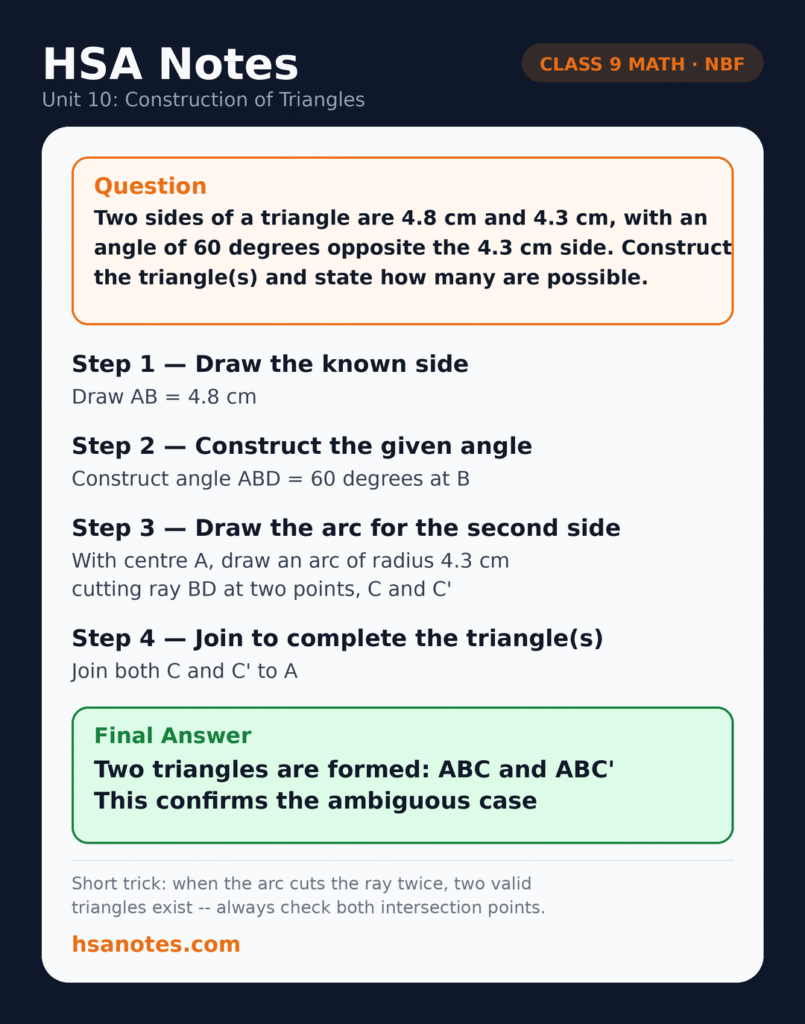
Functional Math 9 Unit 10 Construction of Triangles applied question: constructing a triangle in the ambiguous case with two triangles formed from given sides 4.8 cm and 4.3 cm
5. Angle Bisectors and the In-centre
The bisector of an angle divides it into two equal parts. The angle bisectors of all three angles of any triangle meet at a single point inside the triangle, called the in-centre (inscribed centre), confirming that angle bisectors are concurrent.
6. Altitudes and the Orthocentre
An altitude is a line segment from a vertex perpendicular to the opposite side. The three altitudes of a triangle are concurrent at a point called the orthocentre. The orthocentre lies inside an acute triangle, at the right-angle vertex of a right triangle, and outside an obtuse triangle.
7. Perpendicular Bisectors and the Circumcentre
A perpendicular bisector of a side cuts it into two equal parts at a right angle. The three perpendicular bisectors of a triangle’s sides are concurrent at a point called the circumcentre. It lies inside an acute triangle, at the midpoint of the hypotenuse of a right triangle, and outside an obtuse triangle.
8. Medians and the Centroid
A median joins the midpoint of a side to the opposite vertex. The three medians of a triangle are concurrent at a point called the centroid, which divides each median in the ratio 2:1, and which is also the centre of gravity of a triangular shaped body. In an equilateral triangle, the in-centre, circumcentre, orthocentre, and centroid all coincide at a single point; in any triangle, the circumcentre, orthocentre, and centroid are always collinear.
Illustrative Steps
Construction (Case I — SAS): Construct ΔABC with AB = 2.5 cm, BC = 2.6 cm, and ∠B = 75°.
- Draw AB = 2.5 cm.
- Construct an angle of 75° at vertex B, and draw ray BD.
- With centre B, draw an arc of radius 2.6 cm cutting BD at C.
- Join C to A. ΔABC is the required triangle.
Construction (Case III — ambiguous case): Construct a triangle with two sides 4.8 cm and 4.3 cm, and an angle of 60° opposite the 4.3 cm side.
- Draw AB = 4.8 cm.
- Construct ∠ABD = 60°.
- With centre A, draw an arc of radius 4.3 cm, cutting BD at two points, C and C’.
- Join both C and C’ to A. Two triangles, ABC and ABC’, are formed, confirming the ambiguous case.
Construction (Medians): Construct a triangle and locate its centroid.
- Construct the triangle using any valid case.
- Find the midpoint of each side.
- Join each midpoint to the vertex opposite it, drawing all three medians.
- The point where all three medians meet is the centroid.
Key Facts at a Glance
| Lines of a Triangle | Point of Concurrency |
|---|---|
| Angle bisectors | In-centre |
| Altitudes | Orthocentre |
| Perpendicular bisectors | Circumcentre |
| Medians | Centroid (divides each median 2:1) |
| Case | Number of Triangles |
|---|---|
| Three sides given (SSS) | Exactly one |
| Two sides and included angle (SAS) | Exactly one |
| Two angles and any side (SAA/ASA) | Exactly one |
| Two sides and a non-included angle | Ambiguous: one, two, or none |
Exercises in Unit 10
| Exercise | Main Focus |
|---|---|
| 10.1 | Construction of triangles: SAS, SAA, and the ambiguous case |
| 10.2 | Angle bisectors, altitudes, perpendicular bisectors, and medians, and their concurrency |
| Review Exercise 10 | MCQs and further triangle construction problems |
Exam Tips
- Identify which case applies (SAS, SAA, or the ambiguous case) before starting any construction.
- Keep your compass setting fixed while transferring a length, and use a sharp pencil for accuracy.
- In the ambiguous case, check carefully whether the arc cuts the ray once, twice, or not at all.
- Remember which point of concurrency goes with which set of lines: in-centre (angle bisectors), orthocentre (altitudes), circumcentre (perpendicular bisectors), centroid (medians).
- Write the steps of construction clearly next to your diagram, since marks are often given for the method, not just the final figure.
About HSA Notes
HSA Notes is a free educational platform for secondary and higher secondary students in Pakistan. It publishes solved notes, model papers, and study material aligned with the NBF, PECTAA, PCTAA, and FBISE curricula, covering Mathematics, Physics, Chemistry, Biology, Computer Science, and English. Our solutions are written by our own team, giving students clear, original, step-by-step help.
Online Classes
Students who want guided learning can join our online classes run by Hamdard Science Academy. The classes follow the new NBF book unit by unit, so Unit 10 constructions are demonstrated step by step alongside these notes. To ask about the schedule, fees, or admission, email hsanotes48@gmail.com.
Conclusion
Construction of Triangles is a hands-on unit that rewards careful, methodical work with a compass and ruler rather than long calculations. With regular practice on each case and each special line, it can become one of the most reliable units to score full marks in. Free solved exercises and PDF notes are available on HSA Notes, and online classes are there if you need extra support.