Introduction
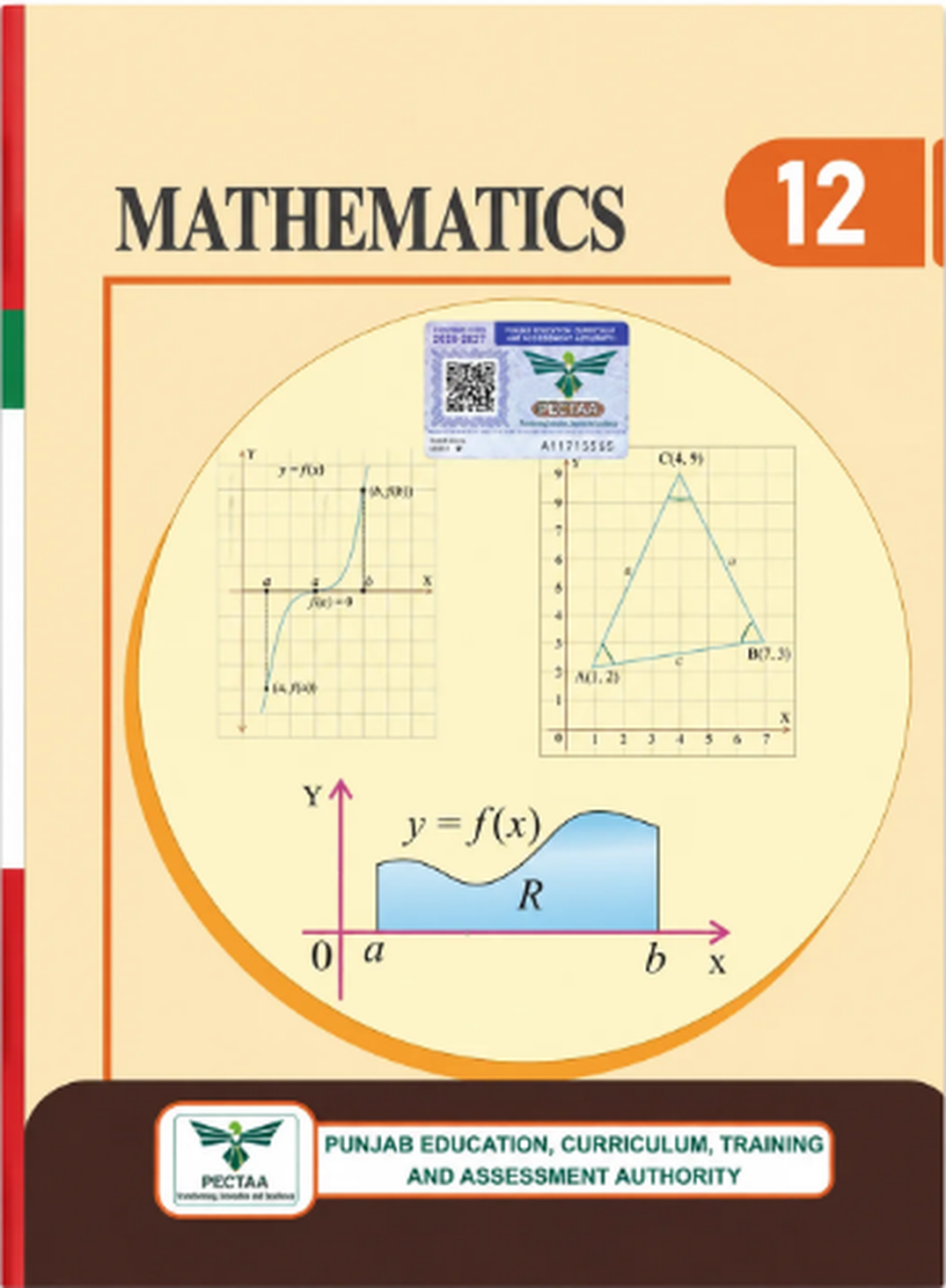
Unit 6 of the Class 12 Mathematics PECTAA New Book introduces Conics the family of curves (circle, parabola, ellipse, and hyperbola) formed when a plane intersects a double cone at different angles.
🎓 Online Classes with Experienced Experts
Building on the coordinate geometry of Unit 5, this unit derives the standard equation of each conic from its geometric definition, studies tangents and normals to these curves, and closes with real-life applications ranging from satellite orbits and suspension bridge cables to radio navigation systems.
What This Unit Covers
Unit 6 is organized into six graded exercises (6.1 to 6.6):
- Circle Students derive the standard equation of a circle (x − h)² + (y − k)² = r² from the definition of a circle as the set of all points equidistant from a fixed centre, study its parametric equations, convert between standard and general form, and solve problems involving circles determined by given points, tangency conditions, and intercepts.
- Tangent and Normal to a Circle This section covers the equation of a tangent at a point on a circle (using the “replacement rule” xx₁, yy₁, etc.), the equation of the normal, determining whether a point lies inside, on, or outside a circle, finding the intersection of a line and a circle, the length of a chord, and the length of the tangent drawn from an external point to a circle.
- Parabola Students derive the standard equation y² = 4ax of a parabola from its focus-directrix definition, learn its key elements (axis, vertex, focal chord, focal distance, latus rectum, parametric equations x = at², y = 2at), and study the other three standard forms obtained by placing the directrix on different sides of the focus.
- Ellipse This part derives the standard equation of an ellipse, its key features (major and minor axis, foci, vertices, co-vertices, eccentricity, latus rectum), the translated (centre not at origin) forms for both horizontal and vertical ellipses, and equations of tangents and normals to an ellipse.
- Hyperbola Students derive the standard equation x²/a² − y²/b² = 1 of a hyperbola, its key features (vertices, transverse and conjugate axis, foci, eccentricity greater than 1, asymptotes), and the equations of tangents and normals to a hyperbola, including the condition for a line to be tangent to a hyperbola.
- Applying Concepts of Conics to Real Life World Problems The unit closes with real-world modelling: a comet’s parabolic orbit around Earth, elliptical electron orbits in the Bohr–Sommerfeld atomic model, the parabolic cable of a suspension bridge, elliptical running tracks and architectural arches, and hyperbolic LORAN radio navigation for aircraft and ships.
Why This Unit Matters
Conics is one of the most visually rich and application-heavy units in Class 12 Mathematics, connecting algebra, geometry, physics, and engineering in a single topic. The tangent-and-normal techniques from Exercise 6.2 (circle) reappear in nearly identical form for the parabola, ellipse, and hyperbola, so mastering the circle case early pays off across the whole unit. The real-life application problems in Exercise 6.6 — orbital mechanics, bridge design, and radio navigation — are a distinctive feature of the new PECTAA book and are increasingly favoured for long questions in board exams.
How to Study Unit 6
- Learn the “replacement rule” for writing a tangent equation (x² → xx₁, y² → yy�1, x → (x+x₁)/2, y → (y+y₁)/2) once for the circle in Exercise 6.2 — the same substitution pattern applies to the parabola, ellipse, and hyperbola later in the unit.
- Keep a single reference table of standard forms, foci, vertices, and eccentricity for the circle, parabola, ellipse, and hyperbola side by side; most mixed exam questions test whether you can identify which conic an equation represents before solving.
- For the ellipse and hyperbola, always compute b² = a² − c² (ellipse) or c² = a² + b² (hyperbola) first, since mixing up these two relations is the most common source of error.
- Practise converting a translated conic (centre at (h, k)) back to standard form using the substitution X = x − h, Y = y − k — this shortcut applies uniformly across parabola, ellipse, and hyperbola problems.
- For applied problems in Exercise 6.6, first identify which conic the scenario describes (orbit and satellite problems are usually ellipses or parabolas; navigation and time-difference problems are usually hyperbolas) before setting up the equation.
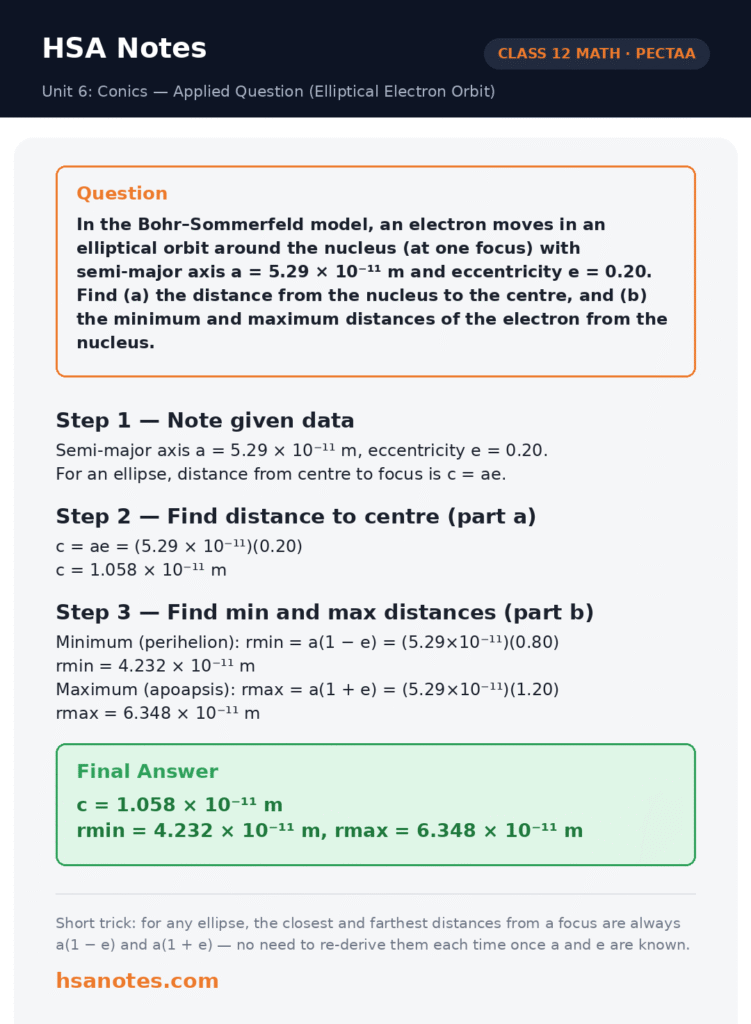
HSA Notes solved question card Class 12 Math PECTAA, Unit 6 Conics, Applied problem: an elliptical electron orbit in the Bohr–Sommerfeld model with semi-major axis 5.29×10⁻¹¹ m and eccentricity 0.20, solved step by step to find the distance from the nucleus to the centre and the minimum and maximum orbital distances
Practice Questions – Unit 6
Short Questions
- Find the equation of a circle with centre (2, −3) and radius 5.
- Write the parametric equations of the parabola y² = 4ax.
- Find the eccentricity of the ellipse x²/25 + y²/9 = 1.
- Find the length of the latus rectum of the hyperbola 9x² − 16y² = 144.
- Determine whether the point (1, 1) lies inside, on, or outside the circle x² + y² − 4x − 4y + 4 = 0.
- Write the equation of the tangent to the circle x² + y² = 25 at the point (3, 4).
Long Questions
- Find the equation of the circle passing through three given non-collinear points.
- Find the length of the tangent drawn from the point (5, 4) to the circle x² + y² − 2x − 6y + 6 = 0.
- Derive the equation of the tangent and normal to the ellipse (x−h)²/a² + (y−k)²/b² = 1 at a given point.
- A hyperbola has a vertical transverse axis, eccentricity √19/4, and latus rectum of length 3/2, and passes through the points (2, 8) and (2, 0). Find its equation.
- Find the condition that the line lx + my = 1 is a tangent to the hyperbola x²/a² − y²/b² = 1.
Applied Questions
- A comet has a parabolic orbit with Earth at the focus. When the comet is h km from Earth, the line joining the comet and Earth makes an angle of 30° with the axis of the parabola. How close will the comet come to Earth?
- The cable of a suspension bridge is parabolic. The roadway is 10 m below the lowest point of the cable, the span of the bridge is 200 m, and the tops of the piers are 50 m above the roadway. Find the equation of the parabola.
- An athletic field features an elliptical running track 120 m long along its major axis and 80 m wide along its minor axis. Find the distance from the centre to each focus, and how far apart two water fountains placed at the foci would be.
- LORAN (long-distance radio navigation) uses synchronized pulses from widely separated transmitting stations travelling at the speed of light. The difference in arrival times of these pulses at an aircraft or ship is constant on a hyperbola having the transmitting stations as foci. Explain why this locus is a hyperbola.
About HSA Notes
HSA Notes is an educational resource platform providing free study materials for Pakistani students, covering FBISE, Punjab, Sindh, and KP Boards in line with the New Books System. Materials span grades 9–12 across Mathematics, Chemistry, Biology, Physics, Computer Science, English, and Urdu, all prepared in a consistent, easy-to-follow branded format.
Besides free unit-wise notes and solved exercises, HSA Notes also offers online classes for students who want structured, teacher-guided sessions alongside self-study — useful for learners who need concepts explained step by step or want doubt-solving support beyond what a PDF can provide. For online classes, contact: hsanotes48@gmail.com
Conclusion
Unit 6 Conics equips students with the tools to describe circles, parabolas, ellipses, and hyperbolas algebraically: their standard equations, key geometric features, tangent and normal lines, and real-world applications in orbital mechanics, architecture, and navigation. These curves reappear throughout physics and engineering, making a solid grasp of this unit valuable well beyond the exam itself. Practising the solved examples alongside the questions above, and joining HSA Notes’ online classes for extra guidance where needed, will help students build real confidence in this unit.