Introduction
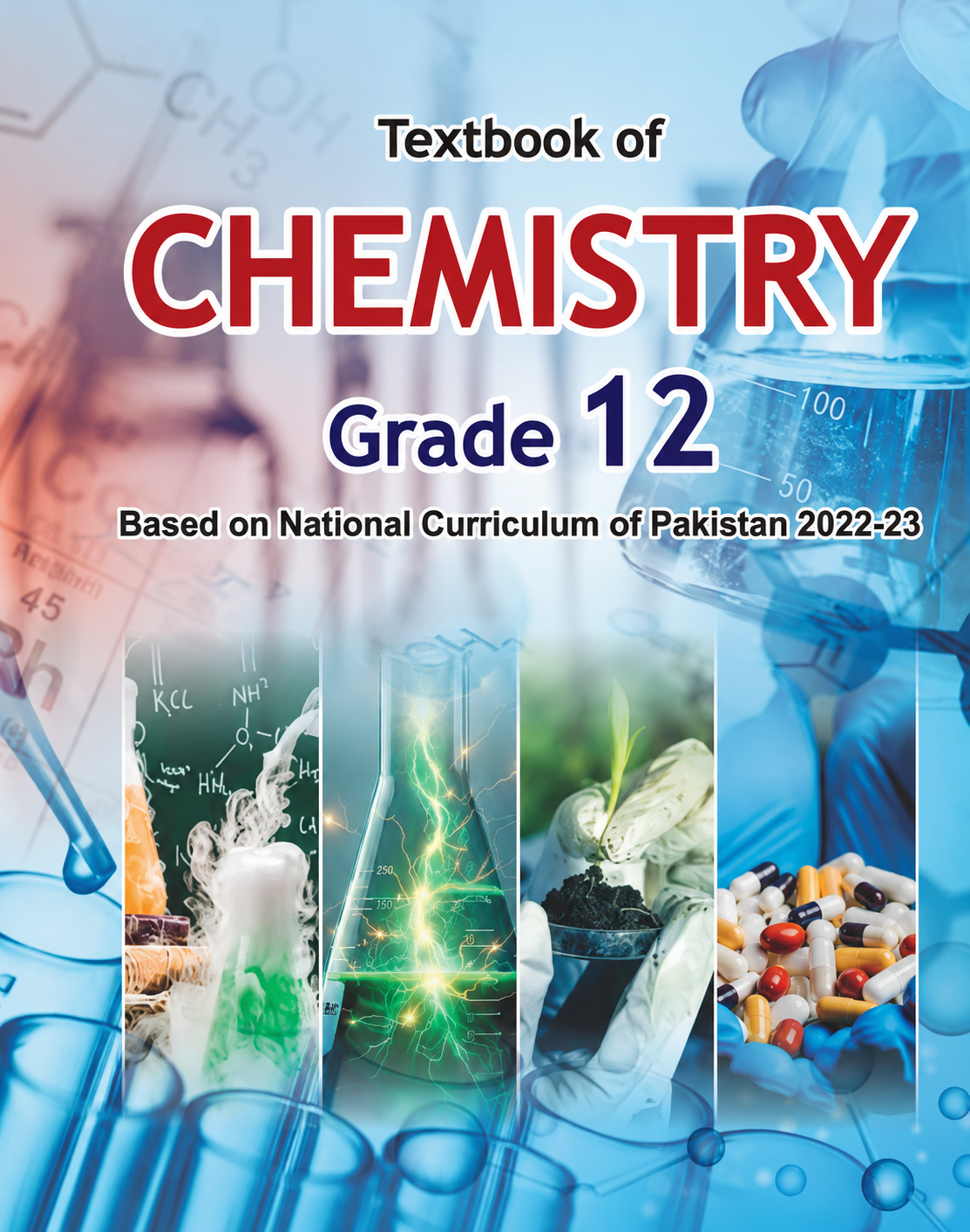
Get complete Class 12 Chemistry Notes for FBISE based on the NBF New Book for Session 2026–27. These notes are designed for HSSC Part-II students who want clear explanations, important concepts, solved questions, chemical equations, numerical problems, MCQs, and revision material in an easy-to-understand format.
Class 12 Chemistry NBF New Book – Unit-wise Notes
| Unit | Chapter Name | Status |
|---|---|---|
| 1 | Ethics and Values in Chemistry | Coming Soon |
| 2 | Electrochemistry | Coming Soon |
| 3 | Chemical Equilibria | Coming Soon |
| 4 | Acid-base Chemistry | Coming Soon |
| 5 | Group 2 Elements | Coming Soon |
| 6 | The Transition Metals | Coming Soon |
| 7 | Organic Chemistry | Coming Soon |
| 8 | Hydrocarbons | Coming Soon |
| 9 | Halogenoalkanes | Coming Soon |
| 10 | Hydroxy Compounds | Coming Soon |
| 11 | Carbonyl Compounds | Coming Soon |
| 12 | Nitrogen Compounds | Coming Soon |
| 13 | Polymers | Coming Soon |
| 14 | Organic Synthesis | Coming Soon |
| 15 | Biochemistry | Coming Soon |
| 16 | Empirical Data Collection and Analysis | Coming Soon |
| 17 | Qualitative Analysis | Coming Soon |
| 18 | Spectroscopy | Coming Soon |
| 19 | Chromatography | Coming Soon |
| 20 | Materials | Coming Soon |
| 21 | Medicine | Coming Soon |
| 22 | Agriculture | Coming Soon |
| 23 | Industry | Coming Soon |
The new Class 12 Chemistry book covers 23 units, beginning with ethics and values in Chemistry and progressing through electrochemistry, chemical equilibria, acid-base chemistry, inorganic and organic Chemistry, analytical techniques, biochemistry, materials, medicine, agriculture, and industry. The chapter structure shown in the NBF textbook is also reflected in current Class 12 FBISE Chemistry resources.
Official Youtube Channel: www.youtube.com/@FBISEOfficial
Class 12 Chemistry Notes FBISE NBF New Book
Chemistry at Class 12 level combines theoretical concepts with chemical reactions, equations, calculations, laboratory techniques, and real-world applications. Students need a strong understanding of concepts rather than relying only on memorization.
HSA Notes provides unit-wise study material to make the preparation process easier. Students can use these resources to revise definitions, chemical equations, important reactions, numerical problems, diagrams, mechanisms, and examination-focused questions.
Class 12 Chemistry Complete 23 Units
Unit 1: Ethics and Values in Chemistry
This unit introduces the ethical and responsible practice of Chemistry. Students study scientific reasoning, ethical considerations, responsible research, safety, and the wider impact of chemical knowledge and applications.
Unit 2: Electrochemistry
Electrochemistry deals with the relationship between chemical and electrical energy. Important concepts include oxidation-reduction reactions, electrochemical cells, electrode potentials, electrolysis, and the Nernst equation.
Unit 3: Chemical Equilibria
Chemical Equilibria focuses on reversible reactions and the conditions under which equilibrium is established. Students study equilibrium-related concepts, acid-base strength, buffer solutions, solubility product, precipitation reactions, common-ion effect, and partition coefficient.
Unit 4: Acid-base Chemistry
This unit develops the concepts of acids and bases and their behavior in aqueous solutions. Students study pH, the pH scale, ionic product of water, calculations, and pH titration curves.
Unit 5: Group 2 Elements
Group 2 Elements introduces the properties and chemical behavior of alkaline earth metals. Students study trends in physical properties, reactions with oxygen, comparisons with Group 1 elements, and important uses and properties of Group 2 compounds.
Unit 6: The Transition Metals
The Transition Metals unit examines the characteristic properties and chemical behavior of transition elements. Students study their compounds, reactions, oxidation states, and important applications.
Unit 7: Organic Chemistry
Organic Chemistry introduces the fundamental principles used to understand carbon-containing compounds. Students study important organic structures, properties, reactions, and concepts that provide a foundation for later organic Chemistry units.
Unit 8: Hydrocarbons
Hydrocarbons are compounds consisting mainly of carbon and hydrogen. This unit covers important classes of hydrocarbons, their structures, properties, reactions, and applications.
Unit 9: Halogenoalkanes
Halogenoalkanes contain halogen atoms attached to carbon chains. Students study their structures, properties, reactions, and important mechanisms involved in their chemical transformations.
Unit 10: Hydroxy Compounds
Hydroxy Compounds include important organic compounds containing hydroxyl groups. Students learn about their structures, properties, reactions, and applications in Chemistry.
Unit 11: Carbonyl Compounds
Carbonyl Compounds focuses on compounds containing the carbonyl group. Students study their structures, properties, reactions, and important chemical transformations.
Unit 12: Nitrogen Compounds
This unit introduces important organic compounds containing nitrogen. Students study their structures, properties, reactions, and applications while developing a deeper understanding of organic functional groups.
Unit 13: Polymers
Polymers are large molecules formed from repeating structural units. This unit explains polymer structures, formation, properties, types, and applications in everyday life and industry.
Unit 14: Organic Synthesis
Organic Synthesis focuses on preparing organic compounds through suitable chemical reactions. Students learn how different reactions can be combined to convert one organic compound into another.
Unit 15: Biochemistry
Biochemistry connects Chemistry with biological systems. Students study important biochemical substances and chemical processes associated with living organisms.
Unit 16: Empirical Data Collection and Analysis
This unit develops skills related to collecting and analysing experimental data. Students learn how chemical observations and measurements can be recorded, interpreted, and evaluated scientifically.
Unit 17: Qualitative Analysis
Qualitative Analysis focuses on identifying chemical substances and ions through characteristic reactions and observations. Students learn analytical techniques and the interpretation of experimental results.
Unit 18: Spectroscopy
Spectroscopy introduces techniques used to study substances by examining their interaction with electromagnetic radiation. Students learn how spectroscopic information can help identify and analyse chemical compounds.
Unit 19: Chromatography
Chromatography is an important separation and analytical technique. This unit explains how mixtures can be separated and how chromatographic methods can be used to identify components.
Unit 20: Materials
The Materials unit explores the Chemistry and properties of useful materials. Students learn how chemical structure and composition influence the properties and applications of different materials.
Unit 21: Medicine
This unit explains the relationship between Chemistry and medicine. Students explore chemical substances, medicines, their applications, and the role of Chemistry in healthcare.
Unit 22: Agriculture
Agriculture connects chemical knowledge with farming and crop production. Students study the role of Chemistry in agricultural practices and the chemical substances used to improve agricultural productivity.
Unit 23: Industry
The final unit, Industry, demonstrates how Chemistry is applied on a large scale in industrial processes. Students learn how chemical principles are used in manufacturing, production, materials, and industrial applications.
HSA Notes Features
HSA Notes provides Class 12 Chemistry resources including:
- Complete unit-wise Chemistry notes
- NBF New Book-based content
- Important definitions and concepts
- Chemical equations and reactions
- Solved numerical problems
- Short questions and long questions
- MCQs and review questions
- Important examination questions
- Diagrams and tables
- Easy explanations
- Chapter summaries
- PDF study material
These resources are useful for students preparing for FBISE HSSC Part-II Chemistry and can also support revision for students following related intermediate Chemistry courses.
Prepare Class 12 Chemistry with HSA Notes
Effective Chemistry preparation requires a combination of conceptual understanding, reaction practice, numerical problem-solving, and regular revision. Students should carefully study the textbook concepts before attempting solved questions and should practice important chemical equations repeatedly.
Join Class 12 Chemistry Online Classes
Students who want additional guidance for Class 12 Chemistry can join online classes through HSA Notes. For online class details, course information, and enrolment, contact:
Email: hsanotes48@gmail.com
Conclusion
The Class 12 Chemistry NBF New Book 2026–27 covers 23 units ranging from Electrochemistry, Chemical Equilibria, and Acid-base Chemistry to Organic Chemistry, Biochemistry, Spectroscopy, Chromatography, Medicine, Agriculture, and Industry. HSA Notes provides unit-wise study resources, solved questions, important reactions, numerical problems, MCQs, and revision material to support effective FBISE HSSC Part-II preparation. Students can use these notes alongside the textbook for concept building, regular practice, and examination revision.