
Introduction
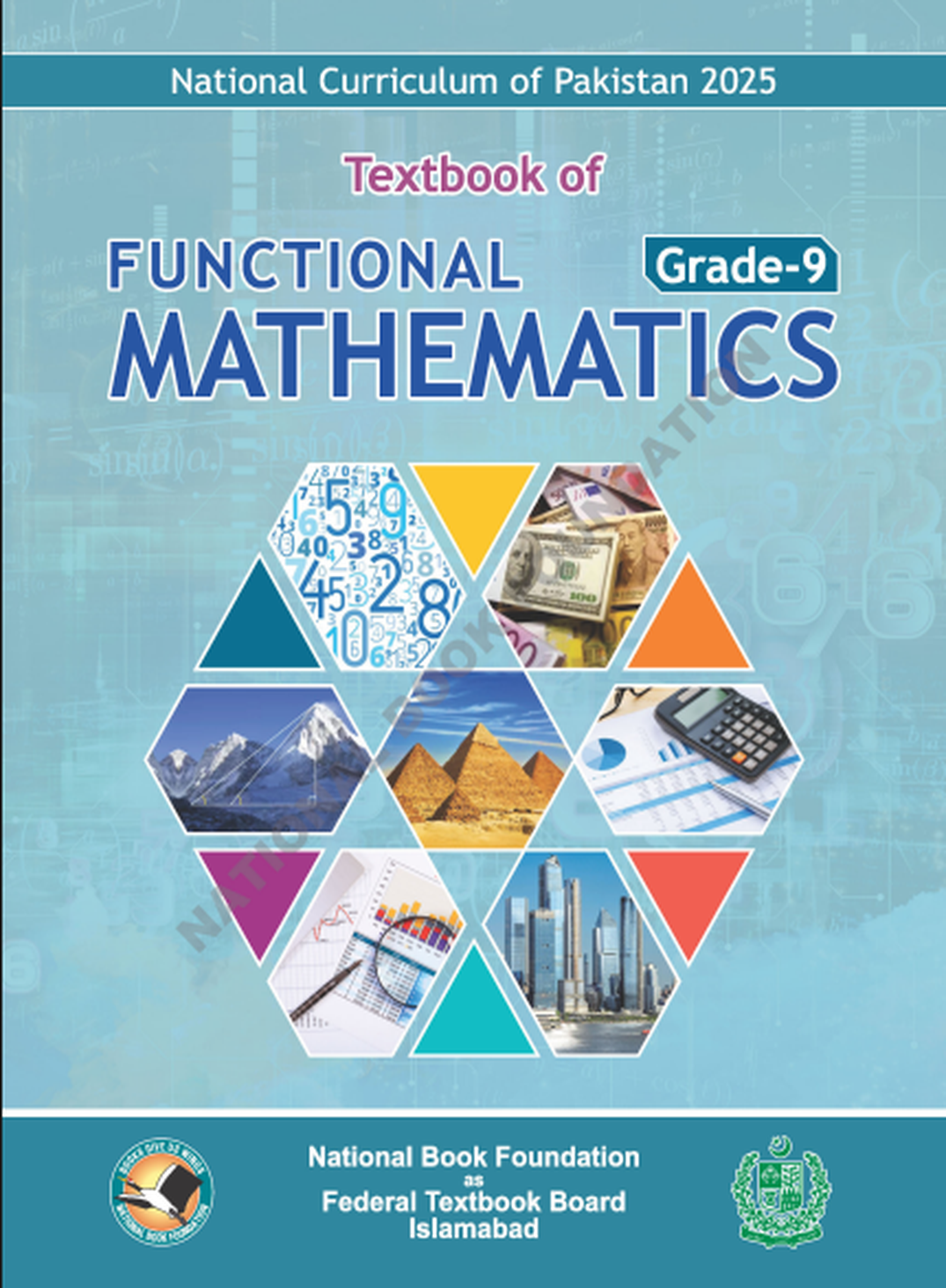
Unit 4 of the new NBF Functional Mathematics Grade 9 FBISE textbook covers Real Numbers, one of the foundational units of the whole book.
🎓 Online Classes with Experienced Experts
Real numbers include every rational number and every irrational number, and they are used to solve real-life problems such as finding velocity, recording temperature, tracking profit or loss, and managing inventory. This unit also introduces radicals, exponents, and scientific notation, tools that make very large and very small numbers easier to write and work with. These notes follow the new NBF book for session 2026-27.
What You Will Learn
By the end of this unit, students will be able to:
- describe the set of real numbers as a combination of rational and irrational numbers;
- apply the properties of equality and inequality of real numbers;
- differentiate between radical form and exponential form of an expression, and convert between them;
- apply laws of indices (exponents) to simplify radical expressions;
- express a number in scientific notation and convert it back to standard notation;
- apply concepts of real numbers to real-world situations such as inventory, temperature, and banking.
Key Topics Explained
1. The Set of Real Numbers
Real numbers (R) are the union of rational numbers (Q) and irrational numbers (Q’), written R = Q ∪ Q’. A rational number can be written as a fraction p/q where q ≠ 0, and includes integers and terminating or recurring decimals. An irrational number, such as √2 or π, cannot be written as an exact fraction and has a decimal that neither terminates nor repeats. Since Q and Q’ share no common elements, they are called disjoint sets, and together they are exhaustive sets because every real number belongs to one or the other.
2. Properties of Real Numbers
Real numbers follow the closure, commutative, associative, identity, and inverse properties under addition and multiplication, and the distributive property connects the two operations. For instance, a(b − c) = ab − ac. These properties are true for all real numbers a, b, c.
3. Equality and Inequality of Real Numbers
The symbols =, <, and > describe the relationship between any two real numbers. For any two real numbers a and b, exactly one of a < b, a = b, or a > b is true (the trichotomy property). Inequalities also follow transitive, additive, and multiplicative properties; notably, multiplying or dividing both sides of an inequality by a negative number reverses the inequality sign.
4. Radicals and Radicands
A square root of a positive number n is a number m whose square is n; every positive number has two square roots that are additive inverses of each other, and the positive one is called the principal square root. In an expression like ⁿ√b, the symbol √ is the radical sign, n is the index, and b is the radicand. The product rule for radicals states ⁿ√a × ⁿ√b = ⁿ√(ab), and the quotient rule states ⁿ√a ÷ ⁿ√b = ⁿ√(a/b); both apply only when the indices are the same.
5. Laws of Exponents (Indices)
An exponent shows how many times a base is multiplied by itself. Rational (fractional) exponents connect directly to radicals: the denominator of the exponent matches the index of the radical, for example 8^(1/3) = ³√8. Key laws include the product rule (an × aⁿ = an⁺ⁿ), the quotient rule (an ÷ aⁿ = an⁻ⁿ), the negative exponent rule (a⁻ⁿ = 1/aⁿ), the power-to-a-power rule ((an)ⁿ = aᵐⁿ), the power-of-a-product rule ((ab)ⁿ = aⁿbⁿ), and the power-of-a-quotient rule ((a/b)ⁿ = aⁿ/bⁿ).
6. Scientific Notation
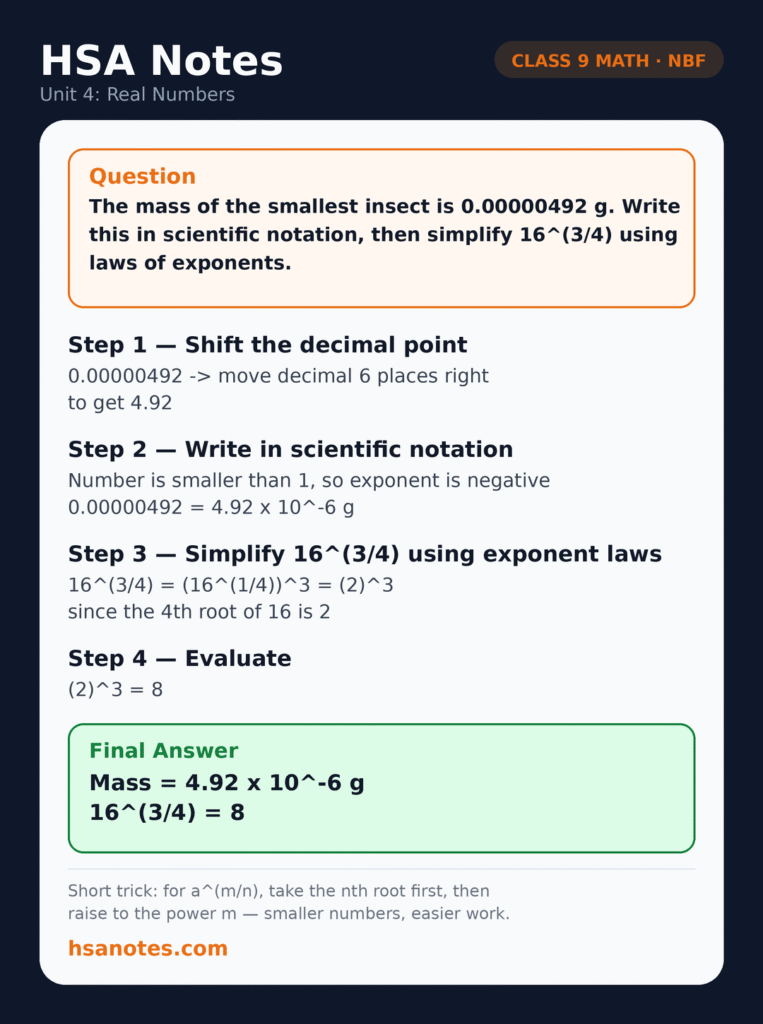
Scientific notation writes a number as a decimal between 1 and 10 multiplied by a power of 10, which is useful for very large or very small numbers. If the original number is 10 or greater, the exponent of 10 is positive; if it is less than 1, the exponent is negative. Standard notation is the ordinary way of writing a number using digits, without exponents.
7. Applications of Real Numbers
Real numbers appear constantly in daily life: natural numbers for counting stock or inventory, integers for recording temperature or gain and loss, and rational and irrational numbers for measurements, banking, and scientific calculations.
Worked Examples
Example 1 (Radical simplification): Simplify √2a × √7b.
√2a × √7b = √(14ab), using the product rule for radicals.
Example 2 (Rational exponent): Simplify 64^(1/3).
64^(1/3) = (4³)^(1/3) = 4.
Example 3 (Scientific notation): Write 5,880,000,000,000 (one light year in miles) in scientific notation.
5,880,000,000,000 = 5.88 × 10¹².
Example 4 (Standard notation): Convert 8.99 × 10⁻⁵ into standard notation.
8.99 × 10⁻⁵ = 0.0000899.
Example 5 (Application, temperature): A cold storage reads −8°C at 6:00 AM, rises 2.5°C per hour until 12:00 PM, then drops 1.75°C per hour until 6:00 PM. Find the temperature at 6:00 PM.
Rise (6 hrs) = 6 × 2.5 = 15°C, so temp at 12:00 PM = −8 + 15 = 7°C.
Drop (6 hrs) = 6 × 1.75 = 10.5°C, so temp at 6:00 PM = 7 − 10.5 = −3.5°C.
Important Formulas at a Glance
| Concept | Formula |
|---|---|
| Set of real numbers | R = Q ∪ Q’ |
| Product rule (radicals) | ⁿ√a × ⁿ√b = ⁿ√(ab) |
| Quotient rule (radicals) | ⁿ√a ÷ ⁿ√b = ⁿ√(a/b) |
| Product rule (exponents) | aᵐ × aⁿ = aᵐ⁺ⁿ |
| Quotient rule (exponents) | aᵐ ÷ aⁿ = aᵐ⁻ⁿ |
| Negative exponent | a⁻ⁿ = 1/aⁿ |
| Power to a power | (aᵐ)ⁿ = aᵐⁿ |
| Scientific notation | a × 10ⁿ, where 1 ≤ a < 10 |
Exercises in Unit 4
| Exercise | Main Focus |
|---|---|
| 4.1 | Properties of real numbers, equality and inequality, number line representation |
| 4.2 | Radicals, radicands, laws of exponents, radical-exponential conversion |
| 4.3 | Scientific notation and standard notation |
| 4.4 (end of unit) | Real-life applications: inventory, temperature, banking, income/expenditure |
| Review Exercise 4 | MCQs, short and long questions |
Exam Tips
- Remember that the product and quotient rules for radicals only work when the indices match.
- Convert radicals to exponents (and back) by matching the denominator of the exponent to the index.
- When multiplying or dividing an inequality by a negative number, always reverse the inequality sign.
- Double-check the sign of the exponent in scientific notation: numbers 10 or greater use a positive exponent, and numbers less than 1 use a negative exponent.
- In application problems, track each change (rise, drop, sale, purchase) one step at a time rather than combining them mentally.
About HSA Notes
HSA Notes is a free educational platform for secondary and higher secondary students in Pakistan. It publishes solved notes, model papers, and study material aligned with the NBF, PECTAA, PCTAA, and FBISE curricula, covering Mathematics, Physics, Chemistry, Biology, Computer Science, and English. Our solutions are written by our own team, giving students clear, original, step-by-step help.
Online Classes
Students who want guided learning can join our online classes run by Hamdard Science Academy. The classes follow the new NBF book unit by unit, so Unit 4 concepts, examples, and exercises are taught in a clear order alongside these notes. To ask about the schedule, fees, or admission, email hsanotes48@gmail.com.
Conclusion
Real Numbers is a foundational unit that connects number properties, radicals, exponents, and scientific notation into one coherent picture. Once the laws of exponents and radicals are memorized and practiced, this unit becomes a reliable source of marks throughout the paper. Free solved exercises and PDF notes are available on HSA Notes, and online classes are there if you need extra support.


1 thought on “Unit 4: Class 9 Functional Math NBF Notes New Book”