
Introduction
Probability is the branch of mathematics that measures how likely an event is to happen, and it is used every day, from guessing whether it will rain to judging the chances of winning a game.
🎓 Online Classes with Experienced Experts
Unit 12 of the Class 10 Mathematics PECTAA New Book builds on the basic idea of probability and extends it to combined events, using diagrams and two key laws to calculate probabilities in more complex situations.
What This Unit Covers
1. Probability, Sample Space and Events (Exercise 12.1) Students revisit the foundations: a random experiment is one where all possible outcomes are known but the exact outcome is not, the sample space S is the set of all possible outcomes, and an event is any subset of the sample space. The unit then classifies events as equally likely, certain, impossible, mutually exclusive, exhaustive, complementary, and elementary, and introduces combined (compound) events, which involve two or more simple events happening together, further split into independent, dependent, mutually exclusive, and non-mutually exclusive types. Students represent these situations using tree diagrams, sample space diagrams, and possibility diagrams, and apply the formula P(E) = n(E)/n(S) to find the probability of an event.
2. The Addition Law of Probability (Exercise 12.2) This section gives the rule for finding the probability that at least one of two events occurs. For any two events, P(A ∪ B) = P(A) + P(B) − P(A ∩ B), and for mutually exclusive events (which share no common outcomes), this simplifies to P(A ∪ B) = P(A) + P(B). Venn diagrams are used throughout to show the union, intersection, and complement of events visually, which makes it easier to decide which version of the rule applies.
3. The Multiplication Law of Probability (Exercise 12.3) This section covers the probability that two events both occur. For independent events, where the outcome of one does not affect the other, P(A and B) = P(A) × P(B). For dependent events, where the outcome of the first event changes the probabilities for the second, conditional probability is used: P(A and B) = P(A) × P(B | A), where P(B | A) is the probability of B given that A has already happened. This distinction is applied throughout to problems involving drawing balls, marbles, or playing cards with and without replacement.
4. Review Exercise 12 The unit closes with a mixed review covering multiple-choice conceptual questions and combined problems that draw on both the addition and multiplication laws together, including cards, dice, and Venn diagram scenarios.
Why This Unit Matters
Probability connects mathematics to everyday decision-making, games, and risk, and it is one of the more intuitive units once the definitions are clear. Board exams typically include one question requiring a tree, possibility, or Venn diagram, and one question applying the addition or multiplication law, so a secure grip on the definitions of independent, dependent, and mutually exclusive events pays off directly.
How to Study Unit 12
- Learn the exact meaning of each type of event (equally likely, mutually exclusive, exhaustive, independent, dependent) since most mistakes come from applying the wrong law to the wrong situation.
- Always write out the sample space S first, and count n(S) carefully before finding n(E).
- Draw a tree diagram, possibility diagram, or Venn diagram whenever a question involves more than one event; it prevents outcomes from being missed or double-counted.
- Before using the addition law, check whether the events are mutually exclusive; if they are not, remember to subtract P(A ∩ B).
- Before using the multiplication law, decide whether the events are independent or dependent (with or without replacement); this decides whether to use P(B) or P(B | A).
Practice Questions – Unit 12
(Original practice problems for self-assessment. Attempt them after studying the unit, then check your working against the solved examples in your notes.)
Short Questions
- Define a random experiment and give one example.
- What is meant by the sample space of an experiment? Write the sample space for tossing a coin twice.
- Define mutually exclusive events and give an example using a single die.
- Write the formula for the probability of an event E in a sample space S.
- State the addition law of probability for two mutually exclusive events.
- State the multiplication law of probability for two independent events.
Long Questions
- A bag contains 6 red balls and 4 yellow balls. A ball is drawn at random. Find the probability that it is (i) red (ii) not yellow.
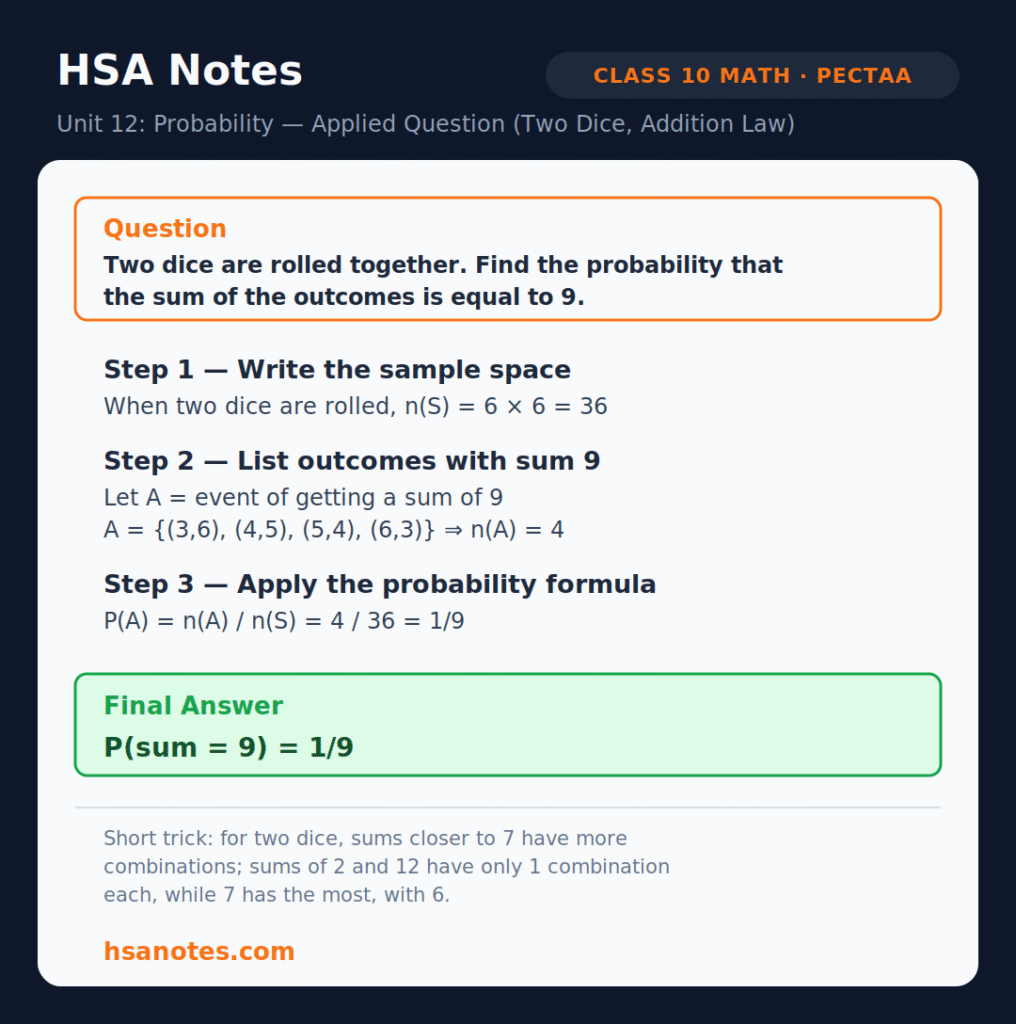
- Two dice are rolled together. Find the probability that the sum of the outcomes is (i) equal to 9 (ii) greater than 9 (iii) an even number.
- If P(A) = 0.4, P(B) = 0.5, and P(A ∩ B) = 0.1, find P(A ∪ B).
- A card is drawn from a standard deck of 52 cards. Find the probability that it is a queen or a heart.
- Two cards are drawn one by one without replacement from a deck of 52 cards. Find the probability that the first card is an ace and the second card is also an ace.
Applied Questions
- A box contains 5 blue pens and 7 black pens. Ahmad draws one pen, replaces it, and then draws another. Find the probability that both pens drawn are blue.
- A survey shows that 60% of students in a school play cricket, 45% play football, and 25% play both. Find the probability that a randomly chosen student plays cricket or football.
- A committee is formed by selecting one member from 3 teachers and one member from 4 students. Draw a tree diagram to show all possible committees, and find the probability that a particular teacher and a particular student are both selected.
- Two marbles are drawn one after another without replacement from a bag containing 4 green and 6 red marbles. Find the probability that the first marble is green and the second marble is red.
These practice questions are written to reinforce Unit 12 concepts and are separate from the textbook’s own exercises. Use them for extra revision before attempting the board-style exercises in the unit.
About HSA Notes
HSA Notes is an educational resource platform providing free study materials for Pakistani students, covering FBISE, Punjab, Sindh, and KP Boards in line with the New Books System. Materials span grades 9–12 across Mathematics, Chemistry, Biology, Physics, Computer Science, English, and Urdu, all prepared in a consistent, easy-to-follow branded format.
Besides free unit-wise notes and solved exercises, HSA Notes also offers online classes for students who want structured, teacher-guided sessions alongside self-study, useful for learners who need concepts explained step by step or want doubt-solving support beyond what a PDF can provide. For online classes, contact: hsanotes48@gmail.com
Conclusion
Unit 12 – Probability equips Class 10 students with the tools to measure uncertainty: sample spaces, tree and possibility diagrams, and the addition and multiplication laws for combined events. Careful attention to whether events are mutually exclusive, independent, or dependent is the key skill this unit tests. Regular practice with the questions above, together with HSA Notes’ online classes where extra support is needed, will help students handle this unit confidently in the board examination.
1 thought on “Unit 12: Class 10 Math PECTAA Notes New Book”