Introduction
Unit 5 of the Class 12 Mathematics PECTAA New Book introduces Analytical Geometry, also called coordinate geometry the branch of mathematics that combines algebra and geometry to study lines, angles, and triangular regions using the xy-plane.
🎓 Online Classes with Experienced Experts
First developed in the 17th century by René Descartes, this approach lets us describe geometric figures with equations, making it possible to calculate distances, midpoints, slopes, and intersections. This unit covers straight lines in all their standard forms, angles between coplanar lines, concurrency of medians, altitudes, and right bisectors, area of a triangular region, homogeneous second-degree equations representing pairs of lines, and real-life applications of analytical geometry.
What This Unit Covers
Unit 5 is organized into three graded exercises (5.1 to 5.3), spanning ten major sections:
- Equation of Straight Lines Students learn the six standard forms of a straight line’s equation — general form, slope-intercept form, point-slope form, two-point form, intercept form, and normal form — and how to write an equation of a line given different combinations of slope, points, and intercepts.
- A Linear Equation in Two Variables Represents a Straight Line This section proves that ax + by + c = 0 always represents a straight line, then shows how to transform this general equation into each of the six standard forms systematically.
- Equations of Medians, Altitudes and Right Bisectors Students find the equations of a triangle’s medians (joining a vertex to the midpoint of the opposite side), altitudes (perpendicular from a vertex to the opposite side), and right bisectors (perpendicular through the midpoint of a side) using coordinates of the vertices.
- Condition of Concurrency of Three Straight Lines This section derives the determinant condition for three lines to pass through a common point, and shows how to find that point of concurrency once it is confirmed.
- Equation of Lines Through the Point of Intersection of Two Lines Students learn to construct the family of lines a₁x + b₁y + c₁ + k(a₂x + b₂y + c₂) = 0 passing through the intersection of two given lines, and how to pick out a specific member satisfying an extra condition such as parallelism or perpendicularity.
- Angle Between Two Lines This part derives the formula tan θ = (m₂ − m₁)/(1 + m₁m₂) for the angle between two lines, along with the special conditions for parallel lines (m₁ = m₂) and perpendicular lines (1 + m₁m₂ = 0).
- Area of a Triangular Region Whose Vertices are Given Students derive and apply the determinant formula for the area of a triangle from its three vertices, and use it to test whether three given points are collinear (area = 0).
- Homogeneous Equation of the Second Degree in Two Variables This section shows how a pair of straight lines through the origin can be represented by a single second-degree homogeneous equation ax² + 2hxy + by² = 0, and classifies the lines as real-distinct, real-coincident, or imaginary based on h² compared to ab.
- Angle Between the Lines (represented by a homogeneous equation) Students derive tan θ = 2√(h² − ab)/(a + b) for the angle between the pair of lines given by ax² + 2hxy + by² = 0, along with the special condition a + b = 0 for perpendicularity.
- Application of Analytical Geometry to Real Life The unit closes with real-world uses of coordinate geometry: finding distances between planets in astronomical units, calculating the slope and distance of an aircraft’s flight path, and other positioning problems in aviation, astronomy, and engineering.
Why This Unit Matters
Analytical Geometry is the foundation on which conic sections, vectors, and three-dimensional geometry in later units are built. The concurrency proofs for medians, altitudes, and right bisectors (Theorems 4, 5, and 6) are classic long-question material in board exams, and the determinant-based area and concurrency formulas reappear throughout the paper wherever coordinates are involved. The homogeneous second-degree equation topic is unique to this unit and is a favourite source of both short and long questions.
How to Study Unit 5
- Memorize all six standard forms of a straight line’s equation and practise converting between them quickly — Exercise 5.1’s transformation questions are almost entirely mechanical once the derivations in Section 5.2.1 are understood.
- For triangle-geometry problems (medians, altitudes, right bisectors), always find the required midpoint and slope first before writing the point-slope equation — most errors come from mixing up which side’s midpoint or perpendicular slope is needed.
- Use the determinant test for concurrency and collinearity as a quick check wherever three lines or three points are given, since it avoids solving simultaneous equations from scratch.
- For homogeneous second-degree equations, factor ax² + 2hxy + by² by splitting the middle term (as with an ordinary quadratic) to find the two lines directly, then apply the sum a + b = 0 test to check perpendicularity without recomputing slopes.
- Keep the two angle formulas — tan θ = (m₂ − m₁)/(1 + m₁m₂) for two given lines and tan θ = 2√(h² − ab)/(a + b) for a homogeneous pair — clearly separated, since exam questions often test whether a student applies the correct one.
HSA Notes solved question card Class 12 Math PECTAA, Unit 5 Analytical Geometry, Applied problem: triangle ABC with vertices A(2,3), B(4,5), C(–2,7), solved step by step to find the equations of the three medians AD, BE and CF using midpoint and point-slope form
Practice Questions – Unit 5
Short Questions
- Find the equation of the line with slope −4 passing through (2, −1).
- Write the equation x + 2y − 6 = 0 in intercept form.
- Find the slope of the right bisector of a segment with slope 2/3.
- Check whether the points A(1, 2), B(3, 6), C(5, 10) are collinear.
- Find the angle between lines with slopes 2 and −1/2.
- Write the condition for ax² + 2hxy + by² = 0 to represent perpendicular lines.
Long Questions
- Find the equations of the altitudes of the triangle with vertices A(1, 2), B(5, −1), C(−2, −4), and show they are concurrent.
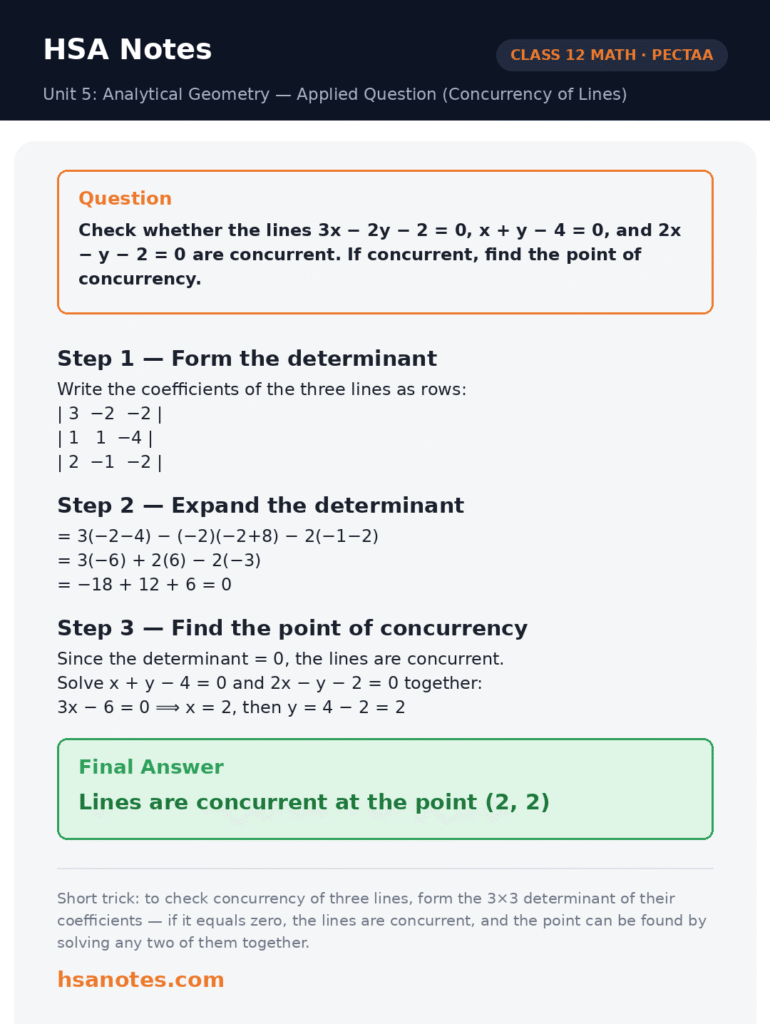
- Check whether the lines 3x − 2y − 2 = 0, x + y − 4 = 0, and 2x − y − 2 = 0 are concurrent; if so, find the point of concurrency.
- Find the family of lines through the intersection of 2x − 3y − 14 = 0 and 2x + y − 10 = 0, and determine the member perpendicular to 2x − 3y + 2 = 0.
- Find the equation of each line represented by 3x² − 10xy + 3y² = 0 and the angle between them.
- Find the interior angles of the triangle with vertices A(1, 2), B(7, 3), C(4, 9).
Applied Questions
- Planet A is at (1, 0) AU and planet B is at (−0.5, 0.866) AU. Find the distance between them in kilometres.
- An aircraft flies from A(100, 200) km to B(500, 800) km. Find the slope of the track and the straight-line distance.
- Two points A(−2, −1) and B(3, 4) lie on a solar panel roof. Find the slope and tilt angle of the panel.
- The trajectories of two projectiles in a physics experiment are modeled by 9x² − 12xy + 4y² = 0. Prove this represents two coincident lines and find the angle between them.
About HSA Notes
HSA Notes is an educational resource platform providing free study materials for Pakistani students, covering FBISE, Punjab, Sindh, and KP Boards in line with the New Books System. Materials span grades 9–12 across Mathematics, Chemistry, Biology, Physics, Computer Science, English, and Urdu, all prepared in a consistent, easy-to-follow branded format.
Besides free unit-wise notes and solved exercises, HSA Notes also offers online classes for students who want structured, teacher-guided sessions alongside self-study useful for learners who need concepts explained step by step or want doubt-solving support beyond what a PDF can provide. For online classes, contact: hsanotes48@gmail.com
Conclusion
Unit 5 Analytical Geometry equips students with the tools to describe and analyze lines and triangles algebraically: the six forms of a line’s equation, concurrency of a triangle’s medians, altitudes, and right bisectors, the angle and area formulas, and homogeneous second-degree equations representing pairs of lines. These skills form the backbone for the conic sections and vector geometry that follow later in the syllabus, making a strong grasp of this unit essential for continued progress in Class 12 Mathematics. Practising the solved examples alongside the questions above, and joining HSA Notes’ online classes for extra guidance where needed, will help students build real confidence in this unit.