Introduction
Unit 8 of the new NBF Functional Mathematics Grade 9 FBISE textbook covers Area and Volume of Similar Figures. Similar figures have the same shape but not necessarily the same size: their corresponding angles are equal and their corresponding sides are proportional.
🎓 Online Classes with Experienced Experts
This unit connects that idea of similarity to real measurement, showing how the areas and volumes of similar shapes relate to each other, with genuine uses in architecture, scale models, maps, and photography. These notes follow the new NBF book for session 2026-27.
What You Will Learn
By the end of this unit, students will be able to:
- convert standard units of area (mm², cm², m²) and volume (mm³, cm³, m³) manually;
- identify whether two or more polygons are similar;
- find the relation between the areas of two similar figures;
- find the relation between the volumes of two similar solids;
- solve problems using the area and volume relationships for similar cubes, cuboids, cones, cylinders, and spheres.
Key Topics Explained
1. Similarity of Polygons
Two or more figures that have the same shape but not necessarily the same size are called similar figures, written with the symbol “~”. If two figures are similar, their corresponding angles are congruent, and the ratios of their corresponding sides are equal; both directions of this statement are true. For two triangles, if two pairs of corresponding sides are in proportion and the angle between them is equal, the triangles are similar.
2. Conversion of Units of Area
The basic unit of area is a square unit (mm², cm², m²). Since 1 m = 100 cm, 1 m² = 100 × 100 = 10,000 cm². Since 1 cm = 10 mm, 1 cm² = 10 × 10 = 100 mm². To convert from a smaller area unit to a larger one, divide by the appropriate squared conversion factor; to convert from larger to smaller, multiply.
3. Area of Similar Figures
The ratio of the areas of two similar figures is equal to the square of the ratio of any two corresponding lengths of the figures. For two similar triangles or two similar circles with corresponding lengths ℓ₁ and ℓ₂, the relationship is A₁/A₂ = (ℓ₁/ℓ₂)². This rule works for any pair of similar polygons, not just triangles or circles.
4. Conversion of Units of Volume
The basic unit of volume is a cubic unit (mm³, cm³, m³). Since 1 m = 100 cm, 1 m³ = 100 × 100 × 100 = 1,000,000 cm³. Since 1 cm = 10 mm, 1 cm³ = 10 × 10 × 10 = 1,000 mm³.
5. Volume of Similar Solids
The ratio of the volumes of two similar solids is equal to the cube of the ratio of any two corresponding lengths of the solids: V₁/V₂ = (ℓ₁/ℓ₂)³. This applies to similar cubes, cuboids, cones, cylinders, and spheres. If the two solids are made of the same material, the ratio of their masses equals the ratio of their volumes, since mass is proportional to volume for a constant density.
Worked Examples
Example 1 (Similar triangles, finding sides): ΔABC ~ ΔDEF, with AB = 6 cm, BC = 9 cm, DE = 4 cm. Find EF.
Since the triangles are similar, AB/DE = BC/EF, so 6/4 = 9/EF, giving EF = (9 × 4) ÷ 6 = 6 cm.
Example 2 (Area ratio of circles): Two similar circles have radii 2 cm and 3 cm. Find the ratio of their areas.
A₁ = π(2)² = 4π cm², A₂ = π(3)² = 9π cm². Ratio A₁/A₂ = 4π/9π = 4:9, matching (r₁/r₂)² = (2/3)² = 4/9.
Example 3 (Area of similar cylinder bases): The ratio of the areas of the bases of two similar cylinders is 9:4. The smaller base has area 240 cm². Find the larger base’s area and the ratio of heights.
A₁/A₂ = 9/4, so A₁ = (9/4) × 240 = 540 cm². Since A₁/A₂ = (h₁/h₂)², h₁/h₂ = √(9/4) = 3:2.
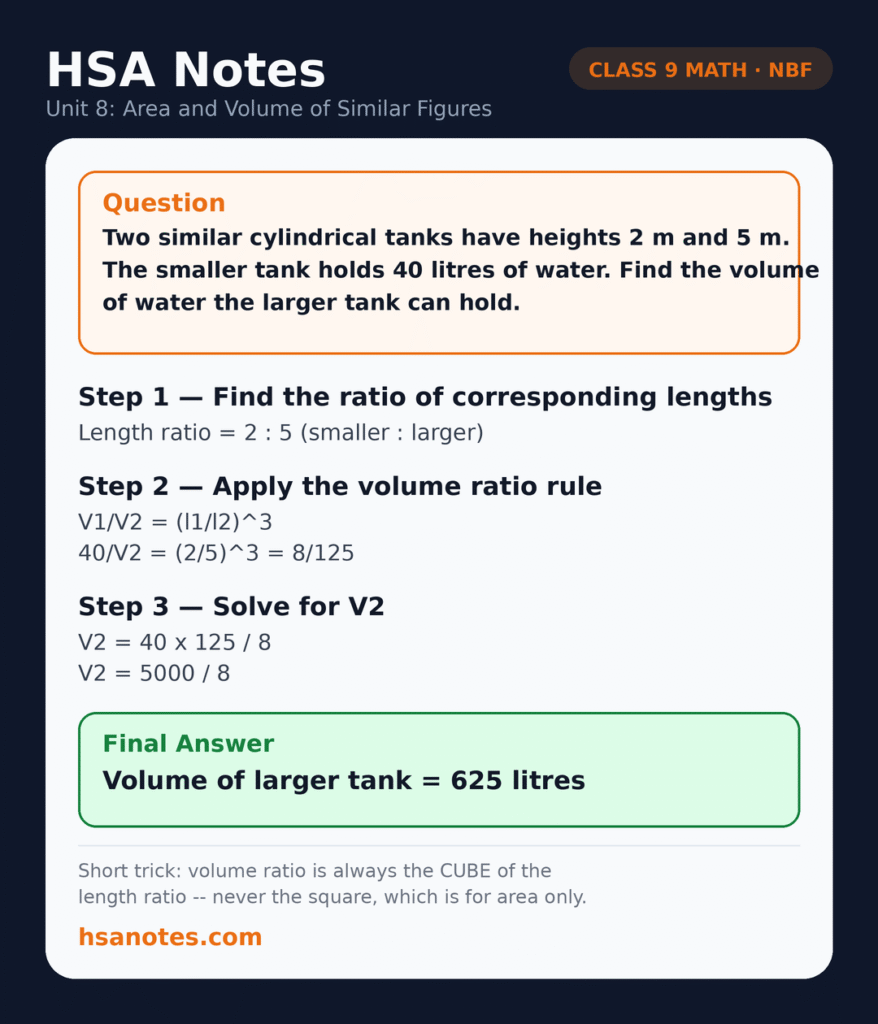
Example 4 (Volume of similar solids): Two similar solids have corresponding lengths 2 cm and 4 cm. Find how many times the volume of the larger solid is compared to the smaller one.
V₁/V₂ = (ℓ₁/ℓ₂)³ = (4/2)³ = 2³ = 8. The larger solid’s volume is 8 times the smaller one’s.
Example 5 (Scale model application): A model bus is built at a scale of 1:10 and has a volume of 30 m³. Find the volume of the actual bus.
Volume ratio = (scale factor)³ = 10³ = 1000. Actual volume = 30 × 1000 = 30,000 m³.
Important Formulas at a Glance
| Concept | Formula |
|---|---|
| Area unit conversion (m² to cm²) | × 10,000 |
| Area unit conversion (cm² to mm²) | × 100 |
| Volume unit conversion (m³ to cm³) | × 1,000,000 |
| Volume unit conversion (cm³ to mm³) | × 1,000 |
| Ratio of areas of similar figures | A₁/A₂ = (ℓ₁/ℓ₂)² |
| Ratio of volumes of similar solids | V₁/V₂ = (ℓ₁/ℓ₂)³ |
| Ratio of masses (same material) | m₁/m₂ = V₁/V₂ |
Exercises in Unit 8
| Exercise | Main Focus |
|---|---|
| 8.1 | Identifying similar polygons, finding unknown sides using similarity |
| 8.2/8.3 | Converting units of area, area ratio of similar figures |
| 8.4 | Converting units of volume, volume ratio of similar solids |
| Review Exercise 8 | MCQs, similar figures and solids problems |
Exam Tips
- Always confirm similarity first (equal angles, proportional sides) before applying area or volume ratios.
- Remember: the area ratio uses the square of the length ratio, and the volume ratio uses the cube.
- When converting units, square the linear conversion factor for area and cube it for volume.
- In mixed problems, find the length ratio first, then calculate area or volume ratio from it.
About HSA Notes
HSA Notes is a free educational platform for secondary and higher secondary students in Pakistan. It publishes solved notes, model papers, and study material aligned with the NBF, PECTAA, PCTAA, and FBISE curricula, covering Mathematics, Physics, Chemistry, Biology, Computer Science, and English. Our solutions are written by our own team, giving students clear, original, step-by-step help.
Online Classes
Students who want guided learning can join our online classes run by Hamdard Science Academy. The classes follow the new NBF book unit by unit, so Unit 8 concepts, examples, and exercises are taught in a clear order alongside these notes. To ask about the schedule, fees, or admission, email hsanotes48@gmail.com.
Conclusion
Area and Volume of Similar Figures builds directly on the idea of similarity, adding the square and cube relationships that make scaling calculations possible. With steady practice distinguishing when to square and when to cube a ratio, this unit becomes very manageable. Free solved exercises and PDF notes are available on HSA Notes, and online classes are there if you need extra support.