Introduction
Unit 6 of the new NBF Functional Mathematics Grade 9 FBISE textbook covers Linear Equations and Inequalities in One Variable. Equations and inequalities let us model real situations where quantities are equal, or where one is less than, greater than, or within a range of another.
🎓 Online Classes with Experienced Experts
This unit builds from simple linear equations to equations with fractions, radicals, and absolute values, then does the same for inequalities, before applying all of it to real-world problems involving age, money, distance, and business. These notes follow the new NBF book for session 2026-27.
What You Will Learn
By the end of this unit, students will be able to:
- solve linear equations in one variable, including those with fractions, radicals, and absolute values;
- solve linear inequalities in one variable, including compound inequalities joined by “and” or “or”;
- represent the solution set of an inequality on a number line;
- apply the concept of linear equations and inequalities to real-world problems such as age, geometry, and business.
Key Topics Explained
1. Linear Equations in One Variable
A linear equation in one variable can be written in the standard form ax + b = 0, where a and b are real numbers and a ≠ 0. The highest exponent of the variable is always 1, which is why it is also called an equation of degree one. Its solution is found by isolating the variable using the properties of equality: addition, subtraction, multiplication, and division. Two or more equations with the same solution are called equivalent equations.
2. Equations Involving Fractions and Radicals
Equations with fractions are solved by multiplying every term by the LCM of the denominators to clear the fractions, then solving the resulting linear equation. A radical equation has the variable under a radical sign; it is solved by isolating the radical term and squaring both sides. Squaring can introduce an extraneous root, a root that does not satisfy the original equation, so every solution must be checked by substitution.
3. Equations Involving Absolute Value
The absolute value of a real number x, written |x|, is its distance from 0 on the number line, and is always non-negative. An absolute value equation of the form |ax + b| = c, where c > 0, is equivalent to two separate equations: ax + b = c or ax + b = −c. Both are solved separately to get the full solution set. If c = 0, there is exactly one solution; if c < 0, the equation has no solution.
4. Linear Inequalities in One Variable
A linear inequality can be written in the form ax + b < 0 (or similarly with >, ≤, ≥), where a ≠ 0. It is solved almost exactly like a linear equation, using the properties of inequalities, with one key difference: multiplying or dividing both sides by a negative number reverses the direction of the inequality sign.
5. Compound Inequalities
When two inequalities are joined by “or,” the solution set is the union of both individual solution sets. When they are joined by “and,” the solution set is the intersection of both individual solution sets, meaning only the values that satisfy both inequalities at once.
6. Applications in Daily Life
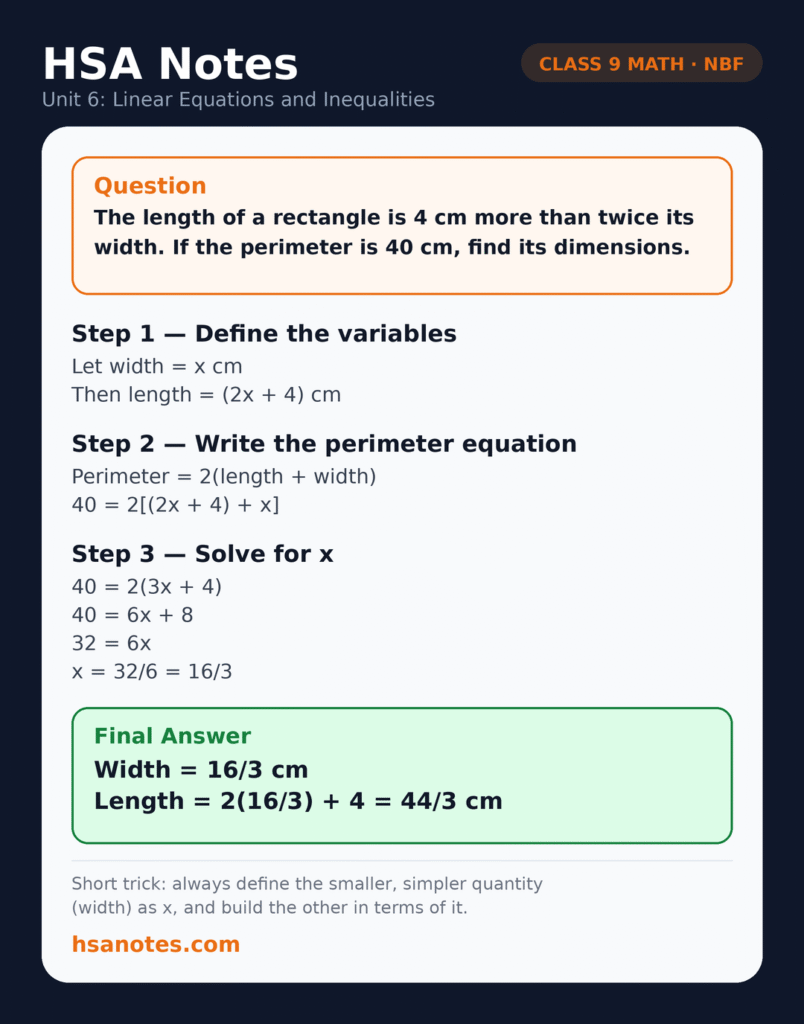
Linear equations and inequalities solve many practical problems: finding an unknown age from a given relationship, finding the dimensions of a rectangle from its perimeter, determining how many items were purchased from a total cost, and calculating speed, distance, or time.
Worked Examples
Example 1 (Equation with fractions): Solve (2x/5) − 1 = x/2 + 1/4.
Multiply through by the LCM of 5, 2, 4, which is 20: 8x − 20 = 10x + 5.
8x − 10x = 5 + 20, so −2x = 25, giving x = −25/2.
Example 2 (Radical equation): Solve √(x + 3) = 7.
Square both sides: x + 3 = 49, so x = 46. Check: √(46 + 3) = √49 = 7. ✓
Solution: x = 46.
Example 3 (Absolute value equation): Solve |2x + 5| = 11.
2x + 5 = 11 gives x = 3. 2x + 5 = −11 gives x = −8.
Solution set: {3, −8}.
Example 4 (Inequality, reversing sign): Solve 3(−4 + 5y) ≤ −8(1 − 2y) + 6.
−12 + 15y ≤ −8 + 16y + 6, so −12 + 15y ≤ 16y − 2, giving −y ≤ 10, so y ≥ −10.
Example 5 (Application): Ali is 5 years older than his brother, and the sum of their ages is 25. Find each age.
Let the brother’s age = x. Then Ali’s age = x + 5. So x + (x + 5) = 25, giving 2x = 20, x = 10.
Brother’s age = 10 years, Ali’s age = 15 years.
Important Formulas at a Glance
| Concept | Rule |
|---|---|
| Standard form | ax + b = 0, a ≠ 0 |
| Radical equation | Isolate radical, square both sides, check for extraneous roots |
| Absolute value equation | |ax+b| = c (c>0) → ax+b = c or ax+b = −c |
| Multiply/divide inequality by negative | Reverse the inequality sign |
| Compound inequality (“or”) | Union of solution sets |
| Compound inequality (“and”) | Intersection of solution sets |
Exercises in Unit 6
| Exercise | Main Focus |
|---|---|
| 6.1 | Linear equations, including those with fractions |
| 6.2 | Linear equations involving radicals |
| 6.3 | Equations involving absolute value |
| 6.4 | Linear inequalities, including compound inequalities |
| 6.5 | Real-life applications of equations and inequalities |
| Review Exercise 6 | MCQs, short and long questions |
Exam Tips
- Clear fractions first by multiplying through by the LCM of all denominators.
- Always check radical equation solutions in the original equation to rule out extraneous roots.
- Split every absolute value equation into its two cases before solving.
- Remember to reverse the inequality sign whenever multiplying or dividing by a negative number.
- For “and” compound inequalities, find where both solution sets overlap; for “or,” combine them.
About HSA Notes
HSA Notes is a free educational platform for secondary and higher secondary students in Pakistan. It publishes solved notes, model papers, and study material aligned with the NBF, PECTAA, PCTAA, and FBISE curricula, covering Mathematics, Physics, Chemistry, Biology, Computer Science, and English. Our solutions are written by our own team, giving students clear, original, step-by-step help.
Online Classes
Students who want guided learning can join our online classes run by Hamdard Science Academy. The classes follow the new NBF book unit by unit, so Unit 6 concepts, examples, and exercises are taught in a clear order alongside these notes. To ask about the schedule, fees, or admission, email hsanotes48@gmail.com.
Conclusion
Linear Equations and Inequalities in One Variable builds a toolkit that is used throughout the rest of the course, from simple equations to radicals and absolute values. With steady practice on each exercise type, this unit becomes a dependable source of marks. Free solved exercises and PDF notes are available on HSA Notes, and online classes are there if you need extra support.