Introduction
Unit 5 of the new NBF Functional Mathematics Grade 9 FBISE textbook covers Factorization and Algebraic Manipulation. Factorization is the reverse of multiplication: instead of multiplying factors together to get an expression, this unit expresses a given algebraic expression as a product of its factors.
🎓 Online Classes with Experienced Experts
This skill underlies HCF, LCM, and square roots of algebraic expressions, and it has genuine engineering and business applications, such as finding the dimensions of a cuboid, tank, or machine surface from its volume or area. These notes follow the new NBF book for session 2026-27.
What You Will Learn
By the end of this unit, students will be able to:
- identify common factors of polynomials and factorize quadratic and bi-quadratic algebraic expressions;
- find the highest common factor (HCF) and least common multiple (LCM) of algebraic expressions by factorization;
- find the LCM of two polynomials using the division method when the HCF is known;
- find the square root of an algebraic expression by factorization;
- apply the concepts of factorization to real-world problems in engineering, business, and finance.
Key Topics Explained
1. Factorization of an Algebraic Expression
Factorization expresses an algebraic expression as the product of its factors; it is the reverse of multiplication. The first step is always to find the greatest common factor of all terms and take it outside the brackets, as in 6x + 9 = 3(2x + 3).
2. Factorizing Quadratic Expressions
For a trinomial of the form x² + px + q, split the middle term by finding two numbers whose product is q and whose sum is p. For ax² + bx + c, split the middle term by finding two numbers whose product is ac and whose sum is b, then factor by grouping.
3. Factorizing Bi-Quadratic Expressions
Expressions of the type a⁴ + a²b² + b⁴ are rewritten by adding and subtracting a term to complete a perfect square, giving a⁴ + a²b² + b⁴ = (a² + b² + ab)(a² + b² − ab). A similar method applies to a⁴ + 4b⁴.
4. Highest Common Factor (HCF)
The HCF of two or more polynomials is the highest-degree polynomial that divides each of them exactly. To find it, write each expression in complete factored form, then take the product of the common factors using their lowest power.
5. Least Common Multiple (LCM)
The LCM of two or more polynomials is the lowest-degree polynomial that each of the given polynomials divides exactly. To find it, take the product of every factor, common and uncommon, each raised to its highest power. A key relationship connects the two: the product of the HCF and LCM of two polynomials equals the product of the polynomials themselves, which allows the LCM to be found by division when the HCF, one polynomial, and the product are known.
6. Square Root by Factorization
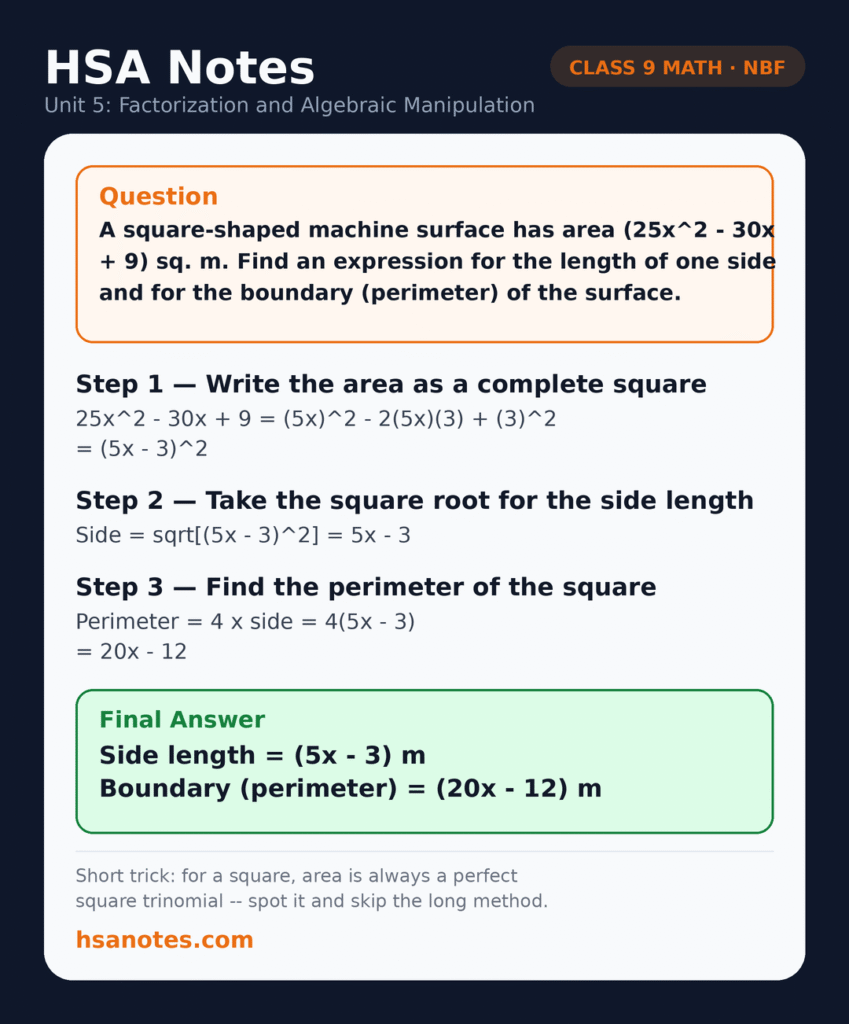
To find the square root of an algebraic expression, first rewrite it as a complete square, then take the square root of both sides. The answer always has two values that are additive inverses of each other, since (x)² and (−x)² give the same result.
7. Applications of Factorization
Factorization has real engineering uses: if the volume or area of an object (a cuboid, cubical tank, or machine part) is given as a polynomial, factorizing it reveals expressions for its length, width, height, or surface area, which can then be used to calculate costs such as painting or polishing per square metre.
Worked Examples
Example 1 (Factorizing ax² + bx + c): Factorize 3x² + 22x − 16.
3x² + 24x − 2x − 16 = 3x(x + 8) − 2(x + 8) = (x + 8)(3x − 2).
Example 2 (HCF by factorization): Find the HCF of 2m² − 2mn, 4m² − 4n², and 2m² − 4mn + 2mn².
2m² − 2mn = 2m(m − n). 4m² − 4n² = 4(m − n)(m + n). 2m² − 4mn + 2mn² is factorized similarly.
Common factors with the least power are 2, m, (m − n), so the HCF = 2m(m − n).
Example 3 (LCM by division method): Find the second polynomial Q, given P = x² − 5x + 6, HCF = x − 3, and LCM = x³ − 9x² + 26x − 24.
Since P × Q = HCF × LCM, Q = (HCF × LCM) ÷ P = [(x − 3)(x³ − 9x² + 26x − 24)] ÷ (x² − 5x + 6).
Carrying out the division gives Q = x² − 6x + 8.
Example 4 (Square root by factorization): Find the square root of 4a² + 12ab + 9b².
4a² + 12ab + 9b² = (2a)² + 2(2a)(3b) + (3b)² = (2a + 3b)².
Taking the square root of both sides gives √(4a² + 12ab + 9b²) = ±(2a + 3b).
Example 5 (Application): The volume of a cuboid is the difference of two cubes with sides x and y. Find an expression for one side of the cuboid.
Volume = x³ − y³ = (x − y)(x² + xy + y²). Since this factors into one linear and one quadratic factor, the length of the cuboid is (x − y).
Important Formulas at a Glance
| Concept | Rule or Formula |
|---|---|
| x² + px + q | Find two numbers with product q, sum p |
| ax² + bx + c | Find two numbers with product ac, sum b |
| a⁴ + a²b² + b⁴ | (a² + b² + ab)(a² + b² − ab) |
| HCF | Product of common factors at their lowest power |
| LCM | Product of all factors (common + uncommon) at their highest power |
| HCF × LCM | = Product of the two polynomials |
| Square root | Write as a complete square, then take ± root |
Exercises in Unit 5
| Exercise | Main Focus |
|---|---|
| 5.1 | Factorizing quadratic and bi-quadratic expressions |
| 5.2 | HCF of algebraic expressions (monomials and compound polynomials) |
| 5.3 | LCM of algebraic expressions, HCF-LCM relationship, LCM by division |
| 5.4 | Square root by factorization and real-life applications |
| Review Exercise 5 | MCQs, factorization and HCF/LCM problems |
Exam Tips
- Always extract the greatest common factor first, before trying any other factorization method.
- For ax² + bx + c, check that the two numbers you choose multiply to give ac, not just c.
- Write each polynomial in fully factored form before comparing them for HCF or LCM.
- Remember the identity HCF × LCM = product of the two polynomials; it often saves a long division.
- A square root of an algebraic expression always has a ± sign in the answer.
About HSA Notes
HSA Notes is a free educational platform for secondary and higher secondary students in Pakistan. It publishes solved notes, model papers, and study material aligned with the NBF, PECTAA, PCTAA, and FBISE curricula, covering Mathematics, Physics, Chemistry, Biology, Computer Science, and English. Our solutions are written by our own team, giving students clear, original, step-by-step help.
Online Classes
Students who want guided learning can join our online classes run by Hamdard Science Academy. The classes follow the new NBF book unit by unit, so Unit 5 concepts, examples, and exercises are taught in a clear order alongside these notes. To ask about the schedule, fees, or admission, email hsanotes48@gmail.com.
Conclusion
Factorization and Algebraic Manipulation builds directly on earlier algebra skills and feeds into HCF, LCM, and square root problems that repeat throughout the paper. With steady practice on splitting the middle term and recognizing common factors, this unit becomes very manageable. Free solved exercises and PDF notes are available on HSA Notes, and online classes are there if you need extra support.