Introduction
Unit 7 of the new PECTAA Class 10 Mathematics book extends trigonometry beyond right-angled triangles. Earlier, students studied sine, cosine, and tangent only for angles less than 90°.
🎓 Online Classes with Experienced Experts
This unit shows how the same ratios apply to angles between 90° and 180°, and introduces the law of sines, the law of cosines, and triangle area formulas that work for any triangle, not just right-angled ones. The unit also covers three-dimensional problems and bearings, which are used in navigation, flight engineering, and everyday direction-finding. These notes follow the new book for session 2026-27 and suit students of all Punjab boards.
What You Will Learn
By the end of this unit, students will be able to:
- extend sine and cosine functions to angles between 90° and 180°;
- determine the sign of each trigonometric ratio in every quadrant;
- apply the law of sines, the law of cosines, and area formulas to any triangle;
- solve trigonometric problems in three dimensions;
- interpret and use three-figure bearings in real-life problems.
Key Topics Explained
1. Trigonometric Ratios and the Six Functions
In a right triangle with angle θ, the ratios are sin θ = opposite ÷ hypotenuse, cos θ = adjacent ÷ hypotenuse, and tan θ = opposite ÷ adjacent, along with their reciprocals cosec θ, sec θ, and cot θ.
2. Signs in the Four Quadrants
Using a unit circle, a point’s coordinates give the sign of each ratio. In the 1st quadrant, all six ratios are positive. In the 2nd, only sin and cosec are positive. In the 3rd, only tan and cot are positive. In the 4th, only cos and sec are positive. This is often remembered by the phrase “All Sin Tan Cos” quadrant by quadrant.
3. Ratios for 0°, 90°, and 180°
Using a unit circle, the point at 0° is (1, 0), at 90° it is (0, 1), and at 180° it is (−1, 0). Reading the coordinates gives values such as sin 0° = 0, cos 90° = 0, and sin 180° = 0, with some ratios undefined where a coordinate is zero.
4. Law of Sines
For a triangle with sides a, b, c opposite angles A, B, C, the law of sines states a/sin A = b/sin B = c/sin C. It is used when two angles and one side, or two sides and a non-included angle, are known.
5. Law of Cosines
The law of cosines states a² = b² + c² − 2bc cos A, and similarly for the other sides. It is used when three sides, or two sides and the included angle, are known.
6. Area of a Triangle
Three formulas are used depending on what is given: Area = ½ab sin C (two sides and the included angle), and Heron’s formula, Area = √[s(s − a)(s − b)(s − c)], where s = (a + b + c) ÷ 2 (all three sides known).
7. Three-Dimensional Problems
These problems involve solid shapes such as cuboids and pyramids. Right triangles are identified inside the solid, and the Pythagorean theorem and trigonometric ratios are applied step by step to find lengths and angles.
8. Bearings
A bearing describes direction as an angle measured clockwise from north, written using three digits, such as 060° or 218°. The bearing of a point back to another is found by adding or subtracting 180° from the original bearing.
Worked Examples
Example 1 (Law of sines): In triangle ABC, A = 40°, B = 60°, and a = 8 cm. Find b.
a/sin A = b/sin B, so b = (8 × sin 60°) ÷ sin 40° = (8 × 0.866) ÷ 0.643 ≈ 10.78 cm.
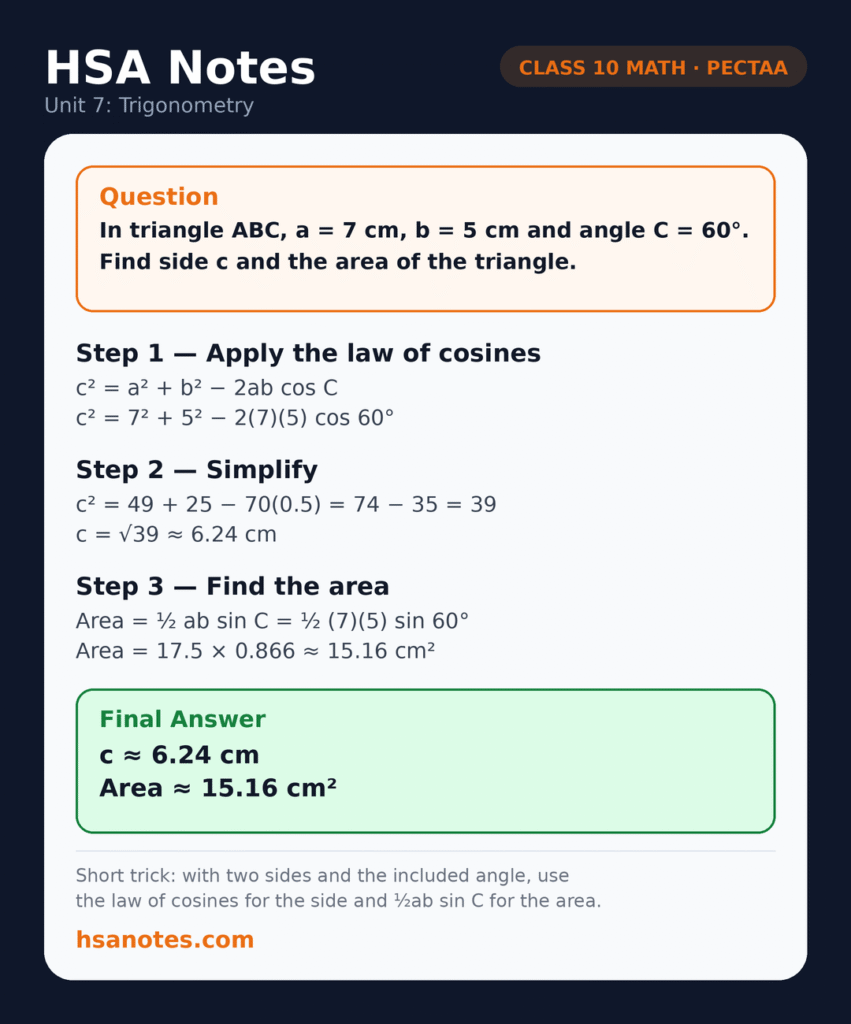
Example 2 (Law of cosines): In triangle ABC, a = 7, b = 5, C = 60°. Find c.
c² = 7² + 5² − 2(7)(5)cos 60° = 49 + 25 − 35 = 39, so c ≈ 6.24.
Example 3 (Area, SAS): Find the area of triangle ABC with a = 4.2, b = 3.2, C = 70°.
Area = ½(4.2)(3.2) sin 70° = 6.72 × 0.9397 ≈ 6.31 square units.
Example 4 (Area, SSS): Find the area of a triangle with sides 4 cm, 3 cm, 5 cm.
s = 6, Area = √[6(2)(3)(1)] = √36 = 6 square cm.
Example 5 (Bearing): The bearing of Q from P is 060°. Find the bearing of P from Q.
Bearing = 180° + 060° = 240°.
Important Formulas at a Glance
| Concept | Formula |
|---|---|
| Law of sines | a/sin A = b/sin B = c/sin C |
| Law of cosines | a² = b² + c² − 2bc cos A |
| Area (SAS) | ½ab sin C |
| Area (SSS) | √[s(s − a)(s − b)(s − c)], s = (a+b+c)/2 |
| Bearing back | original bearing ± 180° |
Exercises in Unit 7
| Exercise | Main Focus |
|---|---|
| 7.1 | Ratios for angles 90° to 180°, signs in quadrants |
| 7.2 | Law of sines |
| 7.3 | Law of cosines and area of a triangle |
| 7.4 | Three-dimensional problems and bearings |
| Review Exercise 7 | MCQs, short and long questions |
Exam Tips
- Identify what is given (two angles and a side, or three sides) before choosing a law.
- Use the law of sines when an angle-side pair is known, and the law of cosines otherwise.
- For 3D problems, sketch the solid and mark the right triangle you plan to use.
- Always express a bearing with three digits, such as 060° instead of 60°.
About HSA Notes
HSA Notes is a free educational platform for secondary and higher secondary students in Pakistan. It publishes solved notes, model papers, and study material aligned with the NBF, PECTAA, PCTAA, and FBISE curricula, covering Mathematics, Physics, Chemistry, Biology, Computer Science, and English. Our solutions are written by our own team, giving students clear, original, step-by-step help.
Online Classes
Students who want guided learning can join our online classes run by Hamdard Science Academy. The classes follow the new PECTAA book unit by unit, so Unit 7 concepts, examples, and exercises are taught in a clear order alongside these notes. To ask about the schedule, fees, or admission, email hsanotes48@gmail.com.
Conclusion
Trigonometry is a wide-ranging unit that rewards students who master the laws of sines and cosines and stay comfortable with 3D reasoning. With steady practice on all four exercises, it can become one of the highest-scoring units in the paper. Free solved exercises and PDF notes are available on HSA Notes for all Punjab boards, and online classes are there if you need extra support.