Introduction
Unit 6 of the new PECTAA Class 10 Mathematics book introduces vectors in the plane. Unlike ordinary numbers, which have only size, a vector carries both magnitude and direction. Displacement, velocity, acceleration, force, and momentum are all vector quantities.
🎓 Online Classes with Experienced Experts
This unit connects the rectangular coordinate system to vectors, and it shows how vector methods solve geometry problems and model real situations such as projectile motion, crosswinds in aviation, and roller coaster design. These notes follow the new book for session 2026-27 and suit students of all Punjab boards.
What You Will Learn
By the end of this unit, students will be able to:
- represent vectors as directed line segments and identify their initial and terminal points;
- express a vector using a position vector or in terms of two non-parallel coplanar vectors;
- find the magnitude of a vector and a unit vector in its direction;
- add and subtract vectors and multiply a vector by a scalar;
- translate a figure by a given vector;
- apply vectors to geometrical and real-world problems.
Key Topics Explained
1. Rectangular Coordinate Plane and Vectors
A rectangular coordinate plane is formed by the x-axis and y-axis meeting at the origin, dividing the plane into four quadrants. A vector has a tail (initial point) and a tip (terminal point). It is written as AB, with an arrow above the letters, or with a single bold letter such as a. A vector with the same magnitude but opposite direction is its negative. Two vectors are equal if they have the same magnitude and direction, regardless of their position. A zero vector has zero magnitude and no defined direction.
2. Position Vectors and Magnitude
The position vector of a point P with respect to the origin O is the vector OP. If a vector has components (x, y), its magnitude is |v| = √(x² + y²), found using the Pythagorean theorem by dropping perpendiculars onto the x-axis.
3. Addition, Subtraction, and Scalar Multiplication
Vectors add head-to-tail: if a and b are placed so that the tail of b touches the tip of a, then a + b is the vector from the tail of a to the tip of b. This is also shown by the parallelogram law, where a + b is the diagonal of the parallelogram formed by a and b as adjacent sides. Subtraction a − b means a + (−b). Multiplying a vector by a scalar k scales its magnitude by |k| and reverses its direction if k is negative. Two non-zero vectors are parallel if one is a scalar multiple of the other.
4. Unit Vectors
A unit vector has magnitude 1. The unit vector in the direction of a is â = a ÷ |a|. The standard unit vectors i and j point along the positive x-axis and y-axis, so any vector can be written as xi + yj.
5. Vector in Terms of Two Non-Parallel Vectors
If a and b are two non-zero, non-parallel coplanar vectors, then any vector in the same plane can be written as a combination ma + nb for some scalars m and n. This idea is used to prove geometric results, such as showing that certain lines are parallel or that a figure is a parallelogram.
6. Translation by a Vector
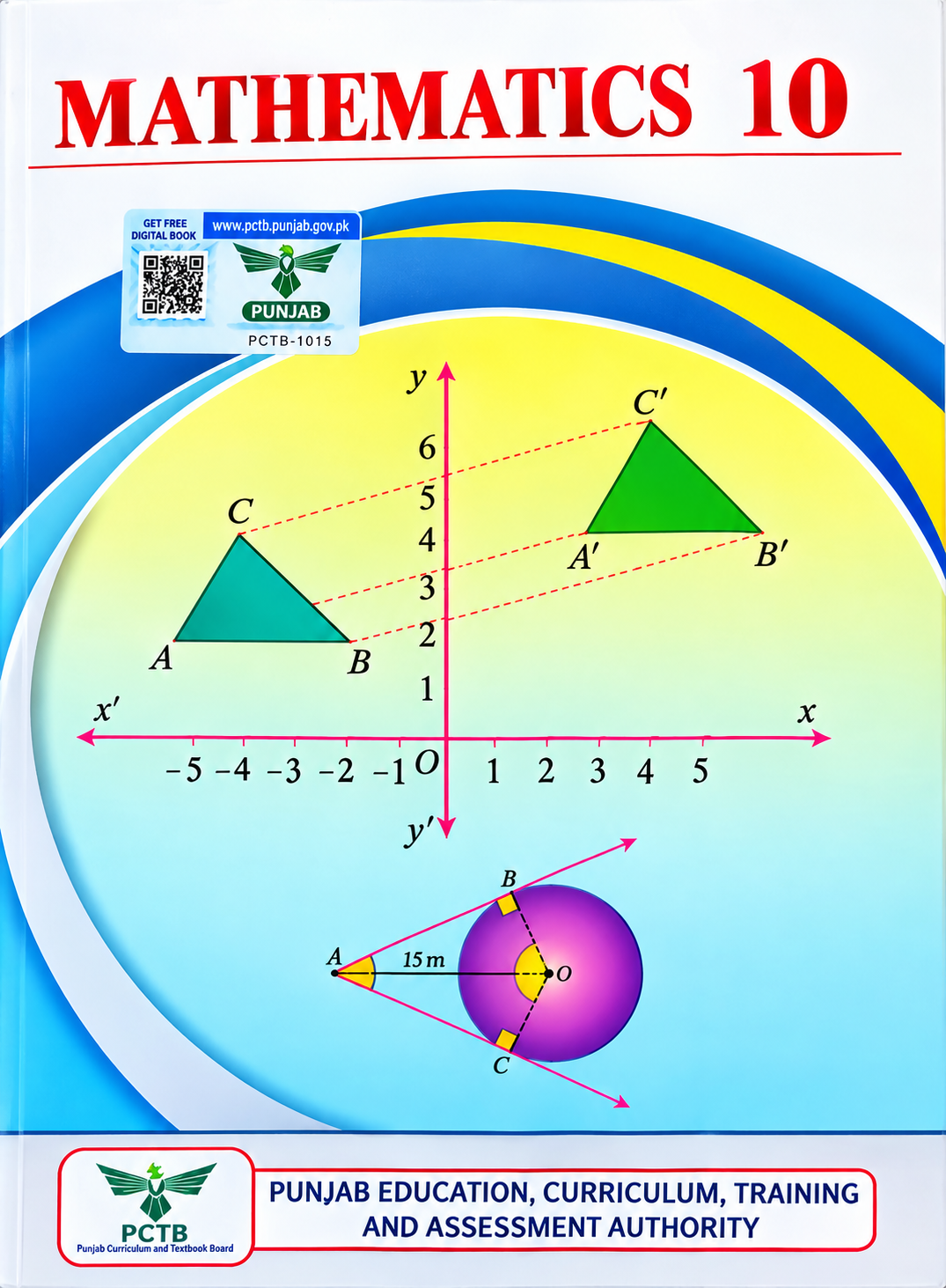
A translation vector moves every point of a figure the same distance in the same direction, without rotation or resizing. If a point P(x, y) is translated by vector ai + bj, its image is P'(x + a, y + b).
7. Applications
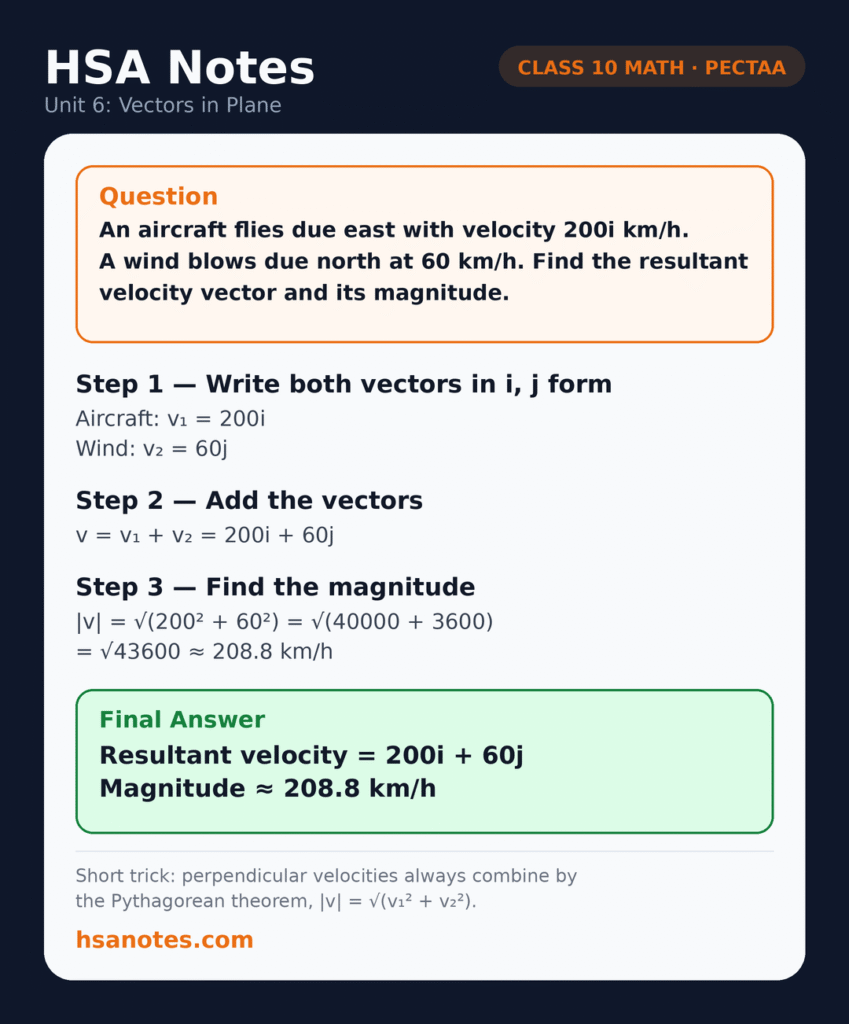
Vectors describe relative velocity, such as an aircraft’s speed affected by wind, and other real-life motion problems, including quantities from the equation v = u + at, which relates initial velocity, final velocity, acceleration, and time.
Worked Examples
Example 1 (Magnitude): Find the magnitude of a = 3i − 4j.
|a| = √(3² + (−4)²) = √25 = 5.
Example 2 (Unit vector): Find the unit vector in the direction of a = 6i − 8j.
|a| = √(36 + 64) = 10, so â = (3/5)i − (4/5)j.
Example 3 (Parallel vectors): Show that a = 5i − 2j and b = −10i + 4j are parallel.
b = −2(5i − 2j) = −2a, so b = −2a, which means a and b are parallel.
Example 4 (Addition): If a = 2i + 3j and b = i − 5j, find a + b and a − b.
a + b = 3i − 2j, and a − b = i + 8j.
Example 5 (Translation): Translate the point P(2, 1) by the vector 3i − 2j.
P’ = (2 + 3, 1 − 2) = (5, −1).
Important Formulas at a Glance
| Concept | Formula |
|---|---|
| Magnitude of xi + yj | √(x² + y²) |
| Unit vector | â = a ÷ |a| |
| Vector addition | (a₁ + b₁)i + (a₂ + b₂)j |
| Scalar multiplication | k(xi + yj) = kxi + kyj |
| Parallel vectors | b = ka for some scalar k |
| Translation of P(x, y) by ai + bj | P'(x + a, y + b) |
Exercises in Unit 6
| Exercise | Main Focus |
|---|---|
| 6.1 | Coordinate plane, magnitude, unit vectors, and parallel vectors |
| 6.2 | Addition, subtraction, and vectors in terms of two non-parallel vectors |
| 6.3 | Translation by a vector and applications |
| Review Exercise 6 | MCQs, short and long questions |
Exam Tips
- Always find the magnitude using √(x² + y²) and simplify the surd fully.
- To check if two vectors are parallel, see if one is a scalar multiple of the other.
- Draw a rough diagram for translation and parallelogram questions before calculating.
- In applied questions, write the given vectors in i, j form before combining them.
About HSA Notes
HSA Notes is a free educational platform for secondary and higher secondary students in Pakistan. It publishes solved notes, model papers, and study material aligned with the NBF, PECTAA, PCTAA, and FBISE curricula, covering Mathematics, Physics, Chemistry, Biology, Computer Science, and English. Our solutions are written by our own team, giving students clear, original, step-by-step help.
Online Classes
Students who want guided learning can join our online classes run by Hamdard Science Academy. The classes follow the new PECTAA book unit by unit, so Unit 6 concepts, examples, and exercises are taught in a clear order alongside these notes. To ask about the schedule, fees, or admission, email hsanotes48@gmail.com.
Conclusion
Vectors in Plane connects algebra and geometry in a very visual way. With clear diagrams and steady practice on magnitude, addition, and translation, this unit can become one of your more enjoyable units. Free solved exercises and PDF notes are available on HSA Notes for all Punjab boards, and online classes are there if you need extra support.