
Introduction
Unit 4 of the Class 12 Mathematics PECTAA New Book builds directly on the integration techniques learned in Unit 3. It introduces differential equations equations that involve derivatives of an unknown function and shows how they are constructed from real-world situations and solved using separation of variables and homogeneous-equation methods. The unit closes by applying these tools to population growth, radioactive decay, economics, and electric circuits.
🎓 Online Classes with Experienced Experts
What This Unit Covers
Unit 4 is organized into three graded exercises (4.1 to 4.3):
- Differential Equations: Definition, Order and Degree Students learn what a differential equation is, how to identify its order (the highest derivative present) and degree (the power of the highest-order derivative), and how first-order differential equations are constructed from practical situations such as population growth/decay, Newton’s law of cooling/heating, inflation/deflation in economics, and RC/RL electric circuits.
- Solution of First-Order and First-Degree Differential Equations This section covers writing a differential equation in the form dy/dx = f(x, y) or in differential form M(x, y)dx + N(x, y)dy = 0, understanding initial value problems (IVPs), and solving two major types: separable differential equations, where variables can be fully separated and integrated on each side, and homogeneous differential equations, which are converted into separable form using the substitution y = vx.
- Applications of First-Order Differential Equations in Real-Life Problems The unit ends with worked real-life models: population growth using dN/dt = kN, radioactive decay and half-life using dM/dt = −kM, inflation/deflation pricing, Newton’s law of cooling/heating for temperature problems, and solving RL circuit current equations using initial conditions.
Why This Unit Matters
Differential Equations is where integration, covered in Unit 3, becomes a tool for modeling change in the real world rather than just computing areas and volumes. The separation-of-variables technique from Exercise 4.2 is the single most tested skill in this unit and appears repeatedly in the applied problems of Exercise 4.3. Growth-and-decay problems (population, radioactive decay, half-life) and circuit problems (RC/RL) are common sources of long questions in board exams, since they combine equation construction, integration, and initial-condition substitution in a single question.
How to Study Unit 4
- Before attempting any applied problem, practise identifying whether a differential equation is separable or homogeneous — most students lose marks by trying the wrong method rather than making an integration mistake.
- For homogeneous equations, always confirm that every term in the numerator and denominator has the same degree before substituting y = vx; this check takes seconds and prevents wasted work.
- Memorize the standard first-order models (dN/dt = kN for growth/decay, dT/dt = −k(T − Ts) for cooling/heating) so you can set up real-life word problems quickly instead of re-deriving them from scratch.
- After finding the general solution, always apply the given initial condition immediately to solve for the constant — this is where most calculation errors occur in exam answers.
- For circuit problems, keep the RC model (RC dq/dt = CVs − q) and RL model (L dI/dt = Vs − RI) side by side, since students commonly mix up which equation applies to charge and which applies to current.
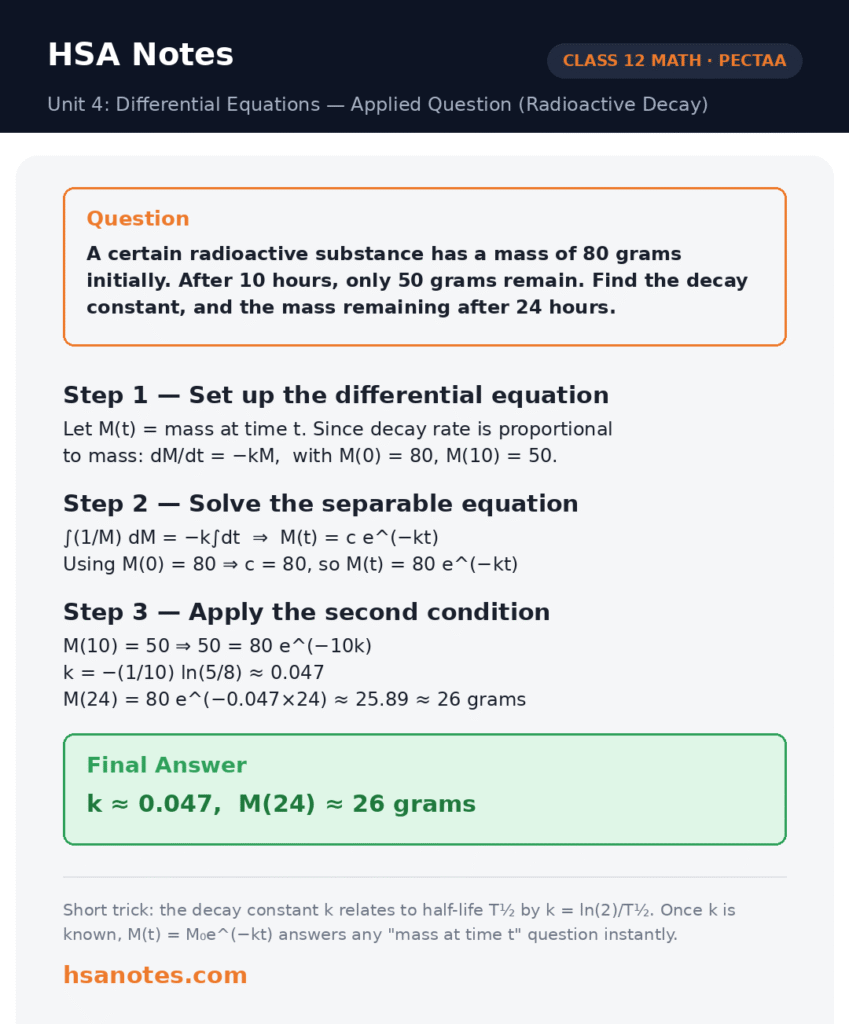
HSA Notes solved question card Class 12 Math PECTAA, Unit 4 Differential Equations, Applied problem: radioactive decay of a substance with initial mass 80 grams reduced to 50 grams after 10 hours, solved step by step to find the decay constant and remaining mass after 24 hours, final answer k ≈ 0.047, M(24) ≈ 26 grams
Practice Questions – Unit 4
Short Questions
- Write the order and degree of d²y/dx² + sin(dy/dx) = 0.
- Determine whether dy/dx = e^(x−y) is separable, homogeneous, or neither.
- Find the general solution of x dx + y dy = 0.
- Construct the differential equation for the discharging of a capacitor in an RC circuit.
- Write the differential equation representing radioactive decay of a substance N.
- Find the general solution of y dx + x dy = 0.
Long Questions
- Find the general solution of the differential equation dy/dx = (x + y)/(y − x).
- Solve the differential equation x sin(y/x) dy − [y sin(y/x) − x] dx = 0.
- Find the general solution of x²(2y + 1) dy/dx − 1 = 0.
- Solve the initial value problem dy/dx − x = xy²; y(0) = 1.
- An object of mass m is thrown vertically upward with air resistance proportional to its velocity. Construct the differential equation for velocity v, and deduce the equation when air resistance is negligible.
Applied Questions
- A culture starts with 1000 bacteria and reduces to 900 after five hours. Use a differential equation to find the number of bacteria 7 hours later.
- A radioactive isotope has a half-life of 12 hours and an initial mass of 160 grams. Find the decay constant, the mass remaining after 36 hours, and the time when only 10 grams remain.
- A can of soda at 4°C is placed in a room at 24°C. After 30 minutes, its temperature is 12°C. Find the temperature after 1 hour.
- An RL circuit has a battery of 12 volts, a resistor of 60 ohms, and an inductor of 2 henries. If the circuit is closed at t = 0 with zero initial current, find the current I(t) at any time t.
About HSA Notes
HSA Notes is an educational resource platform providing free study materials for Pakistani students, covering FBISE, Punjab, Sindh, and KP Boards in line with the New Books System. Materials span grades 9–12 across Mathematics, Chemistry, Biology, Physics, Computer Science, English, and Urdu, all prepared in a consistent, easy-to-follow branded format.
Besides free unit-wise notes and solved exercises, HSA Notes also offers online classes for students who want structured, teacher-guided sessions alongside self-study — useful for learners who need concepts explained step by step or want doubt-solving support beyond what a PDF can provide. For online classes, contact: hsanotes48@gmail.com
Conclusion
Unit 4 Differential Equations equips students with the essential skills to model and solve real-world rate-of-change problems: identifying order and degree, constructing first-order equations from practical situations, and solving them using separation of variables or the homogeneous-equation substitution. These techniques carry forward into further applied problems across the rest of Class 12 Mathematics, particularly wherever growth, decay, or circuit behaviour needs to be modeled mathematically. Practising the solved examples alongside the questions above, and joining HSA Notes’ online classes for extra guidance where needed, will help students build real confidence in this unit.

1 thought on “Unit 4: Class 12 Math PECTAA Notes New Book”