Introduction
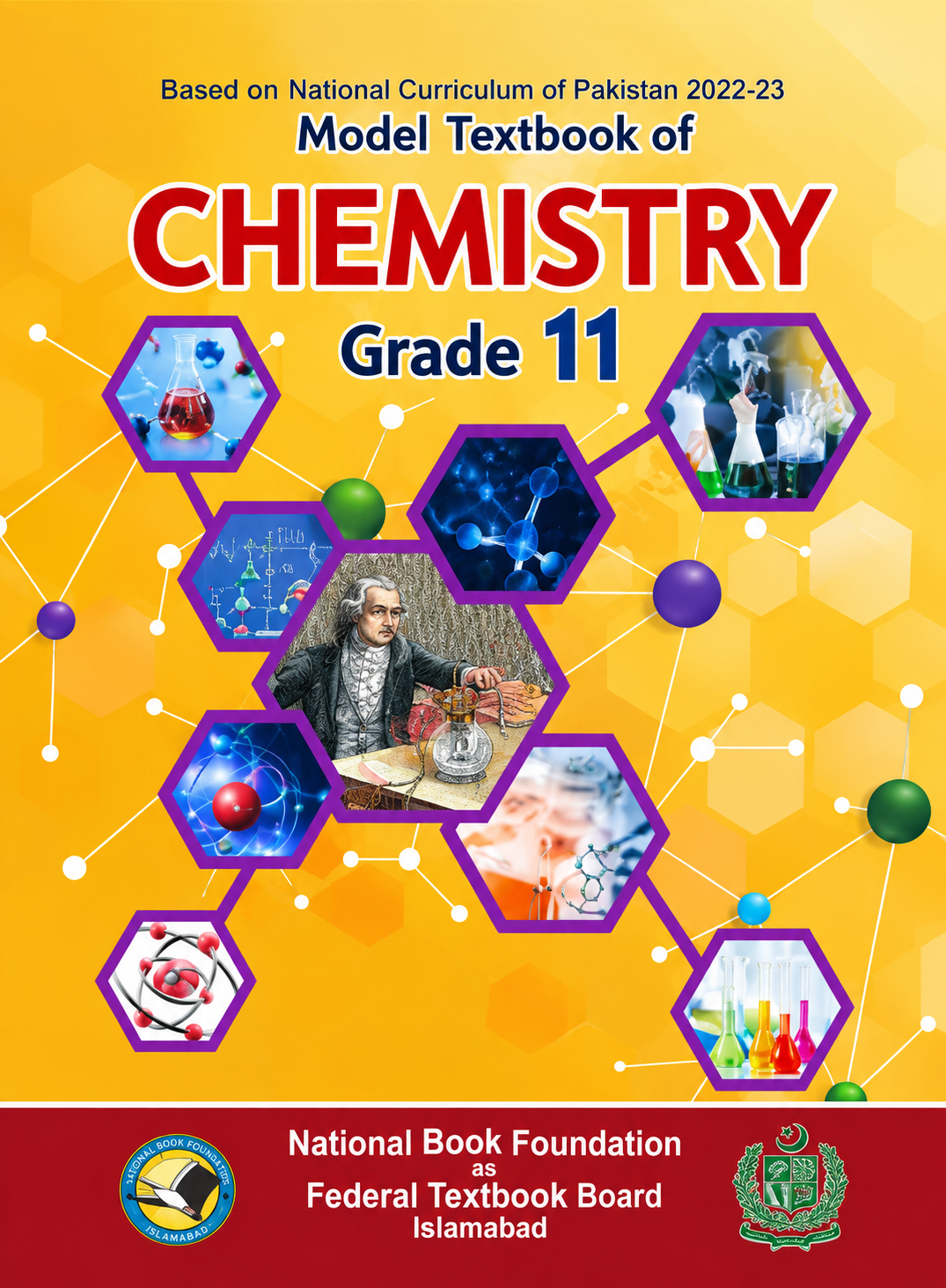
Class 11 Chemistry is one of the most important science subjects for students of FSc Pre-Medical and Pre-Engineering. The latest syllabus introduced by the National Book Foundation and followed by the Federal Board of Intermediate and Secondary Education focuses on conceptual learning, practical understanding, numerical problem solving, and modern chemistry applications.
| Unit | Chapter Name | Category | Notes Status |
|---|---|---|---|
| Unit 1 | Nature of Science in Chemistry | Physical Chemistry | Coming Soon |
| Unit 2 | Atomic Structure | Physical Chemistry | Coming Soon |
| Unit 3 | Chemical Bonding | Physical Chemistry | Coming Soon |
| Unit 4 | Stoichiometry | Physical Chemistry | Coming Soon |
| Unit 5 | States of Matter & Thermochemistry | Physical Chemistry | Coming Soon |
| Unit 6 | Chemical Kinetics | Physical Chemistry | Coming Soon |
| Unit 7 | Chemical Equilibrium | Physical Chemistry | Coming Soon |
| Unit 8 | Acids, Bases and Salts | Inorganic Chemistry | Coming Soon |
| Unit 9 | Periodic Table | Inorganic Chemistry | Coming Soon |
| Unit 10 | Group VIIA (Halogens) | Inorganic Chemistry | Coming Soon |
| Unit 11 | Environmental Chemistry | Inorganic Chemistry | Coming Soon |
| Unit 12 | Water | Inorganic Chemistry | Coming Soon |
| Unit 13 | Nitrogen and Sulphur | Inorganic Chemistry | Coming Soon |
| Unit 14 | Organic Chemistry (Introduction) | Organic Chemistry | Coming Soon |
| Unit 15 | Hydrocarbons | Organic Chemistry | Coming Soon |
| Unit 16 | Halogenoalkanes | Organic Chemistry | Coming Soon |
| Unit 17 | Alcohols | Organic Chemistry | Coming Soon |
| Unit 18 | Aldehydes and Ketones | Organic Chemistry | Coming Soon |
| Unit 19 | Carboxylic Acids | Organic Chemistry | Coming Soon |
| Unit 20 | Amines | Organic Chemistry | Coming Soon |
| Unit 21 | Organic Synthesis | Organic Chemistry | Coming Soon |
| Unit 22 | Petrochemicals and Energy Sources | Applied Chemistry | Coming Soon |
The new Chemistry textbook includes Physical Chemistry, Inorganic Chemistry, Organic Chemistry, and Applied Chemistry. These notes are specially prepared for board exams, conceptual understanding, MCQs preparation, and entry test preparation including MDCAT and ECAT.
Total Units in Class 22 Chemistry FBISE NBF NEW BOOK
The Class 11 Chemistry textbook contains 22 complete units divided into different chemistry categories.
Division of Units
- Physical Chemistry: 7 Units
- Inorganic Chemistry: 6 Units
- Organic Chemistry: 8 Units
- Applied Chemistry: 1 Unit
These units help students understand atomic structure, reactions, organic compounds, equilibrium, environmental chemistry, and industrial chemistry.
Unit 1: Nature of Science in Chemistry
This introductory chapter explains the scientific method and development of chemistry over time.
Important Topics
- Al-Ghazali’s Burning Cotton Experiment
- Democritus Atomic Theory
- Schrodinger’s Cat Experiment
- Maxwell Thought Experiment
- Inductive and Deductive Reasoning
This unit builds scientific thinking and analytical skills.
Unit 2: Atomic Structure
This chapter explains the internal structure of atoms and behavior of electrons.
Important Topics
- Bohr’s Atomic Model
- Quantum Numbers
- Electronic Configuration
- Ionization Energy
- Mass Spectrometry
- Semiconductors
This unit is extremely important for conceptual and numerical questions.
Unit 3: Chemical Bonding
Chemical bonding explains how atoms combine to form compounds.
Important Topics
- Electronegativity
- Bond Energy and Bond Length
- VSEPR Theory
- Hybridization (sp, sp², sp³)
- Sigma and Pi Bonds
- Intermolecular Forces
- Molecular Orbital Theory
Students learn shapes of molecules and bonding theories.
Unit 4: Stoichiometry
Stoichiometry deals with quantitative calculations in chemistry.
Important Topics
- Mole Concept
- Avogadro’s Number
- Limiting Reactant
- Percentage Yield
- Empirical Formula
- Molecular Formula
This chapter contains important numerical problems frequently asked in exams.
Unit 5: States of Matter & Thermochemistry
This chapter explains properties of liquids and energy changes in reactions.
Important Topics
- Vapour Pressure
- Surface Tension
- Hydrogen Bonding
- Exothermic and Endothermic Reactions
- Hess’s Law
- Gibbs Free Energy
Thermochemistry is highly important for conceptual understanding.
Unit 6: Chemical Kinetics
This unit studies reaction rates and factors affecting them.
Important Topics
- Rate of Reaction
- Rate Constant
- Activation Energy
- Arrhenius Equation
- Reaction Mechanism
Numerical problems and graphs are important in this chapter.
Unit 7: Chemical Equilibrium
Chemical equilibrium explains reversible reactions and equilibrium conditions.
Important Topics
- Law of Mass Action
- Equilibrium Constant
- Le Chatelier’s Principle
- Haber Process
- Contact Process
This unit is important for both board and entry test preparation.
Unit 8: Acids, Bases and Salts
This chapter explains acid-base theories and pH calculations.
Important Topics
- Lewis Acids and Bases
- pH and pOH
- Buffer Solutions
- Salt Hydrolysis
- Solubility Product (Ksp)
- Titration and Indicators
Students must practice formulas and numerical questions carefully.
Unit 9: Periodic Table
This unit explains periodic trends and classification of elements.
Important Topics
- Periods and Groups
- Atomic Radius
- Electronegativity
- Ionization Energy
- Metals and Non-metals
This chapter develops understanding of chemical properties.
Unit 10: Group VIIA (Halogens)
This chapter studies fluorine, chlorine, bromine, and iodine.
Important Topics
- Oxidizing Power
- Reactivity of Halogens
- Halogen Acids
- Silver Nitrate Test
- Disproportionation Reactions
Important reactions are frequently asked in exams.
Unit 11: Environmental Chemistry
This unit focuses on air pollution and environmental issues.
Important Topics
- Photochemical Smog
- Acid Rain
- Global Warming
- Ozone Layer Depletion
- Catalytic Converters
- International Environmental Protocols
This chapter increases environmental awareness.
Unit 12: Water
This chapter explains water purification and environmental importance of water.
Important Topics
- Water Distribution
- Wastewater Treatment
- Eutrophication
- Water Conservation
Important conceptual questions are included in this unit.
Unit 13: Nitrogen and Sulphur
This chapter explains industrial and environmental chemistry related to nitrogen and sulphur.
Important Topics
- Haber Process
- Oxides of Nitrogen
- Contact Process
- Sulphur Compounds
Industrial preparation methods are important.
Unit 14: Organic Chemistry (Introduction)
This chapter introduces organic compounds and nomenclature.
Important Topics
- Functional Groups
- IUPAC Nomenclature
- Structural Isomerism
- Homologous Series
This is the foundation chapter for organic chemistry.
Unit 15: Hydrocarbons
This chapter explains alkanes, alkenes, and alkynes.
Important Topics
- Markovnikov’s Rule
- Polymerization
- Ozonolysis
- Geometrical Isomerism
Reaction mechanisms are important for exams.
Unit 16: Halogenoalkanes
This unit explains alkyl halides and substitution reactions.
Important Topics
- SN1 and SN2 Reactions
- Elimination Reactions
- Grignard Reagents
Students must understand reaction pathways carefully.
Unit 17: Alcohols
This chapter studies preparation and reactions of alcohols.
Important Topics
- Lucas Test
- Oxidation Reactions
- Esterification
- Iodoform Test
Organic reaction mechanisms are important here.
Unit 18: Aldehydes and Ketones
This chapter explains carbonyl compounds and their reactions.
Important Topics
- Tollen’s Test
- Fehling’s Test
- Reduction Reactions
- Nucleophilic Addition
This unit is highly important for practical chemistry.
Unit 19: Carboxylic Acids
This chapter explains acidic organic compounds.
Important Topics
- Carboxyl Group
- Esterification
- Reduction
- Acidic Reactions
Reaction equations are important for preparation.
Unit 20: Amines
This chapter explains nitrogen-containing organic compounds.
Important Topics
- Diazotization
- Hinsberg Test
- Azo Dyes
- Carbylamine Reaction
Students should focus on reaction mechanisms.
Unit 21: Organic Synthesis
This chapter explains conversion of compounds through reaction sequences.
Important Topics
- Functional Group Interconversions
- Retrosynthetic Analysis
- Cyanohydrin Synthesis
- Chain Length Increase
This chapter is conceptually advanced and important for entry tests.
Unit 22: Petrochemicals and Energy Sources
This applied chemistry chapter explains petroleum and energy resources.
Important Topics
- Fractional Distillation
- Catalytic Cracking
- Nuclear Energy
- Solar Energy
- Renewable and Non-renewable Sources
This unit connects chemistry with modern industrial applications.
Importance of Chemistry Subject
Chemistry is known as the “central science” because it connects biology, physics, medicine, and engineering. It helps students understand matter, reactions, energy changes, and molecular structures.
Benefits of Studying Chemistry
- Develops analytical thinking
- Improves problem-solving skills
- Helps in MDCAT and ECAT preparation
- Builds concepts for medical and engineering fields
- Supports laboratory and research knowledge
Chemistry Notes and Preparation Material
HSA Notes provides complete Chemistry preparation material including:
- Complete solved notes
- MCQs with explanations
- Short questions
- Long questions
- Numerical problems
- Practical viva questions
- Sample papers
- Guess papers
- PDF notes for revision
All content is prepared according to FBISE board pattern.
MDCAT & Entry Test Preparation
Chemistry is one of the highest-scoring subjects in MDCAT and other entry tests. The MDCAT examination for Pre-Medical students is expected on 16 August (Sunday). Students should prepare conceptual MCQs, organic chemistry reactions, equilibrium, and numericals regularly.
HSA Notes also provides:
- MDCAT Chemistry MCQs
- Chapter-wise tests
- Entry test practice material
- Concept revision notes
Contact HSA Notes
For Chemistry notes, sample papers, guess papers, and PDF study material:
Email: hsanotes48@gmail.com
Conclusion
Class 11 Chemistry notes 2026 provide complete preparation according to the updated FBISE and NBF syllabus. With proper understanding of all 22 units, regular numerical practice, and conceptual revision, students can achieve excellent marks in board exams and entry tests.