Introduction
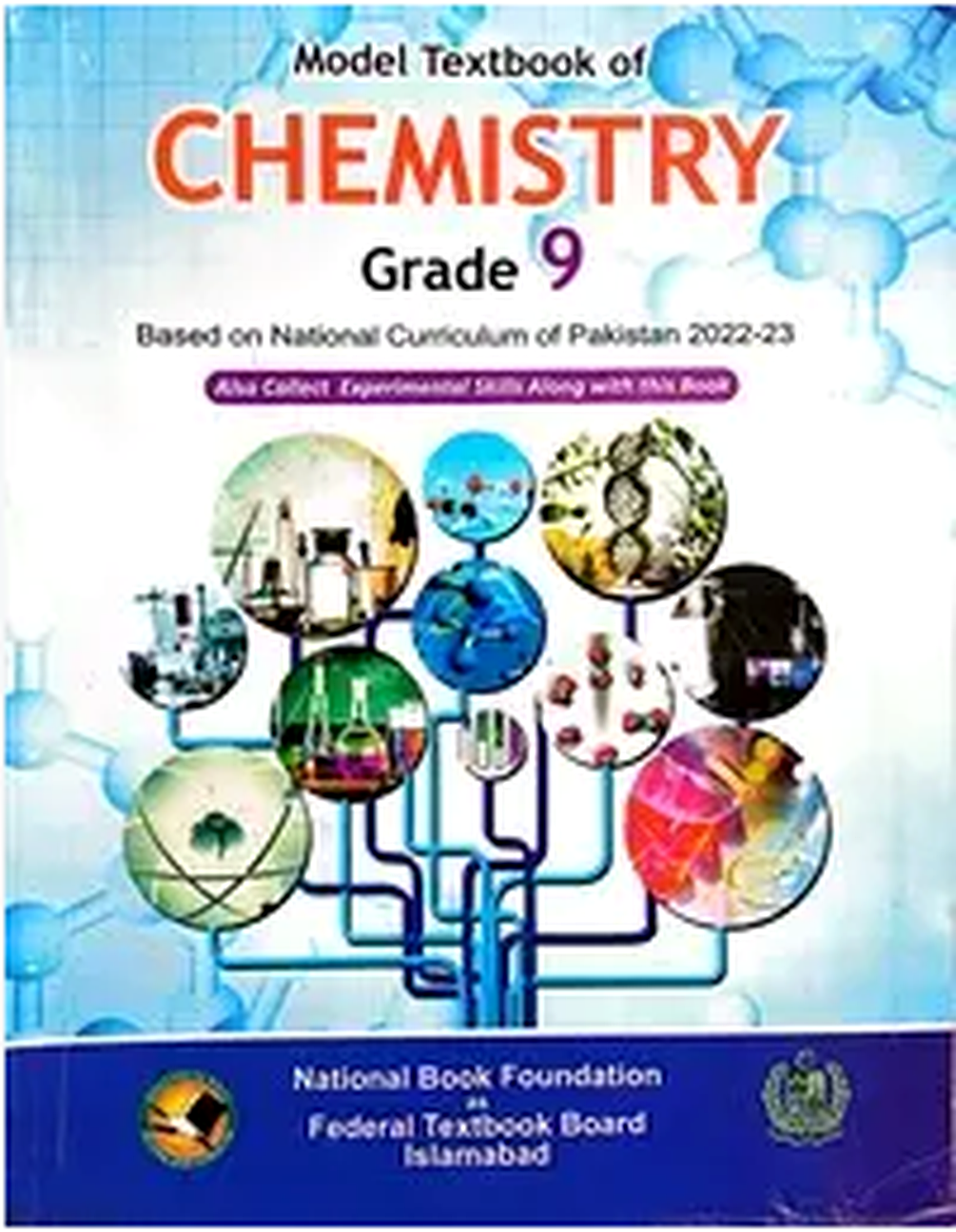
Class 9 Chemistry notes based on the NBF New Book for the 2026 to 2027 session are designed for FBISE students, covering complete solved content to help achieve high marks in board exams. These notes provide complete coverage of the latest syllabus issued by NBF, PECTAA, and PCTBB, including solved exercises, conceptual explanations, and exam focused preparation content.
Full Chapter List
| No. | Chapter | Status |
|---|---|---|
| 1 | Nature of Science in Chemistry | Coming Soon |
| 2 | Matter | Coming Soon |
| 3 | Atomic Structure | Coming Soon |
| 4 | Periodic Table and Periodicity of Properties | Coming Soon |
| 5 | Chemical Bonding | Coming Soon |
| 6 | Stoichiometry | Coming Soon |
| 7 | Electrochemistry | Coming Soon |
| 8 | Energetics | Coming Soon |
| 9 | Chemical Equilibrium | Coming Soon |
| 10 | Acids, Bases, and Salts | Coming Soon |
| 11 | Environmental Chemistry, Air | Coming Soon |
| 12 | Environmental Chemistry, Water | Coming Soon |
| 13 | Organic Chemistry | Coming Soon |
| 14 | Hydrocarbons | Coming Soon |
| 15 | Biochemistry | Coming Soon |
| 16 | Empirical Data Collection and Analysis | Coming Soon |
| 17 | Separation Techniques | Coming Soon |
| 18 | Qualitative Analysis | Coming Soon |
| 19 | Chromatography | Coming Soon |
Official Youtube Channel: www.youtube.com/@FBISEOfficial
Simple Definition
- Nature of Science in Chemistry
Chemistry is a branch of science that studies matter, its properties, composition, and changes.
It uses observation, experimentation, measurement, and evidence to understand chemical phenomena. - Matter
Matter is anything that has mass and occupies space.
It exists mainly as solids, liquids, and gases, with different physical and chemical properties. - Atomic Structure
Atomic structure describes the arrangement of protons, neutrons, and electrons within an atom.
The number and arrangement of these particles determine the identity and properties of an element. - Periodic Table and Periodicity of Properties
The periodic table arranges elements according to their atomic numbers and electronic configurations.
Periodicity refers to the repeating patterns in the physical and chemical properties of elements. - Chemical Bonding
Chemical bonding is the force that holds atoms or ions together in a chemical substance.
Atoms form bonds by gaining, losing, or sharing electrons to achieve greater stability. - Stoichiometry
Stoichiometry is the quantitative study of the amounts of reactants and products in chemical reactions.
It uses balanced chemical equations to calculate masses, moles, and quantities of substances. - Electrochemistry
Electrochemistry is the study of chemical reactions involving the transfer of electrons.
It explains how chemical energy can produce electrical energy and how electricity can cause chemical changes. - Energetics
Energetics is the study of energy changes that occur during physical and chemical processes.
It helps explain whether reactions release or absorb energy. - Chemical Equilibrium
Chemical equilibrium is a state in a reversible reaction where the forward and reverse reactions occur at equal rates.
At equilibrium, the concentrations of reactants and products remain constant. - Acids, Bases, and Salts
Acids, bases, and salts are important classes of chemical substances with different properties and reactions.
Acids donate hydrogen ions, bases accept hydrogen ions, and salts are commonly formed through acid-base reactions. - Environmental Chemistry, Air
Environmental chemistry studies the chemical processes occurring in the environment and their effects.
The chemistry of air includes atmospheric gases, pollutants, and chemical reactions that affect air quality. - Environmental Chemistry, Water
Environmental chemistry of water deals with the composition, properties, and chemical changes of water.
It also studies water pollution, contaminants, and methods used to maintain water quality. - Organic Chemistry
Organic chemistry is the branch of chemistry that studies carbon-containing compounds.
It includes their structures, properties, reactions, and applications in everyday life. - Hydrocarbons
Hydrocarbons are organic compounds made up of only carbon and hydrogen atoms.
They include alkanes, alkenes, alkynes, and aromatic hydrocarbons. - Biochemistry
Biochemistry is the study of the chemical substances and reactions that occur in living organisms.
It includes important biomolecules such as carbohydrates, proteins, lipids, and nucleic acids. - Empirical Data Collection and Analysis
Empirical data is information obtained through direct observation, measurement, or experimentation.
Data analysis involves organizing, interpreting, and evaluating results to draw reliable conclusions. - Separation Techniques
Separation techniques are methods used to separate the components of a mixture based on their different properties.
Common methods include filtration, distillation, evaporation, crystallization, and decantation. - Qualitative Analysis
Qualitative analysis is used to identify the substances or ions present in a sample.
It is based on characteristic observations such as colour changes, precipitates, gases, or other chemical reactions. - Chromatography
Chromatography is a separation technique used to separate and identify components of a mixture.
It works because different substances move at different rates through a stationary phase with a mobile phase.
What You Will Get
- Complete solved MCQs with clear explanations.
- Short questions and long questions covering every chapter.
- Step by step numericals worked through in full.
- Concept based explanations rather than simple definitions.
- Diagrams and tables included wherever a chapter requires them.
- Content fully updated according to the 2025 to 2026 syllabus.
How the Syllabus Is Organized
The nineteen chapters move from the foundational nature of Chemistry as a science, through matter, atomic structure, and the periodic table, into chemical bonding and stoichiometry.
Why These Notes Are Useful
These notes are prepared according to the latest examination pattern of the Punjab Boards and FBISE, with a focus on important questions drawn from past papers, clear concept explanations, easy to follow language, and exam oriented preparation throughout.
Why a Full Chapter Breakdown Helps
With nineteen chapters spanning theory, calculation heavy topics, and practical laboratory skills, Class 9 Chemistry can feel like an unusually large syllabus to plan around.
Preparation Tips for Class 9 Chemistry
- Treat the early chapters on matter, atomic structure, and the periodic table as the foundation for everything that follows, since chemical bonding and stoichiometry both build directly on these concepts.
- Practice stoichiometry and electrochemistry numericals regularly, since these topics reward consistent calculation practice far more than last minute revision.
- Pay close attention to diagrams and setups in the practical chapters, including separation techniques, qualitative analysis, and chromatography, since these are often tested through labelled diagrams and short procedural questions.
Online Classes
For full preparation and guidance, contact HSA Notes for online classes covering the complete Class 9 Chemistry syllabus.
Contact: hsanotes48@gmail.com
Frequently Asked Questions
How many chapters are in the Class 9 Chemistry NBF syllabus? There are nineteen chapters in total, starting with Nature of Science in Chemistry and ending with Chromatography.
Are these notes based on the current FBISE and Punjab Boards syllabus? Yes, these notes are prepared according to the latest examination pattern of both the Punjab Boards and FBISE for the 2025 to 2026 session.
Do the notes include numerical practice? Yes, step by step numericals are included for every chapter that requires calculation, such as Stoichiometry and Electrochemistry.
Are the notes free to access? Yes, HSA Notes provides these Chemistry notes for free, with chapters being added progressively.
Conclusion
With all nineteen chapters of the Class 9 Chemistry NBF syllabus mapped out, from the nature of science through to chromatography, students have a complete roadmap for their board exam preparation. Notes for each chapter are being added progressively, so check back regularly as more units become available.
Best of luck for your Class 9 Chemistry exam!