
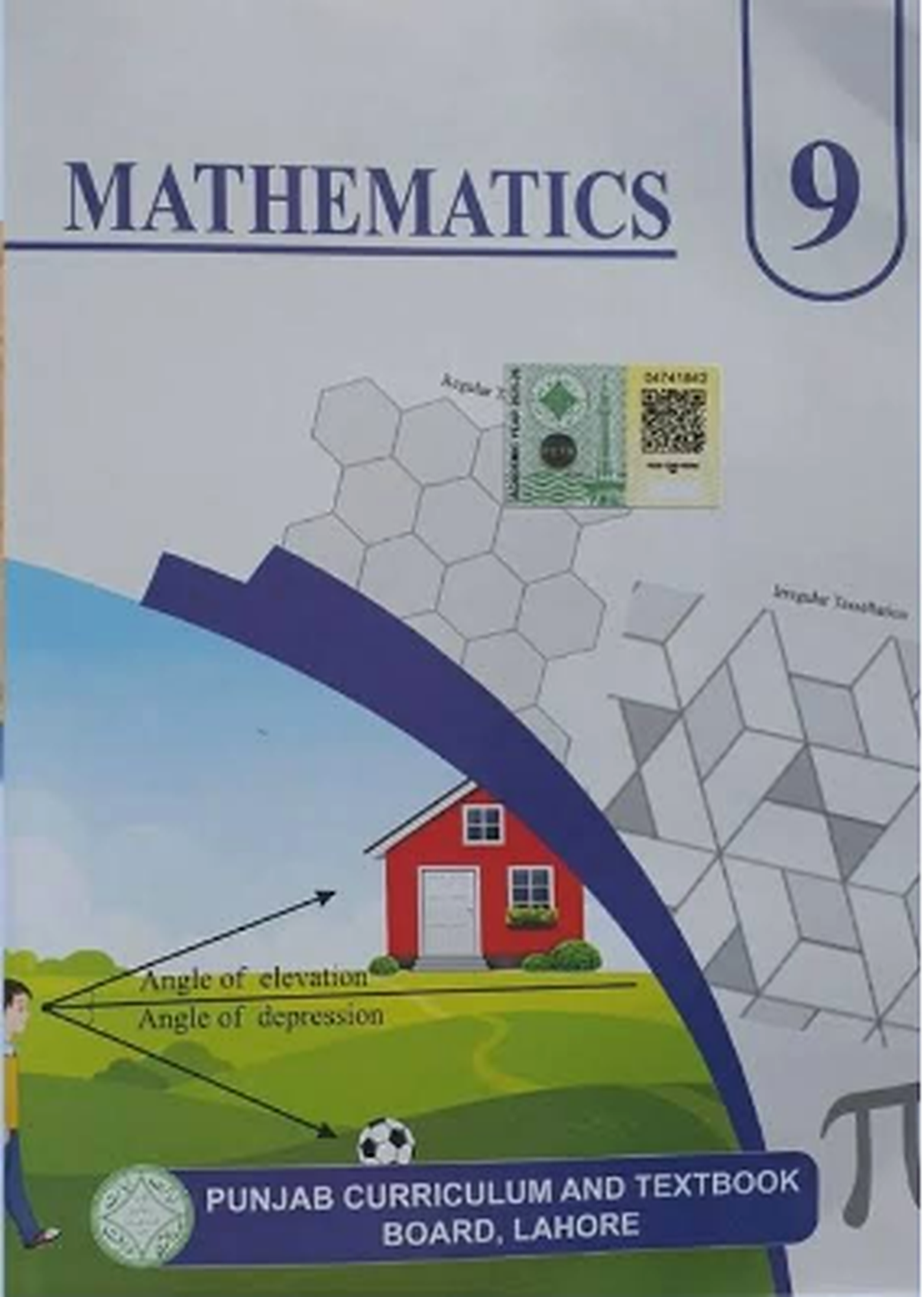
Introduction
hsanotes.com provides 100 percent free Class 9 Mathematics notes for the Punjab Board 2025 to 2026 session, fully aligned with the Punjab Curriculum and Textbook Board, PCTB, PCTBB Lahore, and PECTAA guidance, covering the new courses and new books for this session. Our notes are designed to attract students, teachers, and academies because they help learners consistently achieve 90 percent plus marks in board examinations.
Class 9 Mathematics – Units / Chapters (Punjab Board (New Course/ New Book)
Unit 1: Real Numbers
Unit 2: Logarithms
Unit 3: Set and Functions
Unit 4: Factorization and Algebraic Manipulation
Unit 5: Linear Equations and Inequalities
Unit 6: Trigonometry
Unit 7: Coordinate Geometry
Unit 8: Logic
Unit 9: Similar Figures
Unit 10: Graphs of Functions
Unit 11: Loci and Construction
Unit 12: Information Handling
Unit 13: Probability
Why Students, Teachers, and Academies Choose hsanotes.com
- 100 percent free, no fees, no hidden charges.
- Aligned with PCTB, PCTBB, and PECTAA.
- Covers new courses and new books for the 2025 to 2026 session.
- SLO based, exam oriented content.
- Helps students achieve 90 percent plus marks.
- Trusted by teachers and academies for classroom and tuition use.
Unit Wise Notes
Unit 1: Real Numbers
This unit introduces the real number system, including rational and irrational numbers, integers, and their properties. Students learn how to compare, represent, and perform different operations with real numbers.
It also develops an understanding of number properties and helps students apply real numbers to mathematical problems.
Unit 2: Logarithms
This unit introduces logarithms and their relationship with exponents and powers. Students learn the basic laws of logarithms and how to simplify and solve logarithmic expressions.
The unit also provides useful techniques for working with large numbers and solving problems involving exponential relationships.
Unit 3: Sets and Functions
This unit explains the concept of sets, their representation, types, and operations such as union and intersection. It also introduces functions and explains how elements of one set can be related to another.
Students learn to represent relationships systematically and use sets and functions to solve different mathematical problems.
Unit 4: Factorization and Algebraic Manipulation
This unit focuses on algebraic expressions, factorization, algebraic identities, and techniques for simplifying expressions. Students learn how to take common factors, use formulas, and break expressions into simpler factors.
These skills help students simplify complicated expressions and prepare them for solving equations and higher-level algebra problems.
Unit 5: Linear Equations and Inequalities
This unit covers linear equations and inequalities involving one or more variables. Students learn different methods for solving equations and representing inequality solutions on a number line.
It also helps students apply algebraic methods to practical problems involving unknown quantities and ranges of values.
Unit 6: Trigonometry
This unit introduces the basic concepts of trigonometry and the relationships between the sides and angles of right-angled triangles. Students learn about trigonometric ratios and their applications in solving problems.
Trigonometry helps students determine unknown sides or angles and provides a foundation for more advanced mathematical concepts.
Unit 7: Coordinate Geometry
This unit introduces the Cartesian coordinate system and explains how points and relationships can be represented using coordinates. Students learn about coordinates, distance, and geometric relationships on the coordinate plane.
It connects algebra with geometry and helps students understand geometric figures through numerical and graphical representations.
Unit 8: Logic
This unit introduces mathematical reasoning and logical thinking. Students learn how to understand statements, identify relationships between ideas, and determine whether conclusions are logically valid.
It develops problem-solving and critical-thinking skills that are useful in mathematics and everyday decision-making.
Unit 9: Similar Figures
This unit explains similar figures and the relationships between their corresponding sides and angles. Students learn the conditions for similarity and how proportional relationships can be used to solve geometric problems.
The concepts are useful for finding unknown lengths, comparing shapes, and understanding scale in geometric figures.
Unit 10: Graphs of Functions
This unit focuses on representing functions graphically and understanding the relationship between input and output values. Students learn how to plot points, interpret graphs, and identify patterns in functions.
Graphs make mathematical relationships easier to visualize and help students analyze how one quantity changes with another.
Unit 11: Loci and Construction
This unit introduces loci and geometric constructions using mathematical tools and accurate procedures. Students learn how to construct lines, angles, perpendiculars, and other geometric figures.
It also explains how a locus represents all points that satisfy a particular geometric condition.
Unit 12: Information Handling
This unit covers the collection, organization, presentation, and interpretation of data. Students learn about tables, graphs, averages, and other methods used to make information easier to understand.
It helps students analyze data and draw meaningful conclusions from information presented in different forms.
Unit 13: Probability
This unit introduces probability as a way of measuring the likelihood of an event occurring. Students learn about outcomes, sample spaces, events, and basic probability calculations.
The concepts help students make predictions and understand uncertainty in mathematical and real-life situations.
About the Class 9 Mathematics Syllabus, Punjab Board New Book 2025-2026
The Class 9 Mathematics course under the new Punjab Board syllabus is structured around thirteen units that build on one another in a deliberate sequence, moving from foundational number systems through algebra, geometry, coordinate methods, logical reasoning, and finally into statistics and probability.
This structure reflects the direction the Punjab Curriculum and Textbook Board has taken with the new books introduced for the 2025 to 2026 session, where the emphasis has shifted toward Student Learning Outcomes, commonly referred to as SLOs, rather than rote memorization of long derivations.
Every note published on hsanotes.com for this course has been prepared with that SLO structure in mind, so that each concept a student revises maps directly onto what the board actually expects to see in an exam answer.
trigonometry introduces ratio based reasoning that is unfamiliar to most ninth graders at first, and coordinate geometry asks students to connect algebraic equations with visual graphs, a skill that only comes with repeated practice plotting and interpreting lines.
Our notes for these units focus heavily on worked examples with the exact steps examiners look for, since partial credit in Punjab Board mathematics papers is frequently awarded or withheld based on whether the correct method was shown, not just whether the final answer was correct.
Logic, introduced as its own unit in the new book, asks students to reason about statements, truth tables, and valid arguments in a way that is closer to formal logic than traditional arithmetic.
This can catch students off guard if their preparation has focused only on calculation heavy units, which is why we treat Logic with the same exercise by exercise thoroughness as the numerical chapters.
Similar Figures, covering congruent and similar triangles, and Graphs of Functions then return to more familiar geometric and graphical territory, reinforcing the coordinate geometry skills introduced earlier in the course.
All notes are available as free downloadable PDFs, updated to match the current 2026 to 2027 session syllabus, with new units added as they are completed.
Join Online Classes
Join online classes to aim for 90 plus marks across all thirteen units of the Class 9 Mathematics syllabus, Punjab Board new course, new book 2025-2026 session.
Contact: hsanotes48@gmail.com
Conclusion
With all thirteen units of the Class 9 Mathematics syllabus covered under the new Punjab Board book for the 2025 to 2026 session, hsanotes.com gives students, teachers, and academies a single, reliable resource for exam preparation from Real Numbers through Probability. Every note is built around the SLO structure the board actually tests, so revision time goes toward what earns marks rather than what a generic syllabus might cover. Use these notes alongside regular practice to build both speed and accuracy ahead of your Class 9 Mathematics exam.
Best of luck for your Class 9 Mathematics exam!