
Introduction
Unit 2 of the new NBF Functional Mathematics Grade 9 FBISE textbook covers Zakat, Ushr, and Inheritance, three concepts rooted in Islamic teachings that also have precise mathematical rules.
🎓 Online Classes with Experienced Experts
Zakat and Ushr ensure fair distribution of wealth and support for the poor and needy, while the Islamic law of inheritance ensures that a deceased person’s property is divided fairly among the legal heirs. This unit asks students to apply percentages, fractions, and ratios to real situations involving savings, gold, agricultural produce, and family property. These notes follow the new NBF book for session 2026-27.
What You Will Learn
By the end of this unit, students will be able to:
- calculate Zakat on gold, silver, cash, and other assets using the Nisab and the correct rate;
- calculate Zakat mentally using the 1/40 shortcut;
- calculate Ushr on agricultural produce at the correct rate, depending on the source of irrigation;
- identify the fixed shares of legal heirs under the Islamic law of inheritance;
- divide a deceased person’s property among heirs after settling debts and expenses.
Key Topics Explained
1. Zakat and Nisab
Zakat means purification and growth: it is the portion of wealth given to the needy for the pleasure of Allah, and it purifies the soul while increasing one’s wealth. Zakat is due only once a person’s assets reach the Nisab, the minimum threshold, for one full lunar year.
The Nisab for gold is 7 tola (87.48 grams), and for silver it is 52½ tola (612.36 grams), whichever is less when comparing the value of all assets. The Nisab for cash is the same as for gold or silver, whichever gives the lower amount. The standard rate of Zakat is 2½%, which is the same as 1/40 of total qualifying assets. Items for daily personal use, and agricultural produce fed to wild-grass animals, are excluded from Zakat.
2. Mental Calculation of Zakat
Since 2½% equals 1/40, Zakat on any asset can be found quickly by dividing its value or weight by 40. This shortcut avoids long percentage calculations and is useful for checking answers quickly.
3. Ushr
Ushr is a form of Zakat paid on agricultural produce such as grains, fruits, and vegetables, and it is paid at the time of harvest. Ushr means “one-tenth.” The rate is 10% if the land is irrigated naturally (by rain or natural springs), and 5% if the land is irrigated artificially (such as by wells or canals requiring effort or cost). Mentally, 10% is 1/10 of the produce, and 5% is 1/20 of the produce.
4. Inheritance
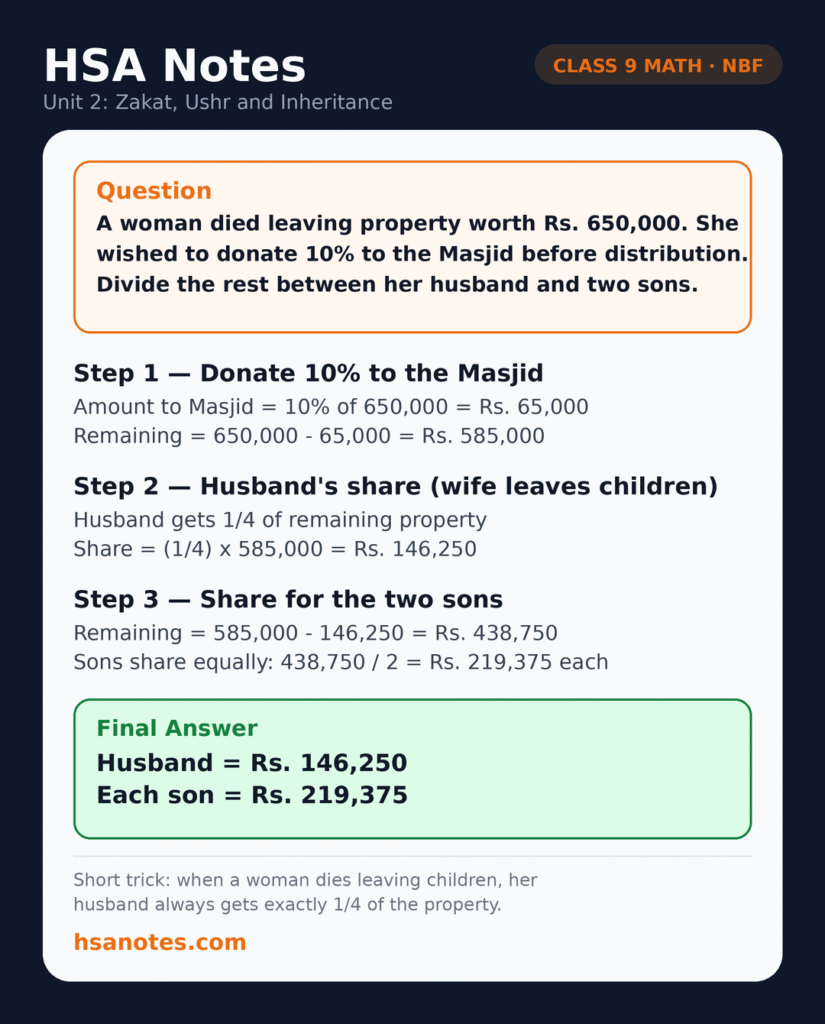
Inheritance in Islam follows a fixed system described in the Quran and Sunnah. After a person’s death, their funeral expenses, debts, and any valid testament are settled first; the remaining property is then distributed among the legal heirs.
There are 12 legal heirs with fixed shares: 4 males (father, true grandfather, uterine brother, husband) and 8 females (wife, daughter, son’s daughter, mother, true grandmother, full sister, paternal half-sister, maternal half-sister).
5. Important Shares
Some of the key fixed shares used in this unit are: the father and mother each receive 1/6 of the property when the deceased leaves children; the widow receives 1/8 when the deceased leaves children, and 1/4 if there are no children; the husband receives 1/4 of his wife’s property if she leaves children, and 1/2 if she leaves none.
Sons and daughters share the remaining property in the ratio 2:1 (a son gets twice the share of a daughter). If a deceased man leaves only one daughter and no sons, she receives 1/2 of the property; if he leaves two or more daughters, they share 2/3 of the property between them.
Worked Examples
Example 1 (Zakat, direct): Mahnaz has 100 grams of gold and 800 grams of silver. Find the Zakat on each using the 1/40 rule.
Zakat on gold = 100 ÷ 40 = 2.5 grams. Zakat on silver = 800 ÷ 40 = 20 grams.
Example 2 (Zakat, reverse): Urooba paid Zakat of Rs. 4,625 on her gold ornaments and savings of Rs. 80,000 combined. Find the value of the ornaments.
Let the total value be x. Since 2½% of x = 4,625, x = 4,625 × 40 = Rs. 185,000.
Value of ornaments = 185,000 − 80,000 = Rs. 105,000.
Example 3 (Ushr): A farmer’s land, irrigated naturally, produces 780 kg of wheat. Find the Ushr due.
Ushr = 10% of 780 kg = (10/100) × 780 = 78 kg.
Example 4 (Inheritance): A person died leaving property worth Rs. 980,000, after paying a debt of Rs. 44,000 and funeral expenses of Rs. 36,000. Divide the remaining amount among his mother, widow, two sons, and two daughters.
Remaining property = 980,000 − 44,000 − 36,000 = Rs. 900,000.
Share of mother (1/6) = Rs. 150,000. Share of widow (1/8) = Rs. 112,500.
Remaining for children = 900,000 − 150,000 − 112,500 = Rs. 637,500.
With 2 sons and 2 daughters in ratio 2:2:1:1 (sum of ratios = 6):
Each son’s share = (2/6) × 637,500 = Rs. 212,500. Each daughter’s share = (1/6) × 637,500 = Rs. 106,250.
Important Formulas at a Glance
| Concept | Rule |
|---|---|
| Nisab of gold | 7 tola or 87.48 g |
| Nisab of silver | 52½ tola or 612.36 g |
| Rate of Zakat | 2½% (same as 1/40) |
| Rate of Ushr (natural irrigation) | 10% (1/10) |
| Rate of Ushr (artificial irrigation) | 5% (1/20) |
| Father/mother’s share (with children) | 1/6 each |
| Widow’s share (with children) | 1/8 |
| Sons : daughters ratio | 2 : 1 |
Exercises in Unit 2
| Exercise | Main Focus |
|---|---|
| 2.1 | Zakat on gold, silver, cash, and mixed assets; mental calculation |
| 2.2 | Ushr on agricultural produce; inheritance distribution problems |
| Review Exercise 2 | MCQs, short and long questions |
Exam Tips
- Always convert the Nisab condition to the lower of gold or silver value before deciding if Zakat is due.
- Use the 1/40 shortcut to check your percentage-based Zakat answer.
- Check whether land is naturally or artificially irrigated before choosing 10% or 5% for Ushr.
- In inheritance questions, subtract debts and funeral expenses first, then distribute the fixed shares before giving the remainder to sons and daughters in the 2:1 ratio.
About HSA Notes
HSA Notes is a free educational platform for secondary and higher secondary students in Pakistan. It publishes solved notes, model papers, and study material aligned with the NBF, PECTAA, PCTAA, and FBISE curricula, covering Mathematics, Physics, Chemistry, Biology, Computer Science, and English. Our solutions are written by our own team, giving students clear, original, step-by-step help.
Online Classes
Students who want guided learning can join our online classes run by Hamdard Science Academy. The classes follow the new NBF book unit by unit, so Unit 2 concepts, examples, and exercises are taught in a clear order alongside these notes. To ask about the schedule, fees, or admission, email hsanotes48@gmail.com.
Conclusion
Zakat, Ushr and Inheritance combines religious obligation with clear mathematical rules. Once the Nisab, the rates, and the fixed shares are understood, the numerical problems in this unit follow a predictable pattern. Free solved exercises and PDF notes are available on HSA Notes, and online classes are there if you need extra support.
1 thought on “Unit 2: Class 9 Functional Math NBF Notes New Book”