
Introduction
Unit 4 of the new PECTAA Class 10 Mathematics book is about functions and their graphs. A function is a rule that gives exactly one output for every input, and it is one of the most important ideas in all of mathematics.
🎓 Online Classes with Experienced Experts
Functions describe how a taxi fare grows with distance, how profit depends on sales, and how one quantity changes with another. In this unit, students learn to combine functions, find inverse functions, draw absolute value graphs, and use functions to solve real-life problems. These notes follow the new book for session 2026-27 and suit students of all Punjab boards.
What You Will Learn
By the end of this unit, students will be able to:
- perform operations on functions and find composite functions;
- define inverse functions and find their domain and range;
- plot graphs of absolute valued functions;
- solve absolute value linear equations and inequalities and show the answer on a number line;
- apply functions to real-world problems such as finance, transport, and sales.
Key Topics Explained
1. Functions, Domain, and Range
If X and Y are non-empty sets, a function from X to Y assigns each element of X exactly one element of Y. The set X is the domain, Y is the co-domain, and the actual outputs form the range. If f(a) = b, then b is the image of a, and a is a pre-image of b. In y = f(x), x is the independent variable and y is the dependent variable.
2. Operations on Functions
Two functions can be added, subtracted, multiplied, and divided: (f + g)(x) = f(x) + g(x), (f − g)(x) = f(x) − g(x), (f · g)(x) = f(x) · g(x), and (f ÷ g)(x) = f(x) ÷ g(x) where g(x) ≠ 0.
3. Composite Functions
The composition of f and g is written (f∘g)(x) = f(g(x)). The inner function g works first, and then f acts on its result. In general, f∘g and g∘f are different.
4. Types of Functions and Inverse Functions
A function is one-to-one (injective) when different inputs give different outputs. It is onto (surjective) when every element of the co-domain has a pre-image. It is bijective when it is both. A function has an inverse only if it is one-to-one and onto. To find f⁻¹, write y = f(x), solve for x, and then swap the variables. The domain of f⁻¹ is the range of f, and the range of f⁻¹ is the domain of f.
5. Vertical and Horizontal Line Tests
A graph represents a function if every vertical line meets it at most once. A function is one-to-one if every horizontal line meets its graph at most once.
6. Absolute Value Functions
The absolute value function f(x) = |x| has a V-shaped graph with its vertex at the origin. For f(x) = a|x − h| + k, the vertex is at (h, k). To solve |expression| = c, write two equations: expression = c and expression = −c. For inequalities, |x| < a means −a < x < a, and |x| > a means x < −a or x > a.
7. Real-Life Problems
Functions model costs, fares, profits, and balances. Absolute value inequalities model tolerance limits, such as an allowed voltage range around a target value.
Worked Examples
Example 1 (Value of a function): If f(x) = 2x² − x, then f(3) = 18 − 3 = 15.
Example 2 (Operations): For f(x) = 3x + 1 and g(x) = x², (f + g)(x) = x² + 3x + 1 and (f · g)(x) = 3x³ + x².
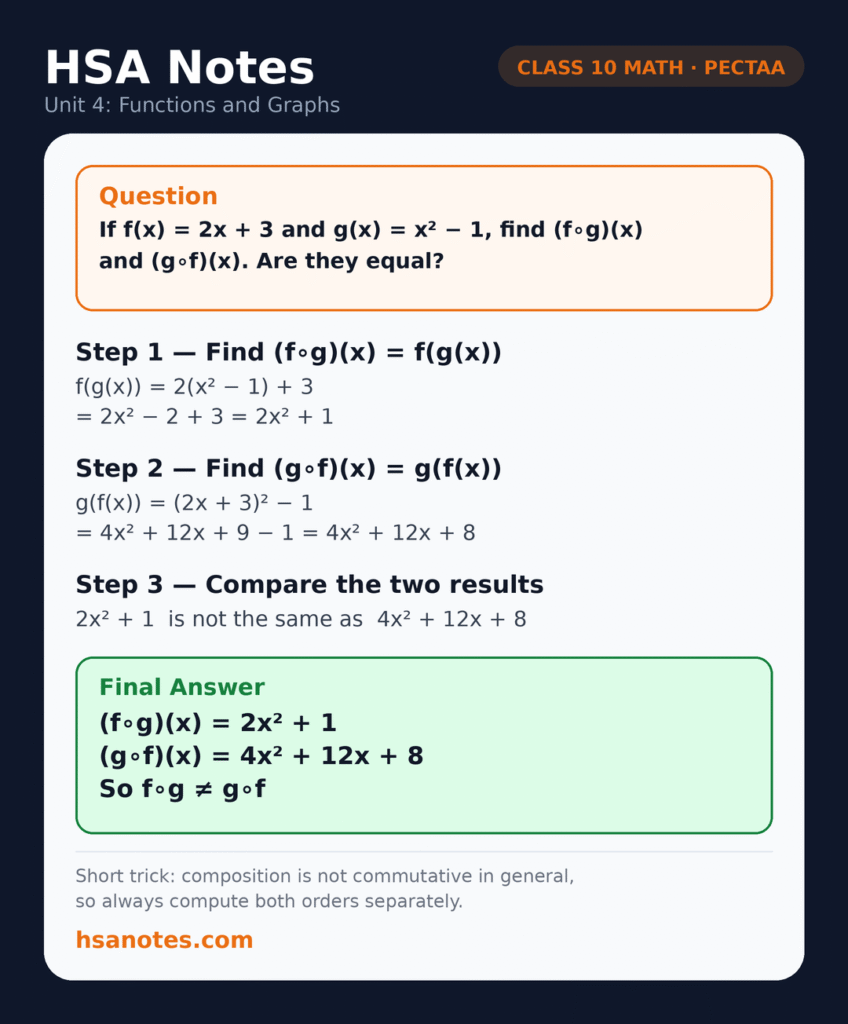
Example 3 (Composition): For f(x) = 2x + 3 and g(x) = x²:
(f∘g)(x) = 2x² + 3, but (g∘f)(x) = (2x + 3)² = 4x² + 12x + 9. So f∘g ≠ g∘f.
Example 4 (Inverse): Find the inverse of f(x) = 3x − 6.
y = 3x − 6, so x = (y + 6) ÷ 3. Hence f⁻¹(x) = (x + 6) ÷ 3.
Example 5 (Absolute value equation): Solve |2x − 1| = 5.
2x − 1 = 5 gives x = 3, and 2x − 1 = −5 gives x = −2. Solution: {3, −2}.
Example 6 (Absolute value inequality): Solve |x − 2| ≤ 3.
−3 ≤ x − 2 ≤ 3, so −1 ≤ x ≤ 5.
Example 7 (Real life): A plan costs C(x) = 300 + 5x rupees for x units. For 40 units, C(40) = 300 + 200 = Rs. 500.
Important Formulas at a Glance
| Concept | Formula |
|---|---|
| Sum of functions | (f + g)(x) = f(x) + g(x) |
| Product of functions | (f · g)(x) = f(x) · g(x) |
| Composition | (f∘g)(x) = f(g(x)) |
| Vertex of a|x − h| + k | (h, k) |
| |x| < a | −a < x < a |
| |x| > a | x < −a or x > a |
Exercises in Unit 4
| Exercise | Main Focus |
|---|---|
| 4.1 | Operations, composition, and inverse of functions |
| 4.2 | Absolute value graphs, equations, and inequalities |
| 4.3 | Real-life problems with functions |
| Review Exercise 4 | MCQs, short and long questions |
Exam Tips
- Work out the inner function first in a composition.
- Always check that f(f⁻¹(x)) = x after finding an inverse.
- Split an absolute value equation into two cases, and check both answers.
- For graphs, mark the vertex first and then plot a few points on each side.
About HSA Notes
HSA Notes is a free educational platform for secondary and higher secondary students in Pakistan. It publishes solved notes, model papers, and study material aligned with the NBF, PECTAA, PCTAA, and FBISE curricula, covering Mathematics, Physics, Chemistry, Biology, Computer Science, and English. Our solutions are written by our own team, giving students clear, original, step-by-step help.
Online Classes
Students who want guided learning can join our online classes run by Hamdard Science Academy. The classes follow the new PECTAA book unit by unit, so Unit 4 concepts, examples, and exercises are taught in a clear order alongside these notes. To ask about the schedule, fees, or admission, email hsanotes48@gmail.com.
Conclusion
Functions and Graphs is a short but important unit that builds skills you will use in FSc Mathematics. With clear definitions and regular practice, it can become one of your easiest units. Free solved exercises and PDF notes are available on HSA Notes for all Punjab boards, and online classes are there if you need extra support.

1 thought on “Unit 4: Class 10 Math PECTAA Notes New Book”