Introduction
A trigonometric equation contains a trigonometric function of an unknown angle. Unit 10 of the PECTAA New Book shows how to find principal solutions in [0, 2π], write general solutions using periodicity, and solve equations graphically when algebra is not enough.
🎓 Online Classes with Experienced Experts
What This Unit Covers
Unit 10 is organized into two graded exercises (10.1 and 10.2):
1. Algebraic Solution of Trigonometric Equations (Exercise 10.1) Students solve equations such as sin x = 1/√2, 2cos²x − 3cos x + 1 = 0, sin 3x = cos 2x and equations that need identities, factorisation or sum-to-product formulas, and write both principal and general solutions.
2. Graphical Solution (Exercise 10.2) Students plot both sides of an equation f(x) = g(x) and read the solutions from the x-coordinates of the intersection points. Applied problems include the angle of a force in a work calculation and the launch angles of a projectile for a required range.
Why This Unit Matters
Trigonometric equations combine identities, algebra and inverse functions, and connect to Units 9 and 11. Board papers usually contain one equation that needs an identity and one graphical question.
How to Study Unit 10
- Learn the CAST rule and the exact values for 0°, 30°, 45°, 60° and 90°.
- Reduce the equation to one trigonometric function, factorise, and solve each factor.
- Give solutions in the interval the question asks for, and add 2nπ or nπ for general solutions.
- Check the given interval for extra solutions from other quadrants.
- Keep the calculator in radian mode for radian intervals.
Practice Questions – Unit 10
(Original practice problems for self-assessment. Attempt them after studying the unit, then check your working against the solved examples in your notes.)
Short Questions
- Solve sin x = 1/2 for x in [0, 2π].
- Write the general solution of cos x = 0.
- What is meant by principal solutions of a trigonometric equation?
- Solve tan x = 1 for x in [0, 2π].
- Write the general solution of sin x = 0.
- Solve cos x = −√3/2 for x in [0, 2π].
Long Questions
- Solve 2sin²x + sin x − 1 = 0 for x in [0, 2π].
- Solve sin x + cos x = 1 for x in [0, 2π].
- Solve tan²x − 3 = 0 for x in [0, 2π].
- Solve cos 2x = cos x for x in [0, 2π].
- Solve sin 3x = sin x for x in [0, π].
Applied Questions
- Solve graphically sin x = x/2 for x in [−π, π] and state the number of solutions.
- A projectile is launched at 30 m/s and must have a range of 60 m. Using R = u² sin 2θ / g with g = 10 m/s², find the two possible launch angles.
- A force of 50 N moves an object 20 m and does 800 J of work. Find the angle between the force and the motion.
- The tide height is h(t) = 3 + 2 sin(πt/6) metres, with t in hours. Find the times in [0, 12] when the height is 4 m.
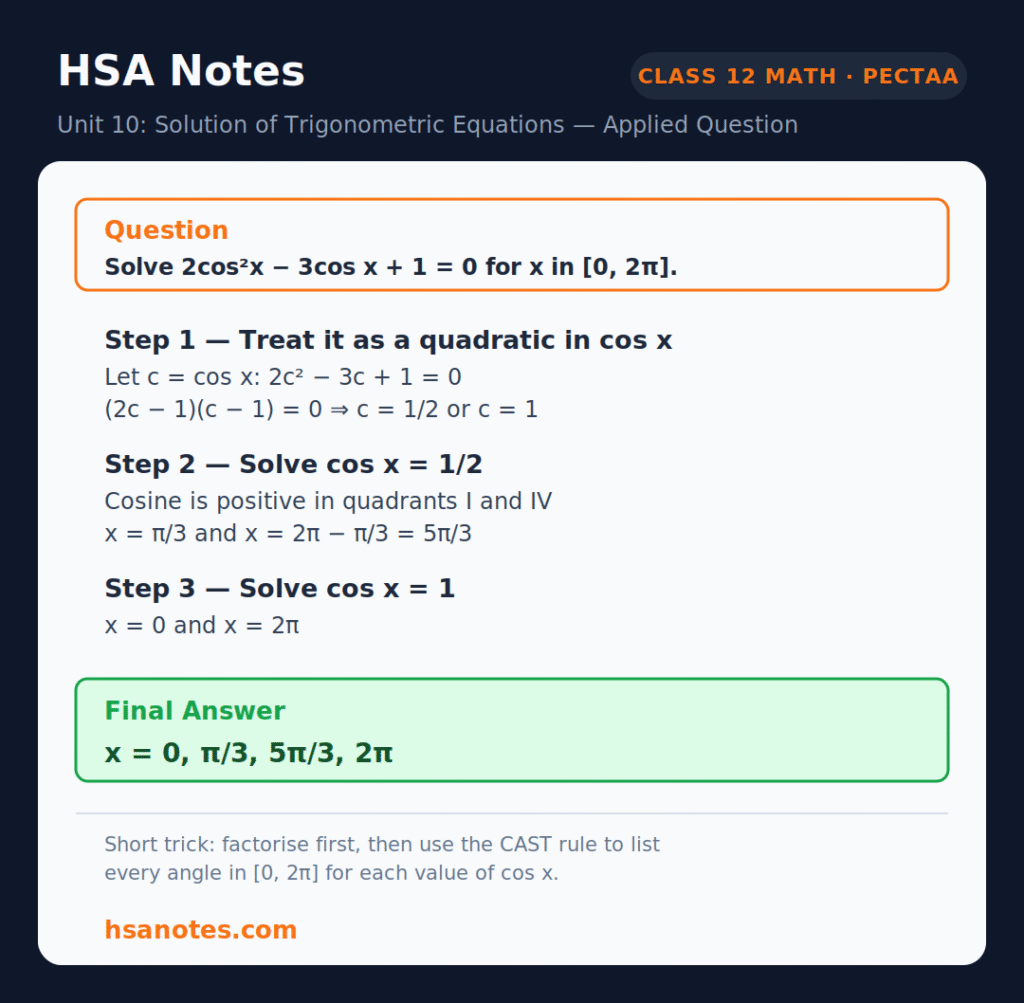
A trigonometric equation contains a trigonometric function of an unknown angle, for example 2cos²x − 3cos x + 1 = 0. Because trigonometric functions are periodic, such an equation has infinitely many solutions. The unit separates these into principal solutions, which lie in the interval [0, 2π], and the general solution, which adds multiples of the period to describe every possible angle.
The algebraic method follows a reliable routine. First reduce the equation to a single trigonometric function using identities. Then factorise or use the quadratic formula, solve each factor, and use the CAST rule to list every angle in the required interval. Equations such as sin 3x = cos 2x or sin x + cos x = 1 need extra identities or a sum-to-product formula, so the exercise builds fluency with these tools.
The second method is graphical. Students plot both sides of an equation, for example sin x and x/2, on the same axes and read the solutions from the x-coordinates of the intersection points. This approach is useful when no algebraic method exists, and it also shows how many solutions an equation has. The unit closes with applications, such as finding the angle of a force from the work done, or the launch angles that give a required projectile range.
Key points to remember
Add 2nπ or nπ correctly when writing the general solution.
Keep the calculator in radian mode when the interval is in radians.
Reduce to one trigonometric function before factorising.
Check every quadrant of the given interval for extra solutions.
About HSA Notes
HSA Notes is an educational resource platform providing free study materials for Pakistani students, covering FBISE, Punjab, Sindh, and KP Boards in line with the New Books System. Materials span grades 9–12 across Mathematics, Chemistry, Biology, Physics, Computer Science, English, and Urdu, all prepared in a consistent, easy-to-follow branded format.
Besides free unit-wise notes and solved exercises, HSA Notes also offers online classes for students who want structured, teacher-guided sessions alongside self-study, useful for learners who need concepts explained step by step or want doubt-solving support beyond what a PDF can provide. For online classes, contact: hsanotes48@gmail.com
Conclusion
Unit 10 – Solution of Trigonometric Equations depends on a clear routine: reduce, factorise, list every angle in the interval, and check. Practising the questions above, and using HSA Notes’ online classes for extra guidance where needed, will make this unit a dependable source of marks.