
Introduction
Unit 7 of the Class 12 Mathematics PECTAA New Book covers Kinematics of Motion in a Straight Line, the branch of mechanics that describes how objects move without asking what causes the motion.
🎓 Online Classes with Experienced Experts
Building on the differentiation of Unit 2 and the integration of Unit 3, this unit uses derivatives to define velocity and acceleration, integrals to recover displacement and velocity, and graphs to interpret motion visually. It closes with the equations of motion for constant acceleration and their use in free fall and vertical projection.
What This Unit Covers
Unit 7 is built around Section 7.1, Rectilinear Motion, with one practice set (Exercise 7.1):
- Scalars and Vectors Students separate scalar quantities (distance and speed) from vector quantities (displacement, velocity and acceleration), and learn that in straight-line motion direction is shown simply by positive and negative signs.
- Displacement, Average Velocity and Acceleration This section defines average velocity (total displacement ÷ total time) and average speed (total distance ÷ total time), then instantaneous velocity v = dx/dt, instantaneous speed |dx/dt|, and acceleration a = dv/dt = d²x/dt². It also introduces a = v dv/dx for problems where velocity is given in terms of position.
- Displacement-Time Graphs Students read a graph of position against time: the slope gives velocity, a flat line means the object is stationary, and a negative slope means motion in the opposite direction.
- Velocity-Time Graphs The slope of a velocity-time graph gives acceleration, and the area under it gives displacement. When the graph goes below the time axis, displacement is A₁ − A₂ while distance travelled is A₁ + A₂.
- Motion with Constant Acceleration Starting from a = dv/dt and integrating, students derive the three equations of motion, v = u + at, x = ut + ½at² and 2ax = v² − u², and apply them to cars, trains and other moving bodies.
- Free Vertical Motion The unit ends with motion under gravity (g = 9.8 m/s²), covering objects dropped from rest and objects thrown upward, including finding maximum height and time of flight.
Why This Unit Matters
Kinematics is where calculus meets physics. Every technique from Units 2 and 3 (derivatives, indefinite integrals, definite integrals and area under a curve) is applied here to a physical situation. Board papers often set a long question that starts from a given acceleration a(t), integrates twice with initial conditions to find v(t) and x(t), and then asks for distance travelled. Graph-interpretation questions are also common in the short-question section.
How to Study Unit 7
- Keep the chain of relationships in mind: differentiate to go from x to v to a, and integrate to go back. Most exam questions are just one direction of this chain.
- When integrating acceleration or velocity, apply the initial conditions immediately to find the constant; forgetting this step is the most common way to lose marks.
- Distinguish displacement from distance. If the velocity changes sign, split the time interval at the point where v = 0 and add the absolute values of the pieces.
- On velocity-time graphs, split the region into triangles, rectangles and trapezia, and treat areas below the axis as negative when finding displacement.
- Write down u, v, a, x and t before every constant-acceleration problem, mark the unknown, and choose the one equation that avoids the quantity you are not given.
- For vertical motion, fix a sign convention first (upward positive means a = −g), and check that it stays consistent through the whole solution.
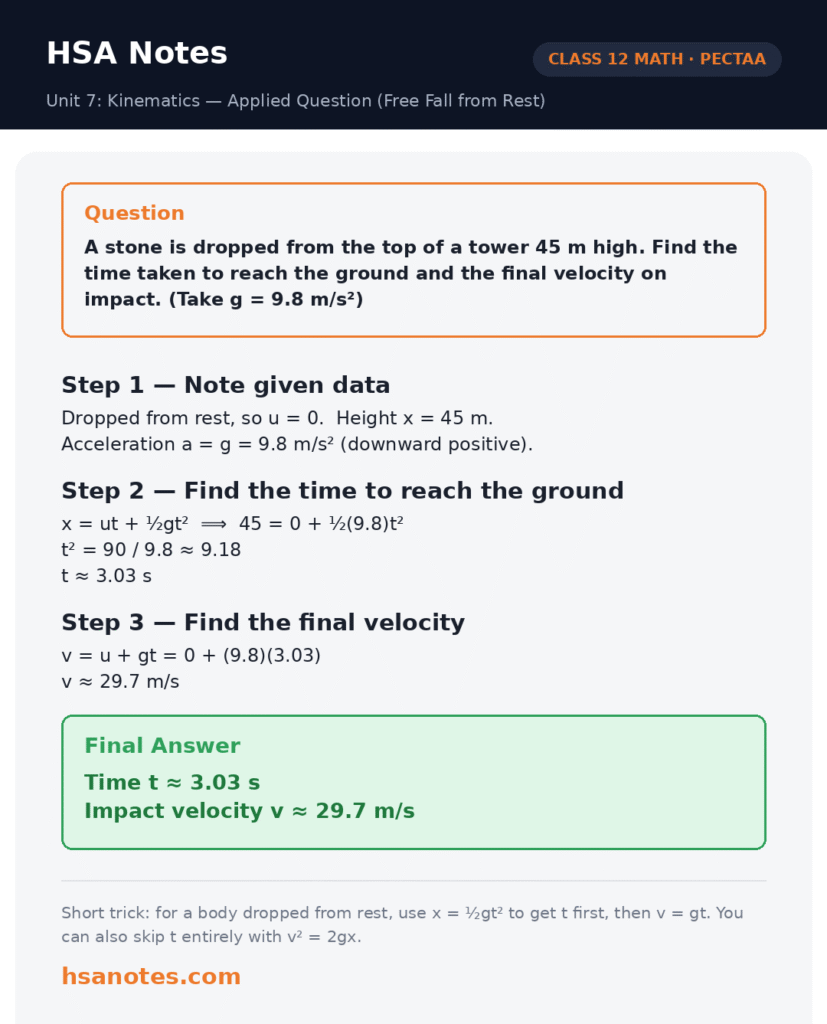
HSA Notes solved question card Class 12 Math PECTAA, Unit 7 Kinematics, Applied problem: a stone dropped from the top of a 45 m tower, solved step by step using the equations of motion to find the time to reach the ground and the impact velocity, final answer t ≈ 3.03 s and v ≈ 29.7 m/s
Practice Questions – Unit 7
Short Questions
- Differentiate the displacement x(t) = t³ − 6t² to find the velocity and the speed at t = 1 s.
- Write the difference between average speed and average velocity.
- A car starts from rest and accelerates uniformly at 3 m/s². Find its velocity after 5 seconds.
- What does the slope of a velocity-time graph represent, and what does the area under it represent?
- Show that a = v dv/dx using the chain rule.
- A ball is thrown vertically upward with a speed of 20 m/s. Find the time it takes to reach maximum height.
Long Questions
- Find the position and velocity of a particle at any time t, given that it starts from rest at t = 0 and has acceleration a(t) = t² + cos t.
- The acceleration of a particle is a(t) = cos t + sin t and its velocity is 2 m/s at t = 0. Find the expression for v(t).
- Derive the three equations of motion for constant acceleration by integration.
- The acceleration of a particle is a(t) = 1/(1 + t) for t ≥ 0. If the velocity is 0 m/s when t = 0, find the velocity at t = 5 seconds.
- A particle is projected vertically upward with a velocity of 100 m/s, and another is let fall from a height of 200 m at the same time. Find the height at which they meet.
Applied Questions
- A stone is dropped from the top of a tower 45 m high. Find the time taken to reach the ground and the velocity on impact.
- A vehicle moving at 36 km/h is stopped by applying brakes and comes to rest in 10 seconds. Find the retardation and the distance covered.
- A train moving at 54 km/h is uniformly accelerated to 90 km/h in 20 seconds. Find the acceleration and the distance covered.
- The motion of a robotic arm along a straight track is described by v(t) = 6 + t − t² for 0 ≤ t ≤ 5. Find the distance travelled by the arm.
About HSA Notes
HSA Notes is an educational resource platform providing free study materials for Pakistani students, covering FBISE, Punjab, Sindh, and KP Boards in line with the New Books System. Materials span grades 9–12 across Mathematics, Chemistry, Biology, Physics, Computer Science, English, and Urdu, all prepared in a consistent, easy-to-follow branded format.
Besides free unit-wise notes and solved exercises, HSA Notes also offers online classes for students who want structured, teacher-guided sessions alongside self-study, which is useful for learners who need concepts explained step by step or want doubt-solving support beyond what a PDF can provide. For online classes, contact: hsanotes48@gmail.com
Conclusion
Unit 7 Kinematics of Motion in a Straight Line shows students how differentiation and integration describe real motion: velocity and acceleration as derivatives, displacement and velocity as integrals, graphs as pictures of both, and the three equations of motion as the shortcut for constant acceleration. A firm grip on these ideas prepares students for physics and for the applied calculus they will meet in further study. Practising the solved examples alongside the questions above, and joining HSA Notes’ online classes for extra guidance where needed, will help students build real confidence in this unit.

1 thought on “Unit 7: Class 12 Math PECTAA Notes New Book”