
Unit 5 of the PECTAA Class 12 Mathematics book (Punjab boards, 2026-27) is analytical geometry: straight lines, triangles and pairs of lines described with equations in the xy-plane. It underpins the conics and vectors that come later, and the concurrency proofs are standard long questions. The solved notes PDF is below.
Source: the exercises in this PDF are from the Punjab Curriculum and Textbook Board (PCTB) textbook for Class 12 Mathematics. The questions belong to the publisher. The solutions and explanations were written by Muhammad Sharjeel. Sources and copyright.
Straight lines (Exercise 5.1)
Know all six forms and be able to move between them: general (ax + by + c = 0), slope-intercept, point-slope, two-point, intercept (x/a + y/b = 1) and normal form. The unit also proves that any equation ax + by + c = 0 is a straight line.
Lines in a triangle
Given the three vertices, you can write the equations of the medians (vertex to midpoint of the opposite side), altitudes (perpendicular from a vertex to the opposite side) and right bisectors (perpendicular through the midpoint of a side), and show that each set meets at one point.
Concurrency and families of lines (Exercise 5.2)
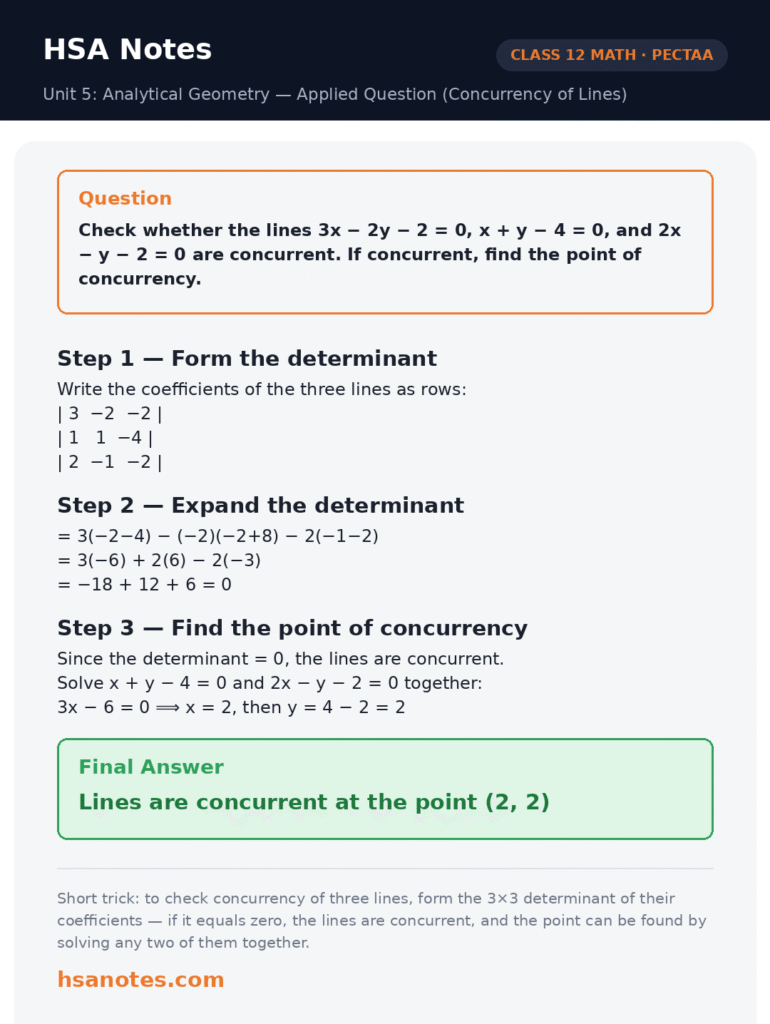
Three lines are concurrent when the determinant of their coefficients is zero. Every line through the intersection of two lines L₁ = 0 and L₂ = 0 has the form L₁ + kL₂ = 0; choose k to meet an extra condition, such as being parallel or perpendicular to a given line.
Angles and areas
The angle between lines with slopes m₁ and m₂: tan θ = (m₂ − m₁)/(1 + m₁m₂). They are parallel if m₁ = m₂ and perpendicular if m₁m₂ = −1. The area of a triangle comes from a determinant of its vertices; if that area is zero, the three points are collinear.
Pairs of lines (Exercise 5.3)
ax² + 2hxy + by² = 0 represents two lines through the origin: real and different if h² > ab, the same line if h² = ab, imaginary if h² < ab. The angle between them is given by tan θ = 2√(h² − ab)/(a + b), and they are perpendicular when a + b = 0. Often the quickest route is to factorize it like a quadratic.
Applications
Distances between planets in astronomical units, an aircraft’s track and distance, and similar positioning problems.
Worked example
Are 3x − 2y − 2 = 0, x + y − 4 = 0 and 2x − y − 2 = 0 concurrent? Solving the last two gives x = 2, y = 2. Substituting into the first: 6 − 4 − 2 = 0. So yes, they all pass through (2, 2).
How to study this unit
- Practise converting between the six forms until it is mechanical.
- For triangle lines, find the midpoint and the slope you need first, then use point-slope form.
- Keep the two angle formulas separate: one for two given lines, one for a homogeneous pair.
Practice questions
Our own revision questions, separate from the textbook. Answers are at the end.
- 1. Line with slope −4 through (2, −1).
- 2. Write x + 2y − 6 = 0 in intercept form.
- 3. Are A(1, 2), B(3, 6) and C(5, 10) collinear?
- 4. Angle between lines with slopes 2 and −1/2.
- 5. Find the two lines in 3x² − 10xy + 3y² = 0 and the angle between them.
- 6. An aircraft flies from (100, 200) km to (500, 800) km. Find the slope of its track and the distance.
- 7. Show 9x² − 12xy + 4y² = 0 is a pair of coincident lines.
Answers: 1. 4x + y − 7 = 0. 2. x/6 + y/3 = 1. 3. Yes, both slopes are 2. 4. 90°, since the slopes multiply to −1. 5. (3x − y)(x − 3y) = 0, so y = 3x and y = x/3; tan θ = 4/3, θ ≈ 53.1°. 6. Slope 1.5, distance √520,000 ≈ 721 km. 7. It is (3x − 2y)² = 0, and h² = ab = 36.
1 thought on “Unit 5: Class 12 Math PECTAA Notes New Book”