
Introduction
Unit 2 of the Class 12 Mathematics PECTAA New Book builds directly on the basic differentiation rules (sum, difference, product, quotient) learned in Class 11. It extends differentiation to trigonometric, inverse trigonometric, exponential, and logarithmic functions, then applies these tools to tangents, increasing/decreasing behaviour, extrema, approximation, and real-life optimization problems.
🎓 Online Classes with Experienced Experts
What This Unit Covers
Unit 2 is organized into seven graded exercises (2.1 to 2.7):
1. Derivatives of Trigonometric and Inverse Trigonometric Functions Students derive and apply the derivative formulas for sec x, csc x, cot x, and the six inverse trigonometric functions, along with the Chain Rule, implicit differentiation, and parametric differentiation for equations given in terms of a parameter t.
2. Derivatives of Exponential and Logarithmic Functions This section covers differentiating eˣ, aˣ, ln x, and log₁₀ x, including cases where logarithmic properties must be applied first to simplify an expression before differentiating (logarithmic differentiation).
3. Equations of Tangent and Normal Lines Students find the slope of a curve at a given point using f′(x₀), then write the equations of the tangent line (using the point-slope form) and the normal line (using the negative reciprocal slope), including special cases like vertical tangents.
4. Increasing/Decreasing Functions and Relative Extrema This section covers determining intervals where a function is increasing or decreasing, finding critical points by setting f′(x) = 0, and classifying each as a relative maximum, relative minimum, or neither using the second derivative test.
5. Linear Approximation Students use the tangent line at a point to build a linear approximation L(x) = f(a) + f′(a)(x – a), then use it to estimate values like square roots, trigonometric values, or cube roots near a known point.
6. Differentials and Error Estimation This part introduces the differential dy = f′(x)dx, uses it to approximate small changes Δy, and applies it to relative and percentage error problems for quantities like the volume of a cube or sphere measured with a small margin of error.
7. Applying Extrema to Real-World Problems The unit closes with optimization word problems: maximizing area or volume, minimizing cost or material, and other real-life scenarios solved by defining a function, finding critical points, and confirming maxima/minima with the second derivative test.
Why This Unit Matters
Further Differentiation is one of the most heavily applied units in the syllabus — its techniques (chain rule, implicit/parametric differentiation, tangent-normal equations, extrema) reappear throughout Units 3–8, especially in Integration and Kinematics. Optimization problems from Exercise 2.7 are a favourite source of long questions in board exams, and error-estimation problems from Exercise 2.6 are common in short-question sections.
How to Study Unit 2
- Get the six inverse trigonometric derivative formulas fully memorized before attempting mixed problems — most errors in this unit come from sign mistakes in these formulas.
- Practise implicit and parametric differentiation separately first, then combine them with the chain rule in mixed questions.
- For extrema problems, always confirm your critical points with the second derivative test rather than assuming a maximum or minimum from the shape alone.
- For optimization word problems, write the constraint equation first, substitute to get a single-variable function, then differentiate — most mistakes happen from skipping the constraint step.
Practice Questions – Unit 2
Short Questions
- Differentiate y = x²·tan x with respect to x.
- Find dy/dx if y = ln(sec x + tan x).
- Find the derivative of f(x) = e^(2x)·cos x.
- If x = t² – 1 and y = t³ + t, find dy/dx in terms of t.
- Find the critical points of f(x) = x³ – 3x² – 9x + 5.
- Write the differential dy for y = √(4 – x²).
Long Questions
- Find the equation of the tangent and normal to the curve y = x² – 4x + 3 at the point where x = 1.
- Determine the intervals on which f(x) = 2x³ – 9x² + 12x + 1 is increasing or decreasing, and classify each critical point using the second derivative test.
- Use implicit differentiation to find dy/dx if x² + xy + y² = 7.
- Find the linear approximation of f(x) = ∛x at x = 8, and use it to approximate ∛8.3.
- Use differentials to approximate the value of √50.
Applied Questions
- The radius of a circular metal plate is measured as 12 cm with a possible error of 0.05 cm. Estimate the percentage error in the calculated area of the plate.
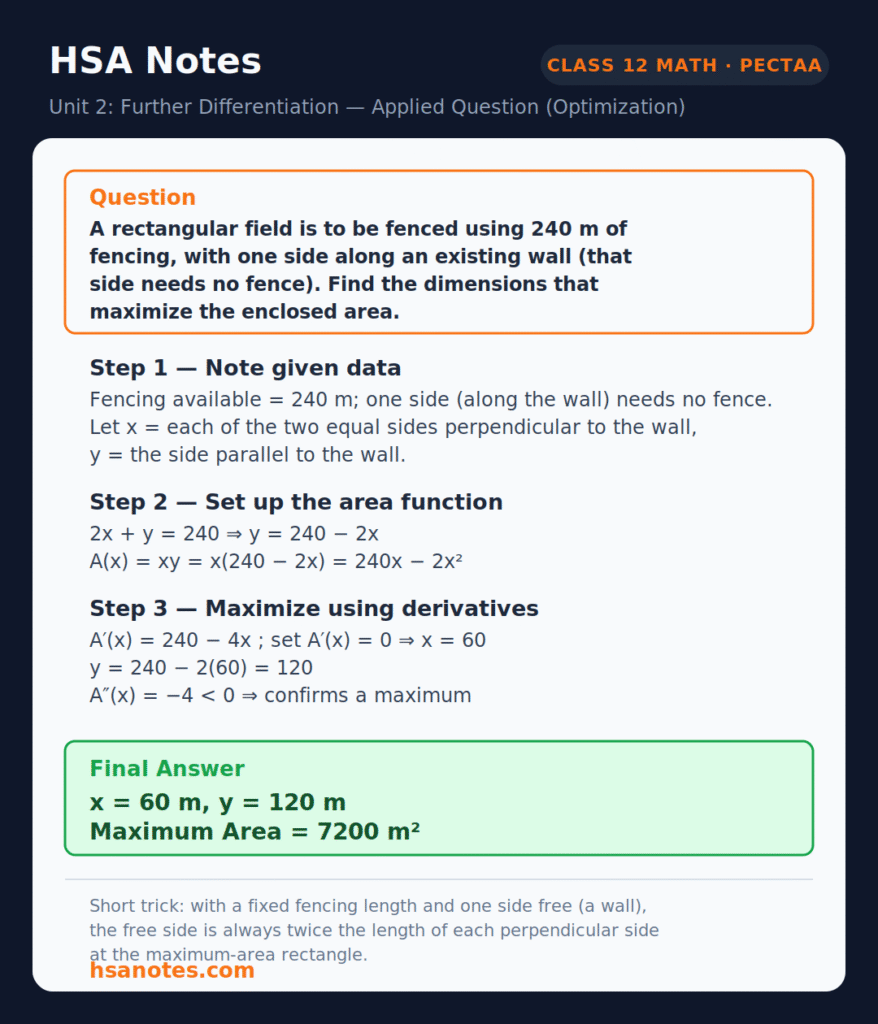
- A rectangular field is to be fenced using 240 m of fencing, with one side along an existing wall (so that side needs no fence). Find the dimensions that maximize the enclosed area.
- An open-top box is to be made from a square sheet of cardboard of side 30 cm by cutting equal squares from each corner and folding up the sides. Find the size of the squares that maximizes the volume of the box.
- A ball is thrown so that its height (in metres) after t seconds is h(t) = 20t – 5t². Find the time at which the ball reaches its maximum height, and find that maximum height.
About HSA Notes
HSA Notes is an educational resource platform providing free study materials for Pakistani students, covering FBISE, Punjab, Sindh, and KP Boards in line with the New Books System. Materials span grades 9–12 across Mathematics, Chemistry, Biology, Physics, Computer Science, English, and Urdu, all prepared in a consistent, easy-to-follow branded format.
Besides free unit-wise notes and solved exercises, HSA Notes also offers online classes for students who want structured, teacher-guided sessions alongside self-study useful for learners who need concepts explained step by step or want doubt-solving support beyond what a PDF can provide. For online classes, contact: hsanotes48@gmail.com
Conclusion
Unit 2 Further Differentiation equips students with the full differentiation toolkit needed for the rest of Class 12 Mathematics: trigonometric and inverse trigonometric derivatives, implicit and parametric differentiation, tangent-normal equations, extrema analysis, linear approximation, differentials, and real-world optimization. These skills carry forward directly into Integration (Unit 3) and Kinematics (Unit 7), making a solid grip on this unit essential for scoring well across the paper. Practising the solved examples alongside the questions above, and joining HSA Notes’ online classes for extra guidance where needed, will help students build real confidence in this unit.

1 thought on “Unit 2: Class 12 Math PECTAA Notes New Book”