Introduction
Complete Units Overview | All Punjab Boards | Free PDF Download
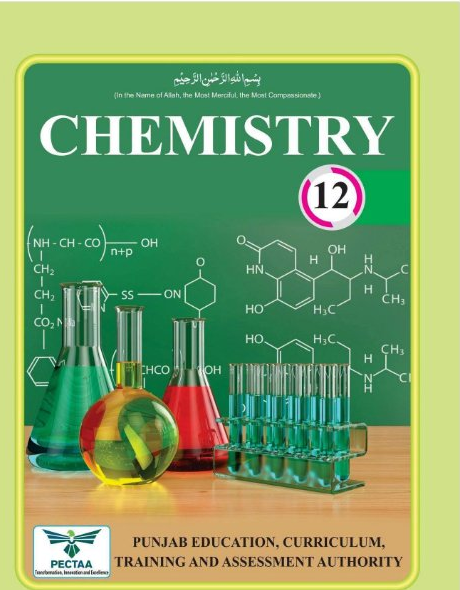
The 12th Class Chemistry Textbook (English Medium) 2025–2026 has been developed under the updated curriculum framework issued by PECTAA for students enrolled in the Punjab Boards system.
Chemistry at the Higher Secondary School Certificate (HSSC Part-II) level is a core science subject that builds a deep understanding of matter, its composition, structure, properties, and the transformations it undergoes during chemical reactions. The revised textbook is designed to move beyond rote memorization and promote conceptual clarity, analytical reasoning, and application-based learning.
The 2025–2026 edition integrates modern developments in chemical sciences such as spectroscopy, polymers, biochemistry, and industrial applications, making it highly relevant to contemporary scientific and technological advancements.
About the New Chemistry Textbook
The new Chemistry textbook follows a structured and student-friendly approach. It is divided into inorganic, organic, physical, and applied chemistry sections, ensuring balanced coverage of all essential areas.
Key features of the textbook include:
- Concept-based learning with step-by-step explanations
- Reaction mechanisms for organic chemistry
- Real-life industrial and environmental applications
- Well-labeled diagrams and molecular structures
- Solved numerical and theoretical examples
- Chapter-wise exercises and conceptual questions
The main goal of this curriculum is to prepare students not only for board examinations but also for competitive exams and higher education in scientific disciplines.
Unit-wise Detailed Overview
Unit 17: Group 2 Elements
This unit introduces alkaline earth metals such as beryllium, magnesium, calcium, strontium, and barium. Students study periodic trends, physical and chemical properties, and important compounds like oxides, hydroxides, and carbonates. The biological importance of calcium and magnesium in living organisms is also highlighted.
Unit 18: Transition Metals
Transition metals are essential in industrial chemistry and catalysis. This unit focuses on electronic configuration, variable oxidation states, complex ion formation, and magnetic properties. Their role in catalysts, pigments, and alloys is also discussed in detail.
Unit 19: Basics of Organic Chemistry
This foundational unit introduces students to carbon chemistry. Topics include covalent bonding in carbon compounds, hybridization, functional groups, isomerism, and IUPAC nomenclature. It provides the basis for understanding advanced organic reactions in later units.
Unit 20: Aromatic Hydrocarbons
This unit focuses on benzene and aromatic compounds. Students learn about aromatic stability, resonance, electrophilic substitution reactions, and industrial applications such as dyes, plastics, and pharmaceuticals.
Unit 21: Halogenoalkanes
Halogenoalkanes are studied with emphasis on substitution and elimination reactions. The unit explains reaction mechanisms, reactivity trends, and their use in solvents, refrigerants, and industrial chemicals.
Unit 22: Hydroxy Compounds
This unit covers alcohols and phenols, their classification, physical properties, and chemical behavior. Important reactions such as oxidation, dehydration, and esterification are included along with their industrial uses.
Unit 23: Carbonyl Compounds and Carboxylic Acids
Aldehydes, ketones, and carboxylic acids are discussed in detail. The unit explains nucleophilic addition reactions, oxidation-reduction behavior, acidity of carboxylic acids, and their role in biological and industrial systems.
Unit 24: Organic Nitrogen Compounds
This unit introduces amines, amides, and related compounds. Students study basicity, preparation methods, and reactions. The biological importance of nitrogen-containing compounds such as amino acids is also emphasized.
Unit 25: Organic Synthesis
Organic synthesis focuses on designing chemical pathways to form complex molecules. Students learn reaction mechanisms, stepwise conversions, and industrial synthesis of important compounds like drugs and polymers.
Unit 26: Polymers
Polymers are large macromolecules used in plastics and synthetic materials. This unit explains addition and condensation polymerization, properties of polymers, and their environmental impact, including recycling challenges.
Unit 27: Biochemistry
This unit connects chemistry with biology. It covers carbohydrates, proteins, lipids, and enzymes. Students understand metabolic processes and the chemical basis of life.
Unit 28: Chromatography
Chromatography is an essential analytical technique used to separate mixtures. The unit covers paper chromatography, column chromatography, and their applications in laboratories, pharmaceuticals, and food testing.
Unit 29: Spectroscopy-1
This unit introduces spectroscopic techniques such as UV and IR spectroscopy. Students learn how molecular structures are analyzed using light absorption and vibrational frequencies.
Unit 30: Spectroscopy-2 (NMR)
Nuclear Magnetic Resonance (NMR) spectroscopy is used for detailed structural identification of organic compounds. The unit explains chemical shifts, spin behavior, and molecular interpretation techniques.
Unit 31: Materials and Energy
This unit explores modern materials and energy sources. It covers renewable energy, fossil fuels, and material science applications in engineering and environmental sustainability.
Unit 32: Medicine, Agriculture and Industry
Applied chemistry is highlighted in this unit. It explains pharmaceutical chemistry, fertilizers, pesticides, and industrial chemical processes that support modern society.
Unit 33: Water
Water chemistry is crucial for environmental and industrial applications. This unit covers water hardness, purification methods, treatment plants, and environmental effects of water pollution.
Importance of Chemistry
Chemistry is considered the central science because it connects physics, biology, environmental science, and engineering. It explains how substances interact and transform under different conditions.
Students studying chemistry develop:
- Strong analytical thinking
- Problem-solving skills
- Scientific reasoning
- Laboratory and experimental skills
- Understanding of real-world phenomena
Career Opportunities
A strong foundation in chemistry opens pathways to multiple professional fields such as:
- Medicine and healthcare
- Pharmacy and pharmacology
- Chemical engineering
- Biotechnology and genetics
- Environmental sciences
- Industrial research and development
Chemistry plays a vital role in shaping modern industries and scientific innovation.
Higher Education Scope
The concepts taught in this textbook prepare students for advanced studies in:
- Organic and inorganic chemistry
- Physical chemistry
- Analytical chemistry
- Biochemistry
- Material sciences
- Pharmaceutical sciences
Students who master this syllabus perform better in university-level science programs and competitive entrance tests.
Real-World Applications of Chemistry
Chemistry is deeply connected to everyday life and modern technology. Its applications include:
- Drug formulation and medical treatments
- Fertilizers and crop protection in agriculture
- Industrial manufacturing processes
- Water purification and environmental safety
- Development of new materials and plastics
- Energy production and storage systems
Study Material by HSANOTES
HSANOTES.COM provides complete academic support for students, including:
- Chapter-wise detailed notes
- MCQs and short questions
- Long questions and solved exercises
- Guess papers and model papers
- PDF downloadable study material
- Exam preparation guides
Contact: hsanotes48@gmail.com
Covered Punjab Boards
This textbook is applicable to all major boards under Punjab:
- Lahore Board
- Gujranwala Board
- Faisalabad Board
- Multan Board
- Rawalpindi Board
- Sargodha Board
- Bahawalpur Board
- DG Khan Board
- Sahiwal Board
Conclusion
The 12th Class Chemistry Textbook (English Medium) 2025–2026 under the curriculum of PECTAA is a comprehensive and modern academic resource that covers all essential areas of chemistry including inorganic, organic, physical, analytical, and applied chemistry.
It is carefully designed to strengthen conceptual understanding, improve analytical abilities, and prepare students for higher education and professional careers in science and technology fields.
By mastering this syllabus, students can achieve academic excellence in board examinations and build a strong foundation for future scientific success.
DISCLAIMER
This material is shared strictly for educational, learning, and academic support purposes only.
All copyrights, trademarks, textbook content, and publication rights belong to their respective publishers, textbook boards, authors, and organizations.
HSA Notes does not claim ownership of official textbook content. This material is provided to help students and teachers access educational resources easily and free of cost.