Introduction
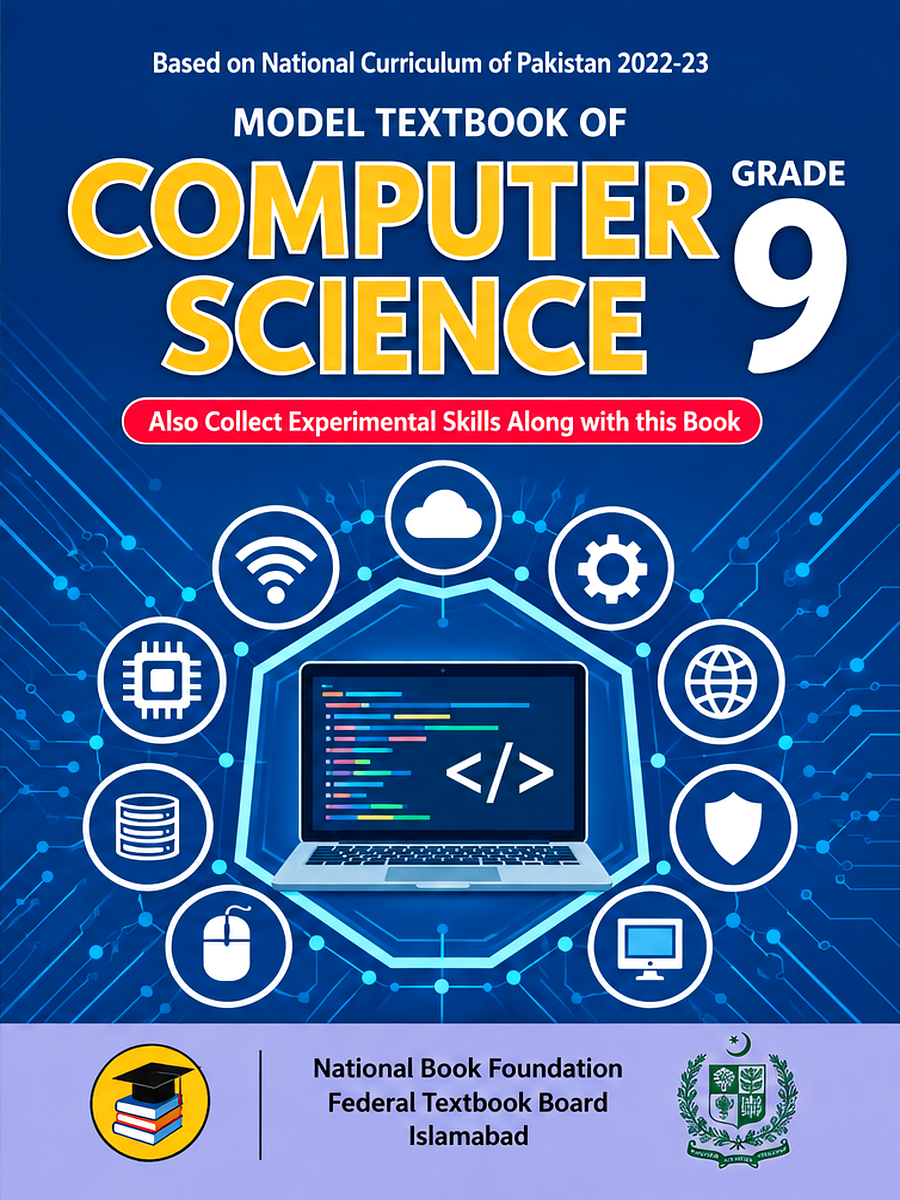
Dear Class 9 students, HSA Notes has prepared 5 complete sample papers for Computer Science, FBISE, based on the New Book (NBF) syllabus covering all 7 units, for the annual examination, session 2026–27.
🎓 Online Classes with Experienced Experts
Computer Science at this level isn’t just theory it’s a mix of concepts, coding, and real-world application, and students need to see exactly how the FBISE paper tests each of those elements. These sample papers are also built around FBISE’s newly restructured 2026 paper pattern, so students preparing for their first-ever board exam know exactly what to expect.
Exam Pattern and Marks Distribution (New FBISE Pattern, 2026–27)
FBISE restructured the SSC-I Computer Science paper in August 2026, moving to a 50% MCQ / 50% descriptive format. This is the pattern fresh Class 9 students will sit under.
Paper Overview
Total Marks: 60 · Time Allowed: 3 hours
| Section | Type | Count | Marks Each | Total |
|---|---|---|---|---|
| A | MCQs | 60 | 0.5 | 30 |
| B | Short Questions | 3 | 6 | 18 |
| C | Long Questions | 2 | 6 | 12 |
Timing: Section A gets 1 hour 20 minutes; Sections B and C together share the remaining 1 hour 40 minutes.
What Each Section Tests
Section A (60 MCQs, 30 marks) now carries half the total marks, spread across all 7 units. Since MCQs can be drawn from anywhere in a chapter — not just the parts that usually show up in long questions — students need broad, whole-chapter coverage rather than just memorizing key definitions.
Section B (3 Short Questions, 18 marks) goes deeper. You’re not just recalling — you’re explaining, writing a short code snippet, or working through a small logic problem. These connect directly to the units and often require a line or two of code, a short explanation, or a simple diagram.
Section C (2 Long Questions, 12 marks) is where logic and application meet. You might be asked to write and correct an HTML/CSS/JavaScript snippet, trace through an algorithm, classify a data set, or explain the impact of a computing concept with examples. These aren’t questions you can answer from memory alone you need to think through the logic.
All 7 Units Covered
Definitions of All 7 Units
- Computer Systems: The study of computer hardware, input/output devices, generations of computers, operating systems, and how data moves through a network.
- Computational Thinking & Algorithms: The study of breaking problems into steps, and representing solutions through flowcharts and algorithms.
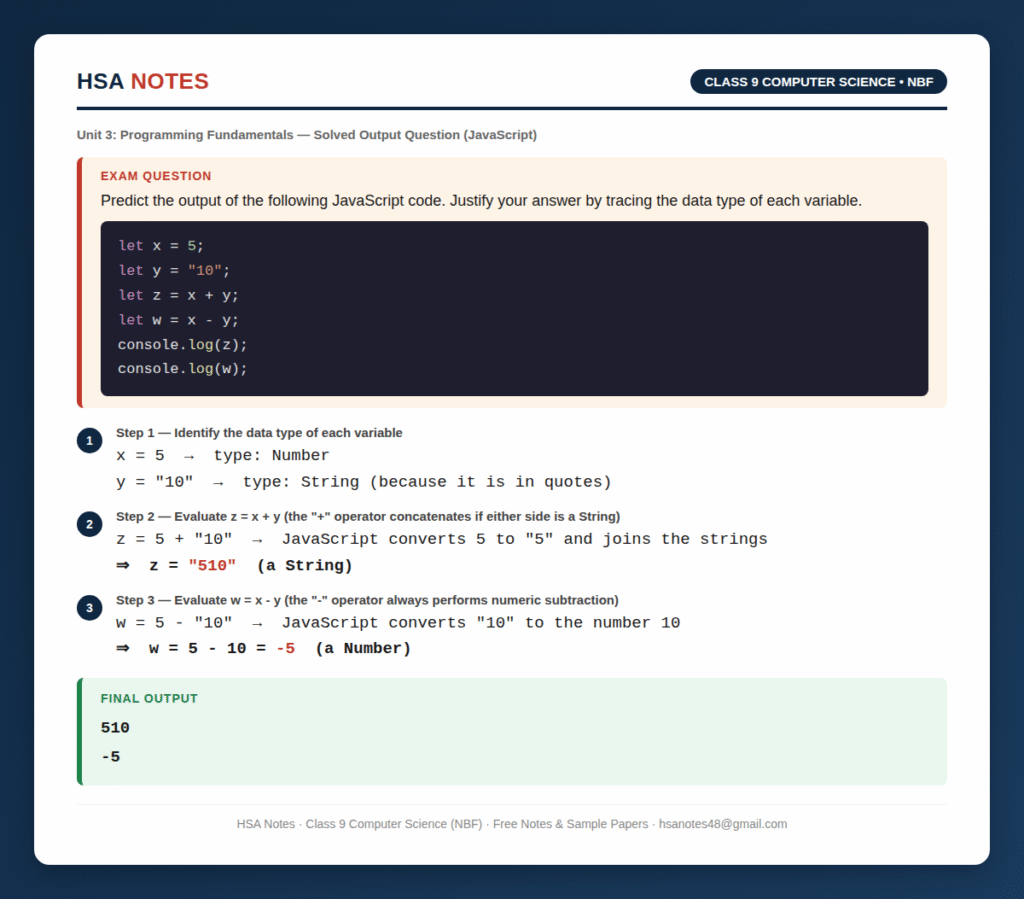
- Programming Fundamentals: The process of building simple web pages and scripts using HTML, CSS, and JavaScript.
- Data & Analysis: The process of collecting, classifying, and interpreting different types of data to support decision-making.
- Applications of Computer Science: The study of modern computing applications such as artificial intelligence, machine learning, and cloud computing.
- Impacts of Computing: The study of computer ethics, laws, security threats, and the safe and responsible use of technology.
- Entrepreneurship: The process of evaluating a business idea and understanding its strengths, weaknesses, opportunities, and threats.
What’s Inside Each Sample Paper
Section A: 60 MCQs
Mixed across all 7 units, so no single topic dominates. Each question is self-contained and tests recall, basic logic, or a quick output-based check.
Section B: 3 Short Questions
Rotating focus across the 5 papers — one paper might emphasize programming and algorithms, another might balance data & analysis with impacts of computing. You’ll see short HTML/CSS/JS snippets, flowchart-drawing prompts, and concept-explanation questions.
Section C: 2 Long Questions
These are the “show your thinking” questions, worth 6 marks each. Typical long questions ask you to:
- Write or correct a short HTML/CSS/JavaScript program
- Trace through a flowchart or algorithm
- Classify data as discrete/continuous or qualitative/quantitative with reasoning
- Explain a real-world computing scenario (e.g., safe internet use, AI applications)
Additional Study Tools Included
Beyond the 5 papers, students also get quick-reference materials:
Unit-Wise Topic Checklist — a simple list of sub-topics under each unit, so students know exactly which concepts are most likely to appear. For example, under Unit 3 (Programming Fundamentals), the checklist includes HTML tags, CSS types, arrays, and JavaScript functions.
Marks-per-Unit Distribution Across All 5 Papers — a breakdown showing how many marks each unit typically gets across all 5 papers combined, so students can prioritize revision. Units 2 and 3 (Algorithms and Programming) typically carry strong weight.
Why These Sample Papers Matter
Computer Science is cumulative and practical. Losing marks usually isn’t because you don’t know the concepts — it’s because you haven’t practiced writing code under time pressure, tracing through logic quickly, or handling the new heavier MCQ section confidently. These papers fix exactly that, with the added benefit of matching FBISE’s newly restructured pattern.
Who Should Use These Sample Papers
Every Class 9 FBISE Computer Science student benefits from these, especially since this is the first batch of students sitting under the new 50-50 pattern. Students with strong fundamentals can use them for timed mock practice and to identify weak units. Students still building confidence can work backward from the questions to see exactly which concepts and skills matter most. Teachers can use these as classroom tests or homework assignments.
Golden Tips for Exam Day
Time Management
- Section A (MCQs): 1 hour 20 minutes
- Section B (Short Qs): about 30 minutes
- Section C (Long Qs): about 60 minutes
- Revision: 10 minutes
Strategy Tips
Read every MCQ carefully — with 60 MCQs worth 30 marks, small mistakes now add up fast. In Section B, identify whether you need code, a flowchart, or an explanation before picking up the pen. In Section C, write a rough plan before finalizing your answer. Show all working — partial credit is real. Use the unit checklist in the final week to refresh memory on high-weight topics rather than re-reading entire units.
Why Choose HSA Notes
HSA Notes is a trusted resource for FBISE and Punjab Board students across all subjects, with free notes, sample papers, and online classes. Everything is prepared by tutors who actually teach Computer Science and updated to match the current NBF curriculum and FBISE’s newly restructured 2026–27 exam pattern.
Join HSA Notes Online Classes
For extra support beyond these sample papers, HSA Notes offers online classes for Class 8 through Class 12, with live doubt sessions, coding walkthroughs, and focused exam practice. Reach out at Contact us: hsanotes48@gmail.com
Conclusion
These 5 Computer Science sample papers, built for the FBISE New Book syllabus covering all 7 units and matching FBISE’s restructured 50% MCQ / 50% descriptive pattern, give Class 9 students complete, exam-format practice for session 2026–27. Free PDF, work through the unit checklist in your final weeks, and go into your exam fully prepared. Contact HSA Notes at hsanotes48@gmail.com or visit hsanotes.com for complete solutions and online class details.