Introduction
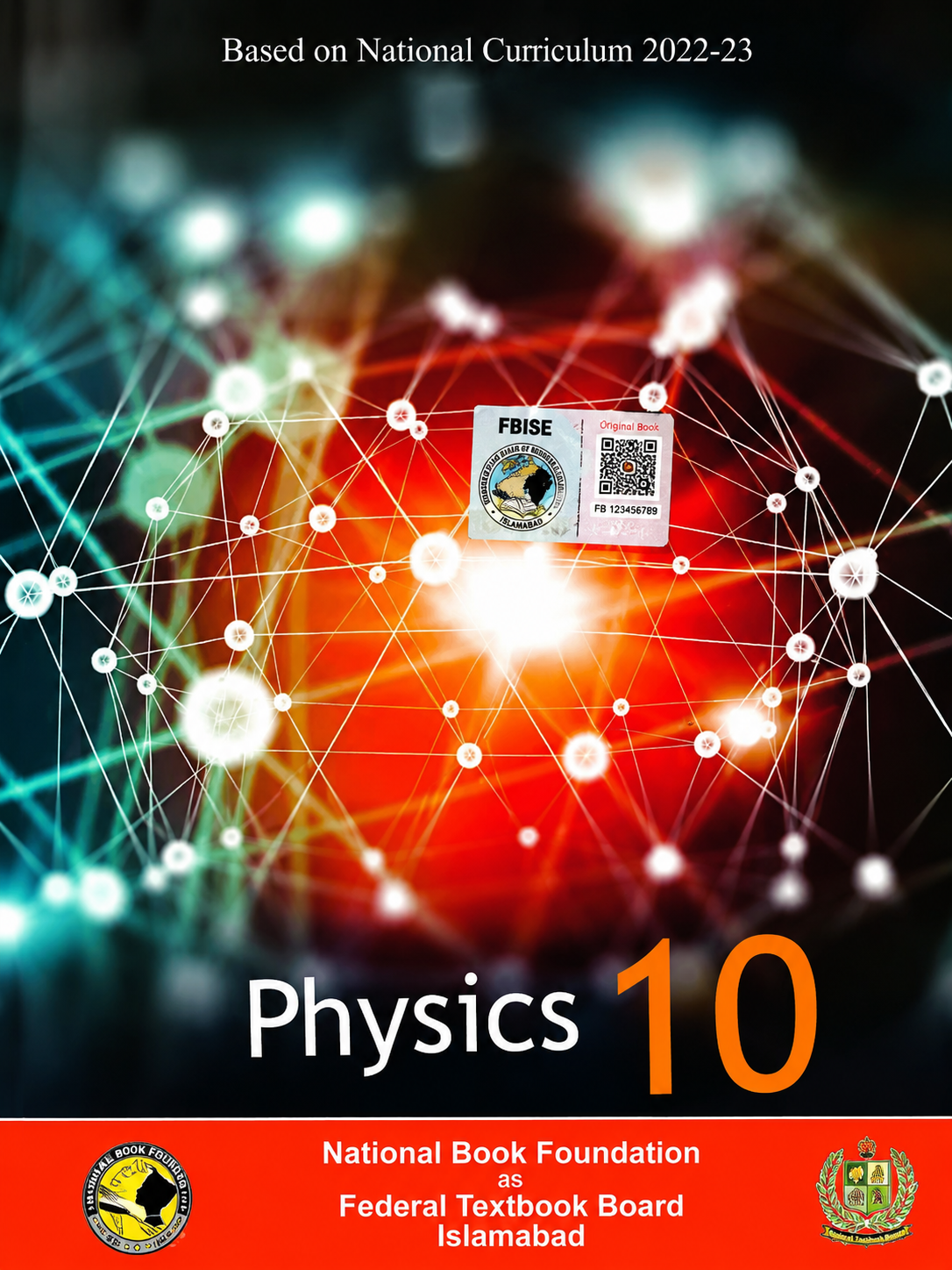
Class 10 Physics under the FBISE New Book (NBF) syllabus brings together twelve chapters that move from everyday thermal phenomena all the way to the structure of the atomic nucleus.
This overview walks through what each chapter covers, how the chapters connect to one another, and why this course forms such an important part of a student’s final year of secondary school science.
It is written to help both students planning their study schedule and teachers organizing their term, and it draws on the same notes and explanations prepared by the experienced faculty at HSA Notes.
Chapter Lists
| Chapter | Title |
|---|---|
| Chapter 10 | Heat Capacity and Modes of Heat Transfer |
| Chapter 11 | Thermal Expansion and Change of State |
| Chapter 12 | Waves |
| Chapter 13 | Sound |
| Chapter 14 | Optics |
| Chapter 15 | Electrostatics |
| Chapter 16 | Current Electricity |
| Chapter 17 | Electric Circuits |
| Chapter 18 | Electronics |
| Chapter 19 | Electromagnetism |
| Chapter 20 | Electromagnetic Waves |
| Chapter 21 | Nuclear Physics |
1. Heat Capacity and Modes of Heat Transfer
This chapter introduces heat capacity and specific heat capacity, explaining why some materials like water absorb large amounts of heat energy while barely changing temperature. Students learn the three modes of heat transfer, conduction, convection, and radiation.
2. Thermal Expansion and Change of State
This chapter looks at how solids, liquids, and gases expand when heated and contract when cooled, along with the practical problems this causes in bridges, railway tracks, and thermometers. It also covers what happens when matter changes state, from solid to liquid to gas and back again, introducing latent heat as the hidden energy involved in melting, freezing, boiling.
3. Waves
This chapter builds the foundation of wave motion, covering transverse and longitudinal waves, wavelength, frequency, amplitude, and wave speed. Students learn how energy travels through a medium without the medium itself moving from one place to another
4. Sound
This chapter focuses on sound as a longitudinal mechanical wave, covering how sound is produced, how it travels through different media, and properties such as pitch, loudness, and quality. Students study the speed of sound in different substances, the phenomenon of echo and reverberation, and applications like ultrasound and sonar. Real world examples such as musical instruments and noise pollution help connect the physics to daily life.
5. Optics
This chapter covers the behavior of light, including reflection, refraction, and the formation of images by mirrors and lenses. Students learn the laws governing these phenomena along with ray diagrams for concave and convex mirrors and lenses, and explore practical applications such as the human eye, cameras, and correction of vision defects.
6. Electrostatics
This chapter introduces electric charge, the forces between charges, and the concept of an electric field. Students learn Coulomb’s law, how objects become charged through friction, induction, and conduction, and how these principles explain everyday occurrences such as static shocks and lightning. The chapter also lays the groundwork for understanding electric potential and capacitance.
7. Current Electricity
This chapter explains electric current as the flow of charge, along with the concepts of potential difference, resistance, and Ohm’s law. Students learn how factors such as length, thickness, and material affect a conductor’s resistance, and study the relationship between voltage, current, and resistance in practical circuits.
8. Electric Circuits
This chapter builds on current electricity by exploring how components behave when connected in series and parallel circuits. Students learn to calculate equivalent resistance, analyze circuit diagrams, and understand the role of devices such as fuses and circuit breakers in electrical safety. Practical wiring examples, including household circuits, help students see the real world relevance of circuit design.
9. Electronics
This chapter introduces basic electronic components such as diodes and transistors, along with the difference between analog and digital signals. Students learn how semiconductor devices control the flow of current and explore simple applications such as rectification and switching.
10. Electromagnetism
This chapter explores the relationship between electricity and magnetism, including how a current carrying conductor produces a magnetic field and how a changing magnetic field can induce a current. Students study devices built on these principles such as electromagnets, electric motors, and generators, along with the law of electromagnetic induction.
11. Electromagnetic Waves
This chapter covers the nature and properties of electromagnetic waves, including the full electromagnetic spectrum from radio waves to gamma rays. Students learn how these waves differ from mechanical waves, particularly their ability to travel through a vacuum.
12. Nuclear Physics
This final chapter introduces the structure of the atomic nucleus, radioactivity, and the difference between alpha, beta, and gamma radiation. Students learn about nuclear fission and fusion, half life calculations, and the applications and risks associated with nuclear energy.
Notes and Support Available
For each of these twelve chapters, HSA Notes provides fully solved multiple choice questions with explanations, constructed and short response answers, detailed long response answers, and completely worked numerical problems that show every formula and substitution.
Online Classes
Alongside the written notes, HSA Notes also offers online classes for Class 10 Physics, taught by the same experienced faculty who prepare the solved content published on the website, giving students the option to combine self study with guided instruction just email us : hsanotes48@gmail.com
Have a Query?
For notes, online classes, or any question about this course, reach out to HSA Notes at hsanotes48@gmail.com
Frequently Asked Questions
How many chapters are in the FBISE Class 10 Physics NBF syllabus? There are twelve chapters, starting with Heat Capacity and Modes of Heat Transfer and ending with Nuclear Physics.
Which chapters are the most numerical heavy? Heat Capacity and Modes of Heat Transfer, Current Electricity, Electric Circuits, and Nuclear Physics all include significant calculation based questions that require careful use of formulas.
Do I need to study the chapters in order? It is recommended, since concepts such as wave properties and electric current are built on in later chapters, and studying in sequence makes those later topics much easier to understand.
Are complete solved notes available for every chapter? Yes, HSA Notes provides solved MCQs, short and long response answers, and numerical solutions for each of the twelve chapters, along with past papers and sample papers for exam practice.
Conclusion
Class 10 Physics under the FBISE NBF syllabus takes students on a journey from the warmth of a cup of tea to the energy locked inside an atomic nucleus, covering heat, waves, sound, light, electricity, magnetism, and nuclear physics along the way. With complete solved notes, past papers, and online classes available through HSA Notes, students have everything needed to build a strong foundation across all twelve chapters and approach their final exam with confidence.