
Introduction
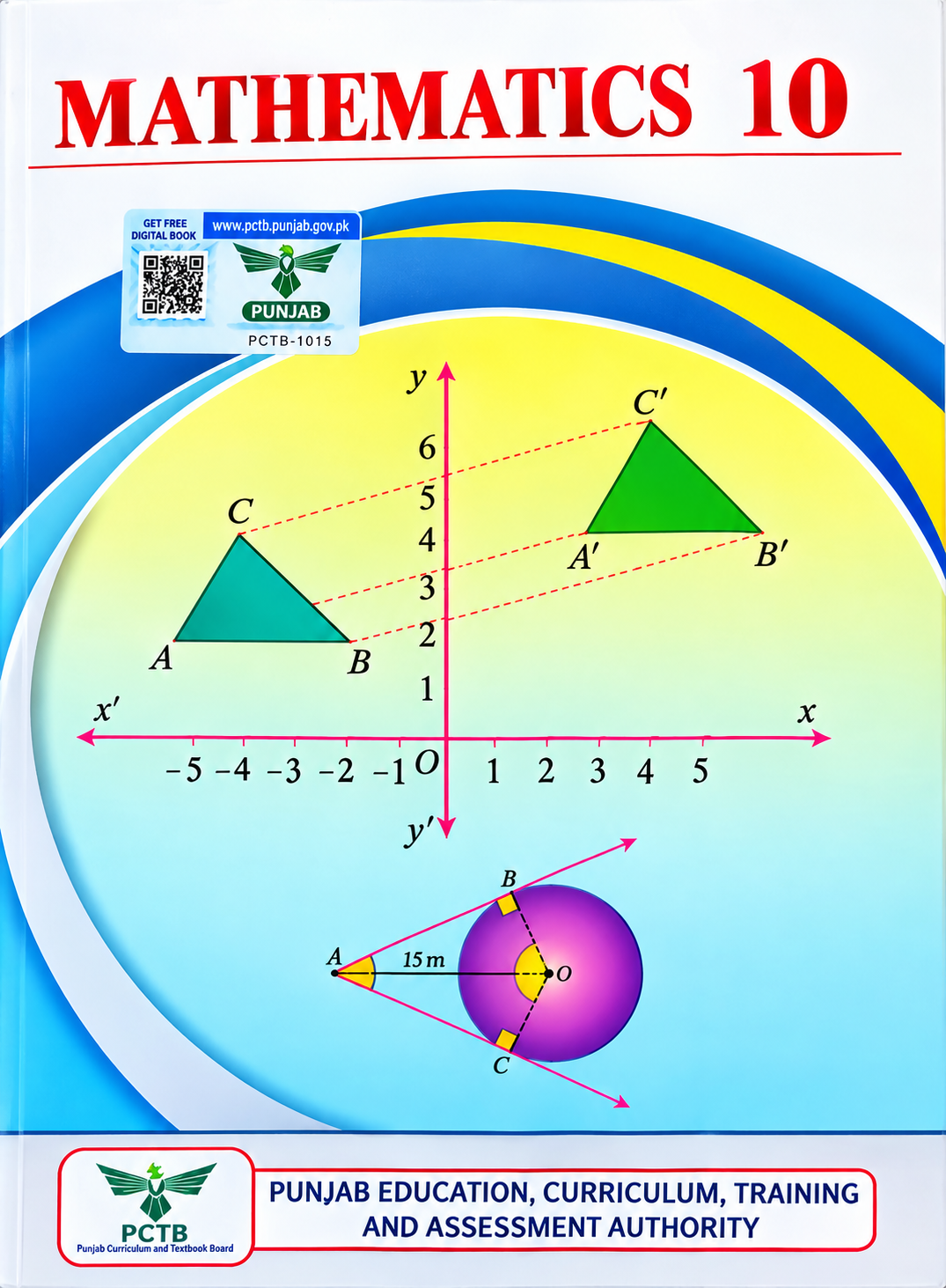
Unit 8 of the new PECTAA Class 10 Mathematics book turns to circle geometry, focusing on chords and arcs. A circle is the set of all points in a plane that are the same distance from a fixed centre. This unit builds a chain of theorems about chords, arcs, and the centre of a circle, and it shows how these ideas appear in decorative designs, rainbows, bridges, and roller coaster tracks.
🎓 Online Classes with Experienced Experts
Circle theorems are a favourite source of proof-based questions in the board exam, so a solid grip on this unit pays off directly in marks. These notes follow the new book for session 2026-27 and suit students of all Punjab boards.
What You Will Learn
By the end of this unit, students will be able to:
- identify the parts of a circle, including radius, chord, diameter, arc, and central angle;
- prove and apply the theorem that a unique circle passes through three non-collinear points;
- prove and apply theorems relating a perpendicular from the centre to a chord;
- prove and apply theorems about congruent and equidistant chords;
- relate congruent arcs to their corresponding chords and central angles;
- apply these results to real-world problems.
Key Topics Explained
1. Parts of a Circle
The radius is the distance from the centre to any point on the circle. A chord joins any two points on the circle, and a diameter is a chord that passes through the centre. An arc is a part of the circumference; a minor arc is smaller than a semicircle, and a major arc is larger. The angle formed at the centre by the two ends of a chord or arc is the central angle.
2. Circle Through Three Points
One and only one circle can pass through three non-collinear points. If the points are collinear, no circle can pass through all three.
3. Perpendicular from the Centre to a Chord
A line from the centre of a circle that bisects a chord (other than a diameter) is perpendicular to that chord. Conversely, a perpendicular drawn from the centre to a chord bisects the chord. This result is proved using congruent triangles, and it is often combined with the Pythagorean theorem to find the distance of a chord from the centre.
4. Congruent and Equidistant Chords
If two chords of a circle are equal in length, they are equidistant from the centre, and if two chords are equidistant from the centre, they are equal in length. This pair of results is used together to solve problems where symmetric chords appear, such as decorative lights placed at equal distances from the centre of a circular garden.
5. Congruent Arcs and Chords
If two arcs of a circle, or of congruent circles, are congruent, then their corresponding chords are equal, and the reverse is also true. Equal chords subtend equal angles at the centre, and equal central angles correspond to equal chords.
Worked Examples
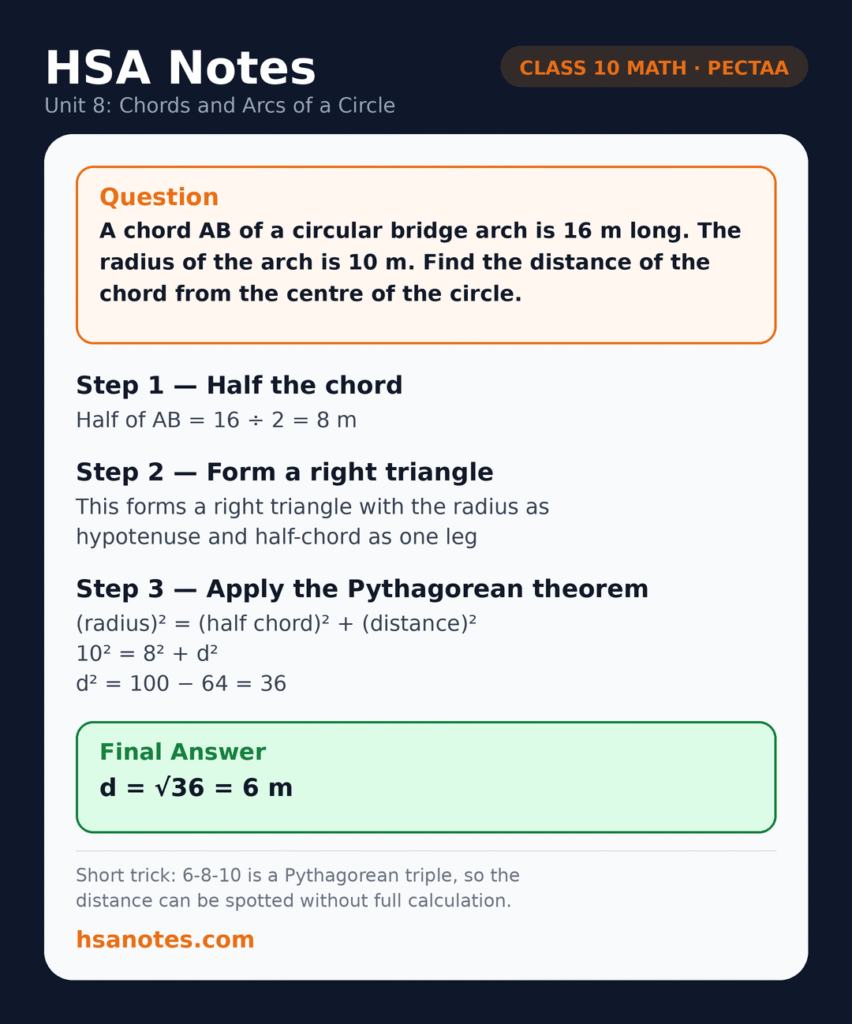
Example 1 (Perpendicular and Pythagoras): A chord AB of length 24 m lies across a circular arch of radius 13 m. Find the distance of the chord from the centre.
Half of AB is 12 m. Using the Pythagorean theorem, (radius)² = (half chord)² + (distance)², so 13² = 12² + d², giving d² = 169 − 144 = 25, so d = 5 m.
Example 2 (Equidistant chords): Two chords of a circle are each 4 cm from the centre. If one chord is 14 cm long, find the length of the other.
Since both chords are equidistant from the centre, they are congruent, so the second chord is also 14 cm.
Example 3 (Perpendicular from centre): A chord of length 10 cm is cut at right angles by a line from the centre of a circle of radius 6 cm. Find the distance from the centre to the chord.
Half the chord is 5 cm, so d² = 6² − 5² = 36 − 25 = 11, giving d = √11 cm.
Example 4 (Congruent chords and arcs): In a circle, chord AB equals chord CD. What can be said about arc AB and arc CD?
Since equal chords correspond to equal arcs, arc AB = arc CD.
Important Facts at a Glance
| Statement | Result |
|---|---|
| Perpendicular from centre to chord | Bisects the chord |
| Line bisecting a chord (not a diameter) from the centre | Perpendicular to the chord |
| Equal chords | Equidistant from the centre |
| Equidistant chords | Equal in length |
| Congruent arcs | Equal corresponding chords |
| Equal chords | Subtend equal angles at the centre |
Exercises in Unit 8
| Exercise | Main Focus |
|---|---|
| 8.1 | Perpendicular from the centre, distance of a chord, and related numericals |
| 8.2 | Congruent and equidistant chords, arcs, and central angles |
| Review Exercise 8 | MCQs, short and long questions |
Exam Tips
- Draw a clear, labelled diagram before starting any circle theorem question.
- Remember that the perpendicular from the centre to a chord always bisects it, which is the key step in most Pythagoras-based numericals.
- State the theorem you are using clearly before applying it in a proof.
- In equidistant-chord problems, check distances from the centre before concluding the chords are equal.
About HSA Notes
HSA Notes is a free educational platform for secondary and higher secondary students in Pakistan. It publishes solved notes, model papers, and study material aligned with the NBF, PECTAA, PCTAA, and FBISE curricula, covering Mathematics, Physics, Chemistry, Biology, Computer Science, and English. Our solutions are written by our own team, giving students clear, original, step-by-step help.
Online Classes
Students who want guided learning can join our online classes run by Hamdard Science Academy. The classes follow the new PECTAA book unit by unit, so Unit 8 theorems, examples, and exercises are taught in a clear order alongside these notes. To ask about the schedule, fees, or admission, email hsanotes48@gmail.com.
Conclusion
Chords and Arcs of a Circle is a compact unit built on a small set of related theorems. Once these theorems are understood and practiced, numerical and proof questions from this unit become quick and reliable marks. Free solved exercises and PDF notes are available on HSA Notes for all Punjab boards, and online classes are there if you need extra support.
1 thought on “Unit 8: Class 10 Math PECTAA Notes New Book”