Introduction
Inverse trigonometric functions recover an angle from a known trigonometric value. Unit 9 of the PECTAA New Book defines the inverse functions by restricting the domain, studies their domains, ranges and graphs, and proves and applies their identities.
🎓 Online Classes with Experienced Experts
What This Unit Covers
Unit 9 is organized into two graded exercises (9.1 and 9.2):
1. Inverse Trigonometric Functions and Their Graphs (Exercise 9.1) Students see why a trigonometric function must be restricted to a one-to-one interval before its inverse exists, learn the principal-value ranges, and find principal values of expressions such as sin⁻¹(√3/2) and cos⁻¹(−√2/2). They also evaluate mixed expressions like sin[cos⁻¹(3/5)] using right triangles and half-angle identities, and sketch the graphs of the inverse functions as reflections in y = x.
2. Identities and Proofs (Exercise 9.2) Students prove results such as sin⁻¹a + sin⁻¹b = sin⁻¹(…) and tan⁻¹a + tan⁻¹b = π/4 using the addition formulas, and solve equations that contain inverse tangent terms, rejecting extraneous roots.
A trigonometric function such as sine repeats its values, so it is not one-to-one and has no inverse on its full domain. This unit shows how restricting the domain to a suitable interval makes the function one-to-one, which allows its inverse to be defined. Students learn the inverse functions sin⁻¹x, cos⁻¹x, tan⁻¹x and their reciprocal partners, along with the exact domain and principal-value range of each one.
The unit then moves to evaluating expressions. Students find principal values such as sin⁻¹(√3/2) or cos⁻¹(−1/2), and simplify mixed expressions like sin(cos⁻¹(3/5)) by drawing a right triangle and reading off the required ratio. They also sketch the graph of each inverse function and see that it is the reflection of the restricted trigonometric curve in the line y = x.
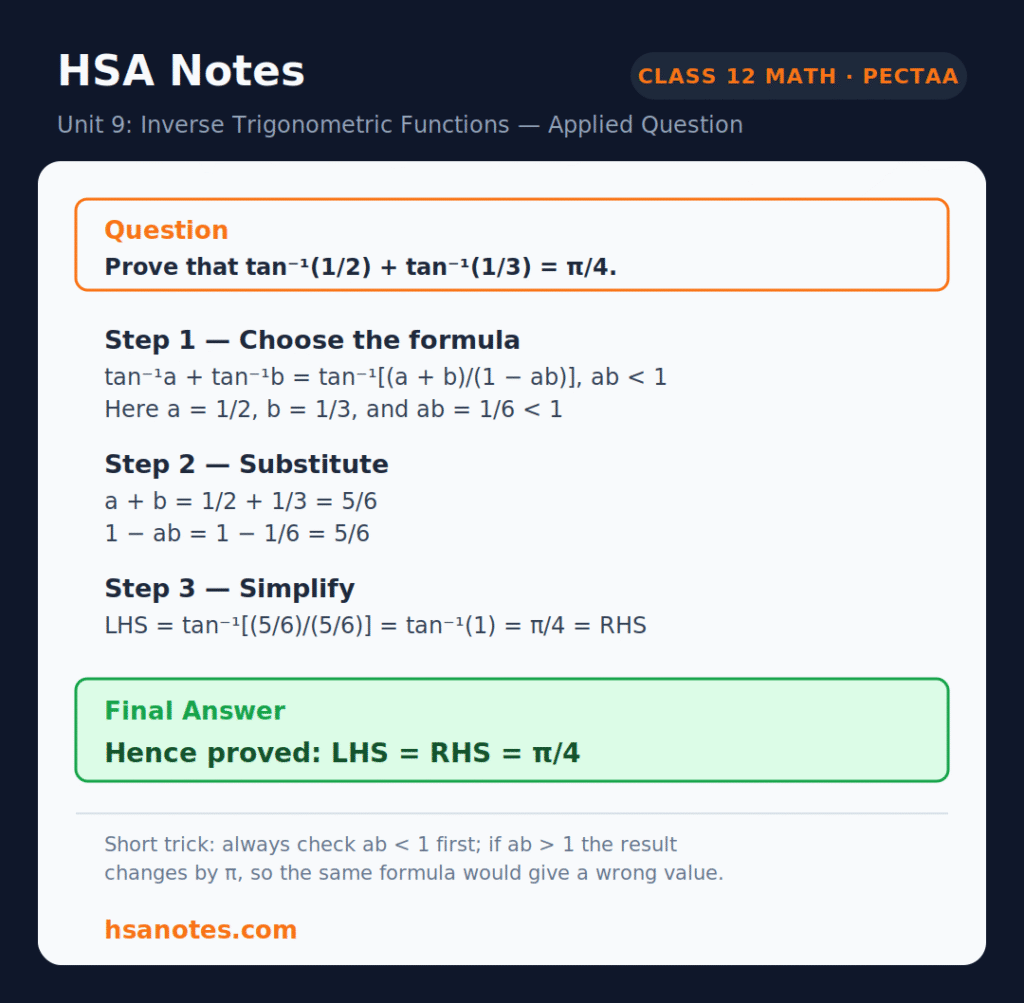
The final part deals with identities and proofs. Students prove statements such as tan⁻¹(1/2) + tan⁻¹(1/3) = π/4 using the addition formula, and solve equations that contain inverse tangent terms. A common exam trap is forgetting the condition ab < 1 in the addition formula, and another is keeping an extraneous root. Substituting every answer back into the original equation avoids both mistakes.
Key points to remember
- Learn the principal-value range of every inverse function exactly.
- Use a right triangle for expressions like sin(cos⁻¹x).
- Check the condition before using the inverse tangent addition formula.
- Verify each root of an equation by substitution.
Why This Unit Matters
Inverse trigonometric functions are needed for integration formulas, for solving equations in Unit 10, and for angle problems. Board questions are mostly principal values and identity proofs, so knowing each range exactly is the key to full marks.
How to Study Unit 9
- Memorise the principal-value range of each inverse function.
- For expressions like sin(cos⁻¹x), draw a right triangle and read the required ratio.
- Check the condition (such as ab < 1) before using the addition formula for inverse tangent.
- After solving an equation, substitute each root back and reject any that fail.
- Draw the graph of y = sin⁻¹x and remember it is the reflection of the restricted sine curve in y = x.
Practice Questions – Unit 9
(Original practice problems for self-assessment. Attempt them after studying the unit, then check your working against the solved examples in your notes.)
Short Questions
- Find the principal value of sin⁻¹(1/2).
- Find the principal value of cos⁻¹(−1/2).
- Find the principal value of tan⁻¹(−1).
- State the domain and range of y = sin⁻¹x.
- Find the value of sin⁻¹x + cos⁻¹x for x in [−1, 1].
- Find sin(cos⁻¹(3/5)).
Long Questions
- Prove that sin⁻¹(3/5) + sin⁻¹(8/17) = sin⁻¹(77/85).
- Prove that tan⁻¹(1/2) + tan⁻¹(1/5) + tan⁻¹(1/8) = π/4.
- Solve tan⁻¹(x + 1) + tan⁻¹(x − 1) = tan⁻¹(8/31).
- Find the value of cos(2 sin⁻¹(3/5)).
- Sketch the graph of y = sin⁻¹x, showing its domain and range.
Applied Questions
- A 10 m ladder leans against a wall with its foot 6 m from the wall. Find the angle between the ladder and the ground.
- A kite string 50 m long is taut with the kite 30 m above the ground. Find the angle the string makes with the ground.
- Find the angle of elevation of the top of a 40 m tower from a point 30 m from its base.
- A ramp rises 1.5 m over a horizontal distance of 6 m. Find its angle of inclination.
These practice questions are written to reinforce Unit 9 concepts and are separate from the textbook’s own exercises. Use them for extra revision before attempting the board-style exercises in the unit.
About HSA Notes
HSA Notes is an educational resource platform providing free study materials for Pakistani students, covering FBISE, Punjab, Sindh, and KP Boards in line with the New Books System. Materials span grades 9–12 across Mathematics, Chemistry, Biology, Physics, Computer Science, English, and Urdu, all prepared in a consistent, easy-to-follow branded format.
Besides free unit-wise notes and solved exercises, HSA Notes also offers online classes for students who want structured, teacher-guided sessions alongside self-study, useful for learners who need concepts explained step by step or want doubt-solving support beyond what a PDF can provide. For online classes, contact: hsanotes48@gmail.com
Conclusion
Unit 9 – Inverse Trigonometric Functions rewards precision: exact ranges, correct conditions in the addition formulas, and checking every root. Regular practice with these questions, and HSA Notes’ online classes where extra support is needed, will make the identities and principal values straightforward.