
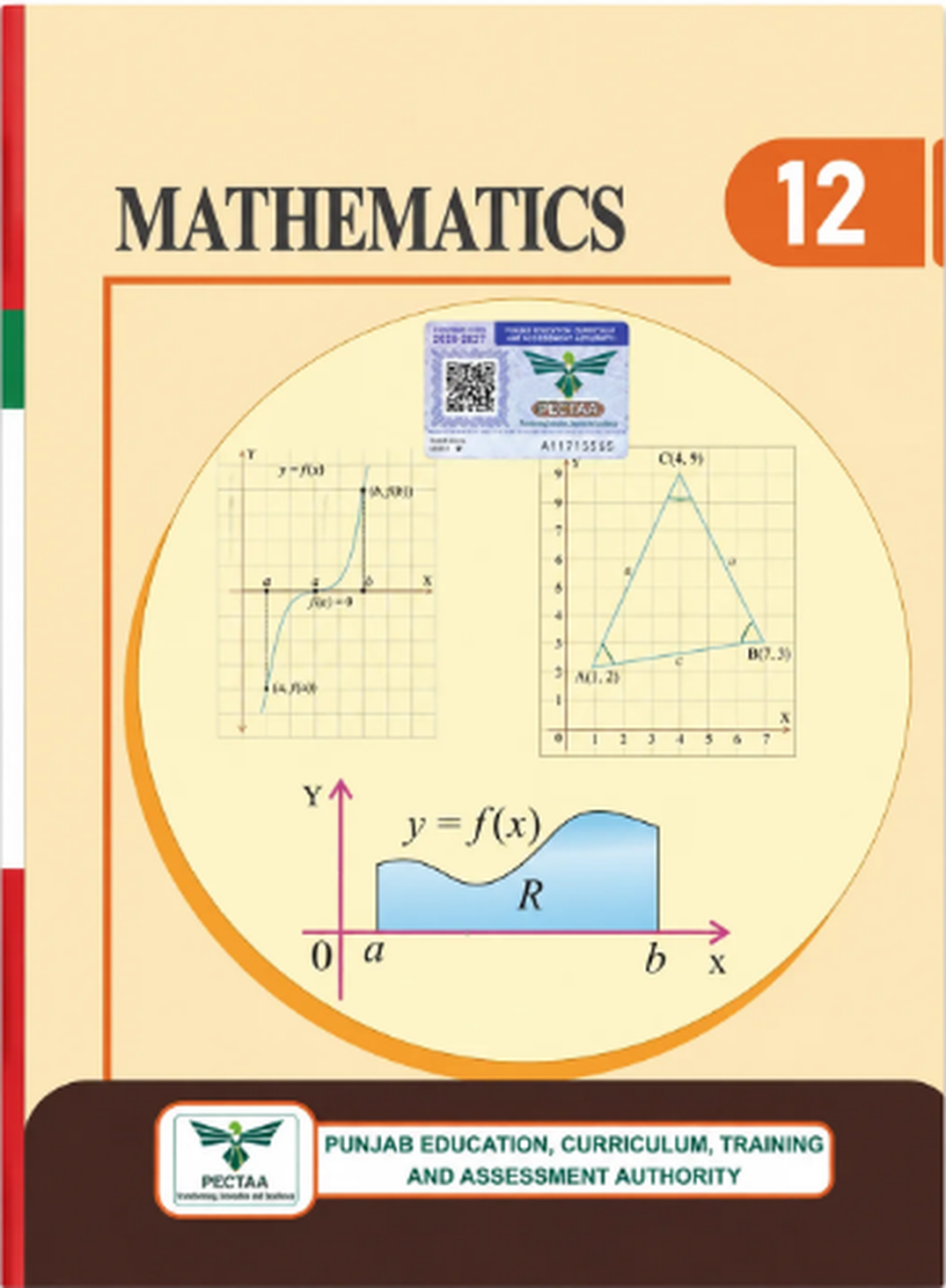
Introduction
Unit 3 of the Class 12 Mathematics PECTAA New Book builds directly on the differentiation techniques learned in Unit 2. It reverses the process of differentiation to introduce integration antiderivatives, indefinite integrals, and definite integrals then develops a full toolkit of integration techniques and applies them to area, volume, and real-life problems in physics, biology, economics, and medicine.
🎓 Online Classes with Experienced Experts
What This Unit Covers
Unit 3 is organized into seven graded exercises (3.1 to 3.7):
- Antiderivatives and the Indefinite Integral Students learn the definition of an antiderivative, the basic rules of integration (constant multiple, sum/difference, power rule, general power rule, linear substitution rule), and a table of standard integral formulas derived directly from differentiation formulas.
- Method of Substitution or Change of Variable This section reverses the Chain Rule to evaluate integrals by substituting u = g(x), covering algebraic, logarithmic, and exponential integrands, including cases where the derivative of the inner function must first be matched to the integrand.
- Trigonometric Substitution Students evaluate integrals containing √(a² – x²), √(a² + x²), and √(x² – a²) using the substitutions x = a sin θ, x = a tan θ, and x = a sec θ respectively, along with a set of special integral formulae proved using these substitutions.
- Integration by Parts This section derives the integration-by-parts formula from the Product Rule and applies it to products of algebraic, trigonometric, exponential, and logarithmic functions, including reduction-type integrals that require solving for the original integral algebraically.
- Integration by Using Partial Fractions Students break rational functions into simpler fractions across four cases — non-repeated linear factors, repeated linear factors, non-repeated irreducible quadratic factors, and repeated irreducible quadratic factors — and integrate each resulting term.
- The Definite Integral This part introduces the definite integral via the First and Second Fundamental Theorems of Calculus, along with the nine key properties of definite integrals (limit reversal, additivity, symmetry substitutions, even/odd function rules) used to simplify evaluation.
- Applications of Definite Integrals The unit closes with real-world applications: area under a curve and between two curves, consumer and producer surplus, volumes of solids of revolution (disk and cross-sectional methods), moment of inertia, distance/velocity/acceleration, population growth rate, average value of a function, and drug dosage calculated through Area Under the Curve (AUC).
Why This Unit Matters
Integration is the single most heavily applied unit in the syllabus — its techniques (substitution, trigonometric substitution, integration by parts, partial fractions) are used throughout the rest of the course and reappear directly in Unit 4 (Introduction to Analytic Geometry) and Unit 7 (Vectors and Kinematics).
Area and volume problems from Exercise 3.6 are a favourite source of long questions in board exams, and the real-life application problems from Exercise 3.7 (population growth, drug dosage, moment of inertia) are increasingly common in the new PECTAA paper pattern.
How to Study Unit 3
- Get the standard integral formula table (Rules 1–5 and the trigonometric/inverse-trigonometric integrals) fully memorized before attempting mixed problems — most errors in this unit come from misapplying the power rule to a non-polynomial expression.
- Practise recognizing which substitution to use (algebraic vs. trigonometric) by first checking whether the integrand contains a radical of the form √(a² ± x²) or √(x² – a²).
- For integration by parts, always apply the ILATE priority (Inverse, Logarithmic, Algebraic, Trigonometric, Exponential) when choosing the first function, and watch for reduction integrals where the original integral reappears on the right-hand side.
- For partial fractions, identify the case (linear, repeated, or quadratic factors) before setting up the equation, and use strategic values of x to solve for constants quickly.
- For area and volume problems, always sketch the region first and identify points of intersection before setting up the definite integral — most mistakes come from mixing up the upper and lower curve.
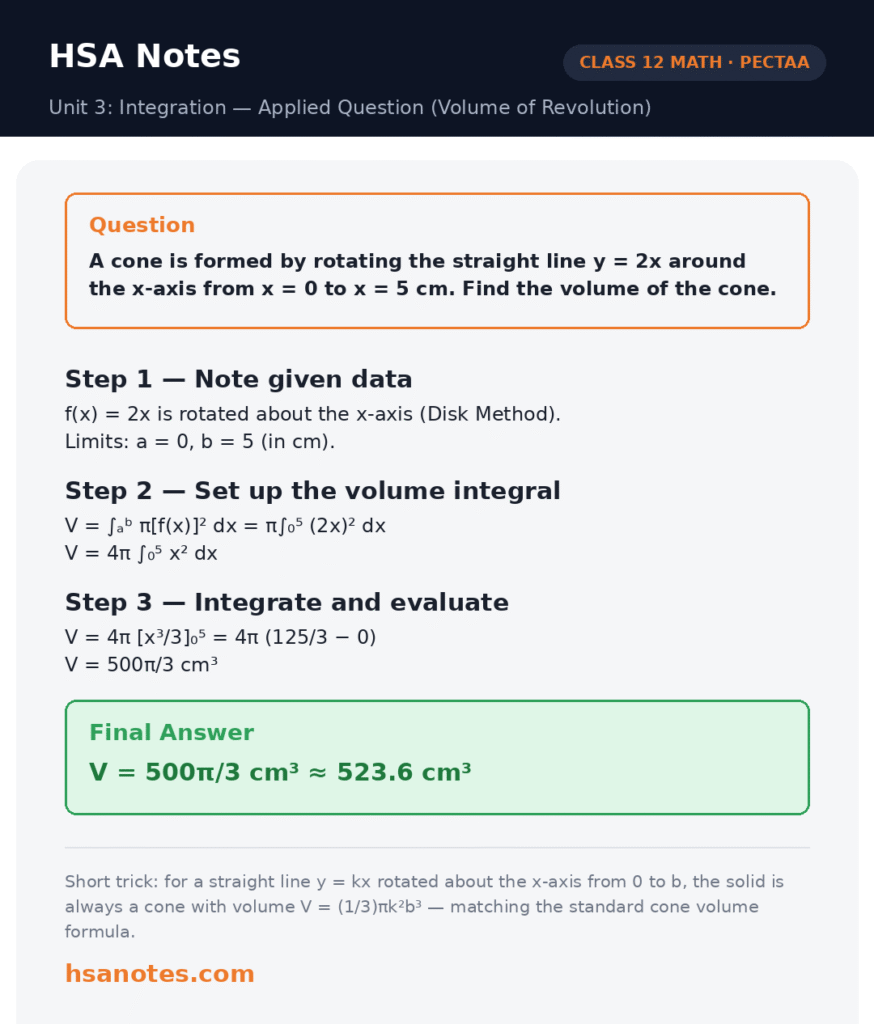
HSA Notes solved question card Class 12 Math PECTAA, Unit 3 Integration, Applied problem: a solid formed by rotating a straight line around the x-axis, solved step by step using the disk method to find the volume, final answer V = 500π/3 cm³ ≈ 523.6 cm³
Practice Questions – Unit 3
Short Questions
- Evaluate ∫(5x³ + 10x + 20) dx.
- Evaluate ∫sec x tan x dx.
- Evaluate ∫x(7x² + 8)⁹ dx using substitution.
- Find the moment of inertia formula and evaluate ∫₋₁¹(x⁵+1) dx.
- Evaluate ∫ln x dx using integration by parts.
- Write the partial fraction decomposition of (3x – 2)/[x(x – 1)(x – 2)].
Long Questions
- Evaluate ∫√(x² – 4x + 13) dx by completing the square and using a special integral formula.
- Evaluate ∫(3x + 5)/(x² + 4x + 3) dx using partial fractions.
- Show that ∫eᵃˣ sin bx dx = [1/√(a²+b²)] eᵃˣ sin(bx – tan⁻¹(b/a)) + c.
- Find the area bounded by the curves y = 13 – x² and y = 2x + 5.
- If f(4 – x) = f(x), show that ∫₀² f(2x) dx = ∫₀² f(x) dx.
Applied Questions
- The demand function for a commodity is p = 30 – 2x – x² and the supply function is p = –6 + 4x + x². Find the consumer’s surplus and producer’s surplus.
- Find the volume of the solid obtained by rotating the region bounded by y = x², x = 2, y = 0 about the x-axis.
- A particle moves along a straight line with acceleration a(t) = 12t – 36 (m/s²) and initial velocity v(0) = 30 m/s. Find the velocity function, the displacement, and the total distance travelled during 1 ≤ t ≤ 6.
- A patient is given an intravenous dose of an antibiotic with concentration C(t) = 8e⁻⁰·¹⁵ᵗ mg/L. Find the total drug exposure (AUC) from t = 0 to t = 6 hours, and determine if it meets a minimum requirement of 40 mg·hr/L.
About HSA Notes
HSA Notes is an educational resource platform providing free study materials for Pakistani students, covering FBISE, Punjab, Sindh, and KP Boards in line with the New Books System. Materials span grades 9–12 across Mathematics, Chemistry, Biology, Physics, Computer Science, English, and Urdu, all prepared in a consistent, easy-to-follow branded format.
Besides free unit-wise notes and solved exercises, HSA Notes also offers online classes for students who want structured, teacher-guided sessions alongside self-study — useful for learners who need concepts explained step by step or want doubt-solving support beyond what a PDF can provide. For online classes, contact: hsanotes48@gmail.com
Conclusion
Unit 3 Integration equips students with the full integration toolkit needed for the rest of Class 12 Mathematics: antiderivatives, substitution, trigonometric substitution, integration by parts, partial fractions, the definite integral, and its real-world applications in area, volume, economics, and medicine. These skills carry forward directly into Analytic Geometry (Unit 4) and Vectors/Kinematics (Unit 7), making a solid grip on this unit essential for scoring well across the paper. Practising the solved examples alongside the questions above, and joining HSA Notes’ online classes for extra guidance where needed, will help students build real confidence in this unit.
1 thought on “Unit 3: Class 12 Math PECTAA Notes New Book”