
Introduction
Complete Chapters Overview | All Punjab Boards | Free PDF Download
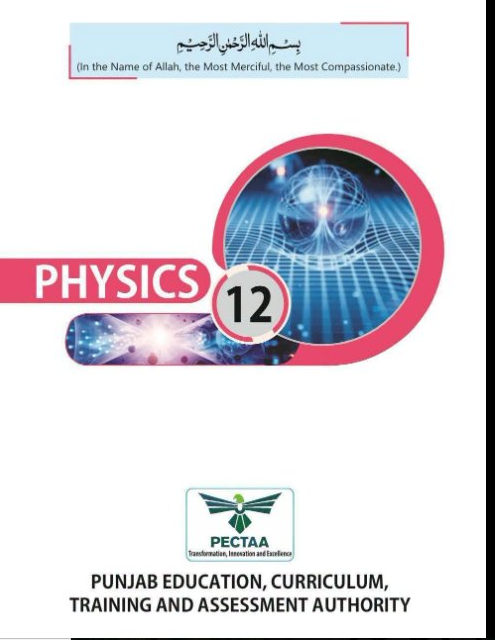
The 12th Class Physics Textbook (English Medium) 2025–2026 has been developed according to the latest PECTAA curriculum for students studying under Punjab Boards. Physics is one of the most important science subjects at the Higher Secondary School Certificate (HSSC) level because it explains the fundamental laws governing matter, energy, motion, electricity, light, and the universe.
The new PECTAA Physics textbook is designed to strengthen conceptual understanding, analytical thinking, scientific reasoning, and problem-solving skills. It introduces students to both classical and modern physics while connecting scientific theories to real-world applications in technology, engineering, medicine, and environmental sciences.
This textbook is suitable for students studying under all Punjab Boards, including Lahore, Gujranwala, Faisalabad, Multan, Rawalpindi, Sargodha, Bahawalpur, DG Khan, and Sahiwal Boards.
About the New Physics Textbook
The new Physics textbook follows a modern approach to learning by emphasizing conceptual clarity, practical applications, numerical problem-solving, and scientific inquiry. Students learn how physical principles explain natural phenomena and technological advancements that shape modern society.
Each chapter contains detailed explanations, solved numerical examples, practical activities, diagrams, and exercises that help students prepare effectively for board examinations and future studies.
Chapter-wise Overview
Chapter 1: Thermal Physics
Thermal Physics deals with heat, temperature, and the behavior of matter under different thermal conditions. This chapter explains how thermal energy affects substances and how heat transfer occurs in everyday life.
Important topics include:
- Temperature and heat
- Thermal equilibrium
- Specific heat capacity
- Heat transfer mechanisms
- Expansion of solids, liquids, and gases
- Laws of thermodynamics
- Thermal applications in industry
Students learn how thermal concepts are applied in engineering, manufacturing, and environmental systems.
Chapter 2: Simple Harmonic Motion
Simple Harmonic Motion (SHM) is one of the most important topics in mechanics. It describes repetitive motion occurring around an equilibrium position.
Important topics include:
- Oscillations and vibrations
- Characteristics of SHM
- Amplitude and frequency
- Periodic motion
- Springs and pendulums
- Energy in SHM
- Applications of oscillatory motion
This chapter helps students understand motion patterns found in nature, engineering systems, and modern technology.
Chapter 3: Physical Optics
Physical Optics explains the wave nature of light and the phenomena resulting from light waves interacting with matter.
Important topics include:
- Wave theory of light
- Interference
- Diffraction
- Polarization
- Optical instruments
- Light wave behavior
- Practical applications of optics
Students gain knowledge about technologies such as lasers, microscopes, telescopes, fiber optics, and communication systems.
Chapter 4: Electrostatics
Electrostatics studies electric charges at rest and the forces between them.
Important topics include:
- Electric charge
- Coulomb’s law
- Electric fields
- Electric potential
- Capacitors
- Charge distribution
- Applications of electrostatic forces
The chapter provides the foundation for understanding modern electrical and electronic systems.
Chapter 5: Alternating Current
Alternating Current (AC) is widely used in power generation and electrical transmission systems.
Important topics include:
- Alternating current principles
- AC circuits
- Resistance, inductance, and capacitance
- RMS values
- Power in AC circuits
- Transformers
- Electrical power distribution
Students learn how electricity is generated, transmitted, and utilized in homes and industries.
Chapter 6: Quantum Physics
Quantum Physics introduces students to modern scientific theories describing matter and energy at atomic and subatomic levels.
Important topics include:
- Quantum theory
- Photoelectric effect
- Wave-particle duality
- Atomic models
- Quantum energy levels
- Modern applications of quantum mechanics
This chapter explains scientific developments that have revolutionized technology, electronics, and computing.
Chapter 7: Nuclear and Particle Physics
This chapter explores the structure of atomic nuclei and the fundamental particles that make up matter.
Important topics include:
- Atomic nucleus
- Radioactivity
- Nuclear reactions
- Nuclear fission
- Nuclear fusion
- Elementary particles
- Applications of nuclear technology
Students learn about energy production, medical applications, and scientific research involving nuclear processes.
Chapter 8: Medical Physics
Medical Physics applies physical principles to healthcare and medical technology.
Important topics include:
- Medical imaging
- X-rays
- Ultrasound
- MRI technology
- Radiation therapy
- Diagnostic techniques
- Physics in healthcare
This chapter demonstrates how physics contributes to disease diagnosis, treatment, and patient care.
Chapter 9: Space and Environment
Space and Environment is a modern chapter that explores the universe and environmental challenges facing humanity.
Important topics include:
- Structure of the universe
- Solar system
- Space exploration
- Satellites
- Climate change
- Environmental sustainability
- Space technology applications
Students develop an understanding of both cosmic phenomena and environmental responsibilities.
Importance of Physics
Physics is often called the foundation of modern science because it explains how the universe operates through fundamental laws and principles.
The subject helps students:
- Develop scientific reasoning
- Improve analytical thinking
- Strengthen problem-solving abilities
- Understand modern technology
- Build quantitative skills
- Explore natural phenomena
Physics plays a crucial role in scientific discovery and technological innovation.
Benefits of Achieving Good Marks in Physics
Students who perform well in Physics gain several academic advantages:
- Better overall HSSC results
- Increased merit for university admissions
- Strong preparation for entry tests
- Improved analytical and mathematical abilities
- Enhanced scientific understanding
- Greater opportunities in technical fields
Strong performance in Physics is particularly beneficial for students pursuing science and engineering careers.
Preparation for Higher Education
The concepts covered in the 12th Class Physics textbook form the foundation for advanced studies in:
- Engineering
- Physics
- Computer Science
- Artificial Intelligence
- Electronics
- Electrical Engineering
- Mechanical Engineering
- Aerospace Engineering
- Medical Sciences
- Environmental Sciences
Students who master these concepts find it easier to succeed in higher education and professional careers.
Real-World Applications of Physics
The knowledge gained from Physics is applied in many areas of modern life, including:
- Power generation
- Telecommunications
- Electronics
- Medical imaging
- Transportation systems
- Space exploration
- Renewable energy technologies
- Environmental monitoring
Understanding Physics enables students to appreciate how scientific discoveries improve everyday life.
Study Material Available
HSANOTES.COM provides:
- Complete Physics Notes
- Solved Exercises
- Numerical Solutions
- MCQs
- Short Questions
- Long Questions
- Important Definitions
- Formula Sheets
- Chapter-wise Tests
- Model Papers
- Guess Papers
- PDF Study Material
Boards Covered
This textbook is suitable for:
- Lahore Board
- Gujranwala Board
- Faisalabad Board
- Multan Board
- Rawalpindi Board
- Sargodha Board
- Bahawalpur Board
- DG Khan Board
- Sahiwal Board
Conclusion
The 12th Class Physics Textbook (English Medium) 2025–2026 provides students with a comprehensive understanding of thermal physics, oscillations, optics, electricity, quantum mechanics, nuclear science, medical applications, and space sciences. The textbook develops scientific knowledge, analytical skills, and problem-solving abilities that are essential for success in higher education and modern scientific careers. By mastering these concepts, students build a strong foundation for future studies in science, engineering, technology, and medicine.
HSANOTES.COM
Email: hsanotes48@gmail.com
DISCLAIMER
This material is shared strictly for educational, learning, and academic support purposes only.
All copyrights, trademarks, textbook content, and publication rights belong to their respective publishers, textbook boards, authors, and organizations.
HSA NOTES does not claim ownership of official textbook content. This material is provided to help students and teachers access educational resources easily and free of cost.
If any publisher or copyright owner has concerns regarding this material, they may contact us for review or necessary action.