
Introduction
Complete Units Overview | All Punjab Boards | Free PDF Textbook Download
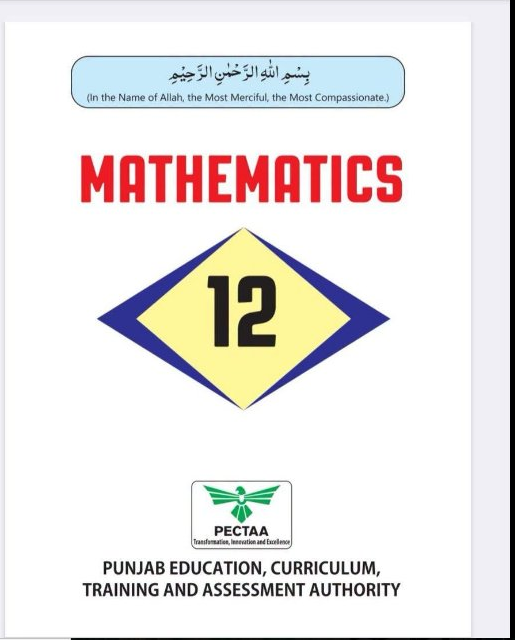
The 12th Class Mathematics Textbook (English Medium) 2025–2026 has been developed according to the latest PECTAA curriculum for students studying under Punjab Boards. Mathematics is one of the most important subjects at the Higher Secondary School Certificate (HSSC) level and serves as the foundation for higher studies in engineering, computer science, data science, economics, physics, statistics, and various technological fields.
The new PECTAA Mathematics textbook focuses on conceptual understanding, analytical reasoning, problem-solving skills, and practical applications of mathematical concepts. Students are encouraged to develop logical thinking and mathematical proficiency through a structured progression of topics ranging from calculus and analytical geometry to vectors and numerical methods.
This textbook is suitable for students studying under all Punjab Boards, including Lahore, Gujranwala, Faisalabad, Multan, Rawalpindi, Sargodha, Bahawalpur, DG Khan, and Sahiwal Boards.
About the New Mathematics Textbook
The new Mathematics textbook introduces advanced mathematical concepts that are essential for university-level education and professional careers. The book emphasizes both theoretical understanding and practical problem-solving techniques.
Each unit contains worked examples, exercises, graphical representations, and application-based questions that help students build confidence in mathematical reasoning and examination preparation.
Unit-wise Overview
Unit 1: Graphical Representation of Functions
This unit focuses on the graphical interpretation of mathematical functions. Students learn how different types of functions behave and how graphs can be used to represent mathematical relationships visually.
Important topics include:
- Domain and range
- Function behavior
- Graph transformations
- Polynomial functions
- Rational functions
- Exponential and logarithmic functions
The unit helps students develop visualization skills that are essential for higher mathematics.
Unit 2: Further Differentiation
Differentiation is one of the most important concepts in calculus. This unit extends students’ understanding of derivatives and their applications.
Important topics include:
- Higher-order derivatives
- Implicit differentiation
- Parametric differentiation
- Derivatives of trigonometric functions
- Applications of differentiation
- Rates of change
Students learn how differentiation is used in science, engineering, and economics.
Unit 3: Integration
Integration is introduced as the inverse process of differentiation. This unit develops students’ ability to solve problems involving areas, accumulation, and continuous change.
Important topics include:
- Indefinite integration
- Definite integration
- Integration techniques
- Substitution methods
- Applications of integration
- Area under curves
Integration provides a foundation for advanced calculus and engineering applications.
Unit 4: Differential Equations
Differential equations describe relationships involving changing quantities.
Important topics include:
- Formation of differential equations
- First-order differential equations
- Solutions of differential equations
- Applications in science and engineering
- Mathematical modeling
Students learn how differential equations are used to represent real-world systems.
Unit 5: Analytical Geometry
Analytical geometry combines algebra and geometry to study shapes using coordinate systems.
Important topics include:
- Coordinate geometry
- Straight lines
- Distance formula
- Midpoint formula
- Slope calculations
- Geometric interpretations
This unit develops problem-solving skills involving geometric figures.
Unit 6: Conic Sections
Conic sections are important curves formed by intersecting a plane with a cone.
Important topics include:
- Circle
- Parabola
- Ellipse
- Hyperbola
- Equations of conics
- Graphical representations
Students gain an understanding of geometric structures used in physics, astronomy, and engineering.
Unit 7: Kinematics
Kinematics applies mathematical concepts to the study of motion.
Important topics include:
- Distance and displacement
- Velocity and acceleration
- Motion in a straight line
- Applications of calculus in motion
- Graphical analysis of motion
This unit demonstrates the practical use of mathematics in physics.
Unit 8: Numerical Method
Numerical methods provide techniques for solving mathematical problems approximately when exact solutions are difficult.
Important topics include:
- Approximation techniques
- Numerical solutions
- Iterative methods
- Error analysis
- Practical computations
Students learn computational approaches widely used in modern science and engineering.
Unit 9: Inverse Trigonometric Functions and Their Graphs
This unit extends trigonometry by introducing inverse trigonometric functions.
Important topics include:
- Inverse sine
- Inverse cosine
- Inverse tangent
- Domains and ranges
- Graphs of inverse functions
- Applications in problem solving
Students develop a deeper understanding of trigonometric relationships.
Unit 10: Solution of Trigonometric Equations
This unit focuses on solving equations involving trigonometric functions.
Important topics include:
- Basic trigonometric equations
- General solutions
- Trigonometric identities
- Analytical techniques
- Practical applications
Students improve their ability to solve complex trigonometric problems.
Unit 11: Vector Valued Functions and Their Differentiations
Vectors play an important role in advanced mathematics, physics, and engineering.
Important topics include:
- Vector functions
- Vector operations
- Differentiation of vector functions
- Motion in space
- Applications of vectors
This unit introduces concepts that are essential for higher studies in science and engineering.
Importance of Mathematics
Mathematics is often called the language of science because it provides the tools needed to understand and solve complex problems.
The subject helps students:
- Develop logical thinking
- Improve analytical abilities
- Strengthen problem-solving skills
- Enhance quantitative reasoning
- Build scientific understanding
- Prepare for technical careers
Mathematics is essential for success in many academic and professional fields.
Benefits of Achieving Good Marks in Mathematics
Students who perform well in Mathematics gain several advantages:
- Better overall HSSC results
- Increased merit for university admissions
- Strong preparation for entry tests
- Improved analytical and reasoning abilities
- Greater opportunities in technical and scientific fields
Strong mathematical skills are highly valued in higher education and employment.
Preparation for Higher Education
The concepts covered in this textbook form the foundation for university-level studies in:
- Engineering
- Computer Science
- Artificial Intelligence
- Data Science
- Mathematics
- Statistics
- Economics
- Physics
- Actuarial Science
- Business Analytics
Students who master these concepts are better prepared for academic and professional success.
Study Material Available
HSANOTES.COM provides:
- Complete Mathematics Notes
- Solved Exercises
- MCQs
- Short Questions
- Long Questions
- Important Formulas
- Numerical Solutions
- Chapter-wise Tests
- Model Papers
- Guess Papers
- PDF Study Material
Boards Covered
This textbook is suitable for:
- Lahore Board
- Gujranwala Board
- Faisalabad Board
- Multan Board
- Rawalpindi Board
- Sargodha Board
- Bahawalpur Board
- DG Khan Board
- Sahiwal Board
Conclusion
The 12th Class Mathematics Textbook (English Medium) 2025–2026 provides a comprehensive understanding of advanced mathematical concepts required for higher education and professional careers. Through topics such as calculus, analytical geometry, conic sections, trigonometry, vectors, and numerical methods, students develop strong analytical and problem-solving skills. The textbook serves as an essential resource for examination preparation and future studies in science, engineering, technology, and mathematics-related disciplines.
HSANOTES.COM
Email: hsanotes48@gmail.com
DISCLAIMER
This material is shared strictly for educational, learning, and academic support purposes only.
All copyrights, trademarks, textbook content, and publication rights belong to their respective publishers, textbook boards, authors, and organizations.
HSA NOTES does not claim ownership of official textbook content. This material is provided to help students and teachers access educational resources easily and free of cost.
If any publisher or copyright owner has concerns regarding this material, they may contact us for review or necessary action.