
Introduction
Unit 1 of the new NBF Functional Mathematics FBISE Grade 9 textbook, based on the National Curriculum of Pakistan 2025, is about Financial Arithmetic.
🎓 Online Classes with Experienced Experts
This unit connects mathematics directly to money matters that students see every day: changing currency for travel or online shopping, buying and selling goods at a profit or loss, getting a discount at a store, and paying or earning a commission. The whole unit is built on real-life word problems rather than abstract formulas, which is the main idea behind the “Functional Mathematics” subject itself. These notes follow the new NBF book for session 2026-27.
What You Will Learn
By the end of this unit, students will be able to:
- define currency and exchange rates, and convert money from one currency to another;
- solve real-life problems involving buying and selling foreign currency;
- identify cost price (CP), selling price (SP), profit, and loss, and calculate profit or loss percentage;
- understand marked price (MP) and discount, and calculate the selling price after a discount;
- define commission and calculate it when the rate of commission and total sales are known.
Key Topics Explained
1. Currency and Exchange Rate
Currency is the money used in a country, such as the Pakistani Rupee (PKR), the US Dollar (USD), or the Japanese Yen (JPY).
An exchange rate is the rate at which the money of one country can be exchanged for the money of another country.
The buying exchange rate is the rate at which a bank or exchange company buys foreign currency from a customer, and the selling exchange rate is the rate at which it sells foreign currency to a customer. The difference between the two is the exchange margin, which is the bank’s profit.
2. Converting Currency
To convert an amount from one currency to another, set up a simple proportion using the given exchange rate, then scale it to the amount in question. The same method works whether converting into or out of Pakistani Rupees, and it also applies to comparing a manual calculation against a currency converter app, where small differences occur because apps use more precise, real-time rates.
3. Cost Price, Selling Price, Profit, and Loss
The cost price (CP) is the price at which an item is bought, including the purchase price plus any additional expenses such as transport. The selling price (SP) is the price at which it is sold.
If SP is greater than CP, a profit is made; if SP is less than CP, a loss occurs. Profit and loss percentages are always calculated on the cost price, never on the selling price.
4. Marked Price and Discount
The marked price (MP), also called the written price, is the price printed on an article before any reduction. A discount is a reduction given on the marked price to attract customers.
Discount is always calculated on the marked price, not on the cost price. The selling price after discount can be found directly by applying the remaining percentage to the marked price.
5. Commission
Commission is the amount paid to an agent, such as a travel agent, property dealer, or salesman, for selling goods or collecting payments on behalf of someone else. Commission is always calculated on the amount of sales, using the rate of commission given as a percentage.
Important Formulas at a Glance
| Concept | Formula |
|---|---|
| Profit | SP − CP |
| Loss | CP − SP |
| Profit % | (Profit ÷ CP) × 100% |
| Loss % | (Loss ÷ CP) × 100% |
| Discount | MP − SP |
| Discount % | (Discount ÷ MP) × 100% |
| Selling price after discount | (100% − Discount%) × MP |
| Commission | (Rate of commission ÷ 100) × SP |
Worked Examples
Example 1 (Currency conversion): Mr. Imran wants to exchange 8,000 PKR to Saudi Riyals, if 1 SAR = 75 PKR.
1 PKR = 1/75 Riyal, so 8,000 PKR = (1/75) × 8,000 = 106.67 Riyals.
Example 2 (Currency conversion): Zeeshan wants to exchange PKR 5,000,000 to US Dollars, if 1 USD = 280.125 PKR.
5,000,000 ÷ 280.125 = 17,849.17 Dollars.
Example 3 (Profit and loss): A trader bought a table for Rs. 6,000, spent Rs. 1,500 on transport, then sold it for Rs. 7,000. Find his profit or loss percent.
CP = 6,000 + 1,500 = Rs. 7,500. SP = Rs. 7,000. Since CP > SP, there is a loss.
Loss = 7,500 − 7,000 = Rs. 500. Loss % = (500 ÷ 7,500) × 100 = 6.67%.
Example 4 (Commission): An agent earns 1.5% commission on the sale of a house for Rs. 20 Million. Find the commission.
Commission = (1.5 ÷ 100) × 20,000,000 = Rs. 300,000.
Example 5 (Commission, reverse): A property dealer charges 2.5% commission and receives Rs. 25,000. Find the selling price of the property.
25,000 = (2.5 ÷ 100) × SP, so SP = 25,000 ÷ 0.025 = Rs. 1,000,000.
Exercises in Unit 1
| Exercise | Main Focus |
|---|---|
| 1.1 | Currency conversion using given and current exchange rates, manual vs. app comparison |
| 1.2 | Cost price, selling price, profit and loss, profit/loss percentage |
| 1.3 | Discount, marked price, and commission |
| Review Exercise 1 | MCQs, short and long questions |
Exam Tips
- Always set up a simple one-unit proportion first when converting currency, then scale it up.
- Remember that profit and loss percentages are based on cost price, while discount percentage is based on marked price.
- Add every additional expense (like transport) to the cost price before comparing it with the selling price.
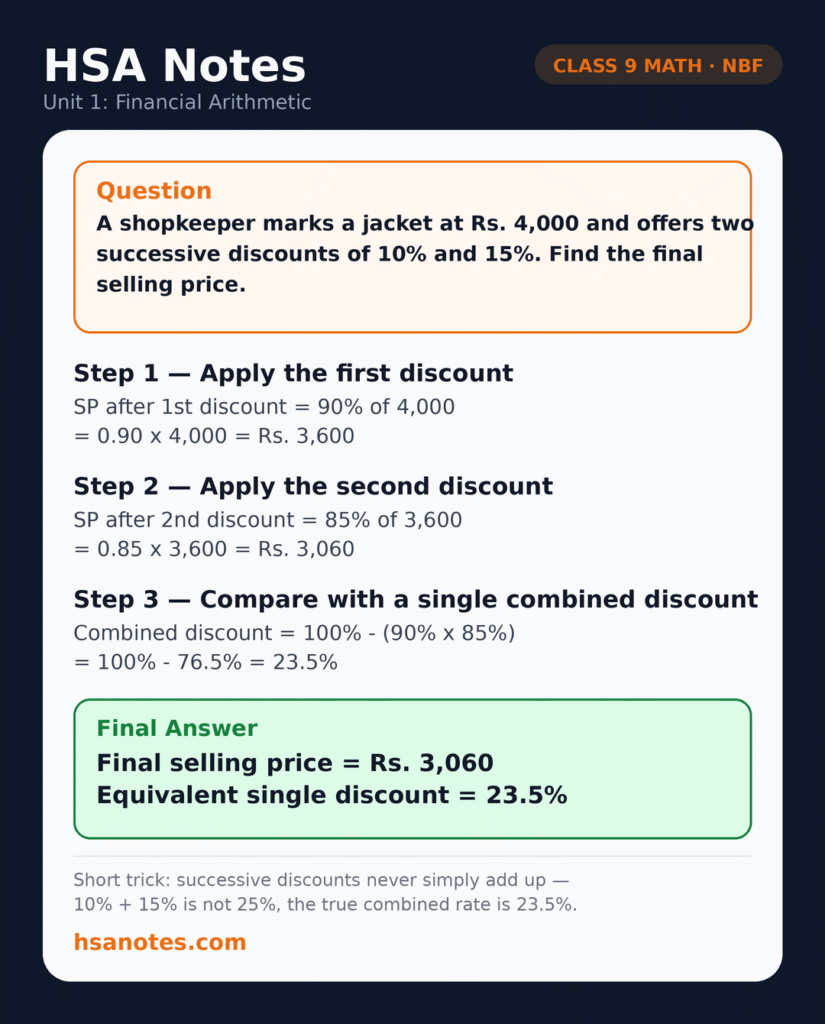
- For successive discounts, apply them one after another rather than simply adding the percentages.
- Write the commission formula clearly and substitute the given rate and sales value carefully.
About HSA Notes
HSA Notes is a free educational platform for secondary and higher secondary students in Pakistan. It publishes solved notes, model papers, and study material aligned with the NBF, PECTAA, PCTAA, and FBISE curricula, covering Mathematics, Physics, Chemistry, Biology, Computer Science, and English. Our solutions are written by our own team, giving students clear, original, step-by-step help.
Online Classes
Students who want guided learning can join our online classes run by Hamdard Science Academy. The classes follow the new NBF book unit by unit, so Unit 1 concepts, examples, and exercises are taught in a clear order alongside these notes. To ask about the schedule, fees, or admission, email hsanotes48@gmail.com.
Conclusion
Financial Arithmetic connects classroom mathematics to everyday money decisions, from currency exchange to shopping discounts. With steady practice on the exercises, this unit becomes an easy source of marks, since every question follows the same small set of formulas. Free solved exercises and PDF notes are available on HSA Notes, and online classes are there if you need extra support.

1 thought on “Unit 1: Class 9 Functional Math NBF Notes New Book”