
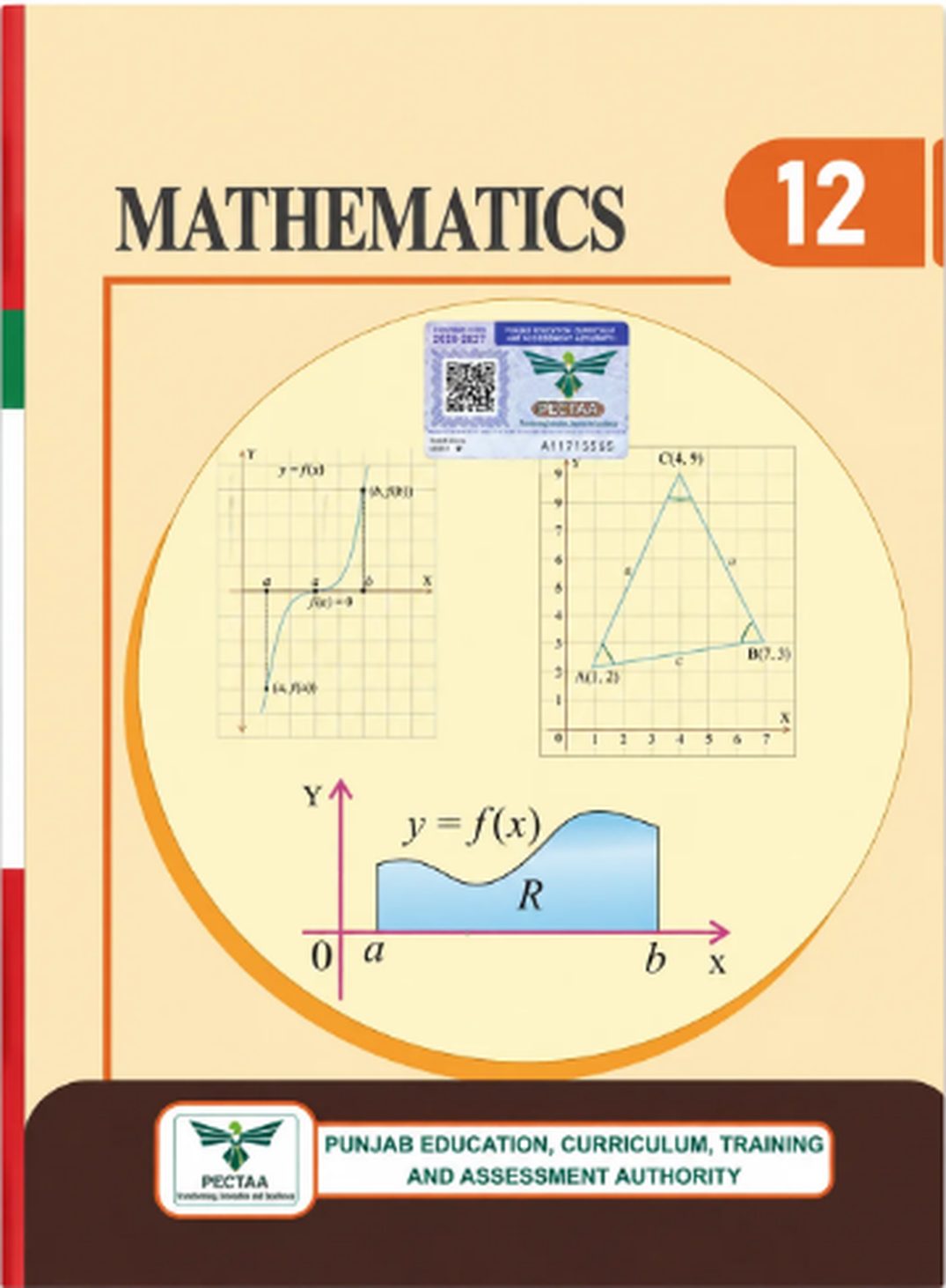
Introduction
Many equations in science and engineering, such as those mixing polynomials with trigonometric, exponential, or logarithmic terms, cannot be solved exactly by algebra.
🎓 Online Classes with Experienced Experts
Unit 8 of the Class 12 Mathematics PECTAA New Book teaches how to approximate their real roots step by step, and how to estimate definite integrals when direct integration is impractical.
What This Unit Covers
Unit 8 is organized into four graded exercises (8.1 to 8.4):
1. Basic Principles and the Graphical Method (Exercise 8.1) Students learn what a root (zero) of f(x) means, how it appears geometrically as the point where the graph crosses the x-axis, and how a sign change of f(x) over an interval, together with continuity, guarantees a root in that interval. Roots are read from graphs to two decimal places.
2. Bisection, Regula-Falsi and Newton–Raphson Methods (Exercise 8.2) This is the core of the unit. Students choose an interval of sign change, fix the accuracy using the tolerance rule |f(c)| < 10⁻ⁿ / 2 for n decimal places, and refine the root iteration by iteration using:
- the Bisection Method (repeatedly halving the interval),
- the Regula-Falsi Method (using the line joining the interval end-points), and
- the Newton–Raphson Method (xₙ₊₁ = xₙ – f(xₙ)/f′(xₙ)), which converges fastest but needs f′(x) ≠ 0 near the starting value.
3. The Trapezium Rule (Exercise 8.3) Students approximate definite integrals by dividing the interval into equal subintervals and summing trapezium areas. They also compare the approximate value with the exact value from the Fundamental Theorem of Calculus and see that the error shrinks as the number of subintervals increases.
4. Real-Life Applications (Exercise 8.4) The unit closes with applied problems: chemical equilibrium concentration, blood-flow rate in an artery, equilibrium charge in a nonlinear LC circuit, decoding-speed and phase-shift problems in secure communication, and operating voltage in an electric circuit, each solved with a suitable numerical method.
Why This Unit Matters
Numerical methods are the practical side of calculus: they show how calculators and computers actually find roots and integrals. Board exams typically ask for one iterative method question with a stated accuracy and one Trapezium Rule question, and the steps are highly scoring because every iteration is written out in a fixed format.
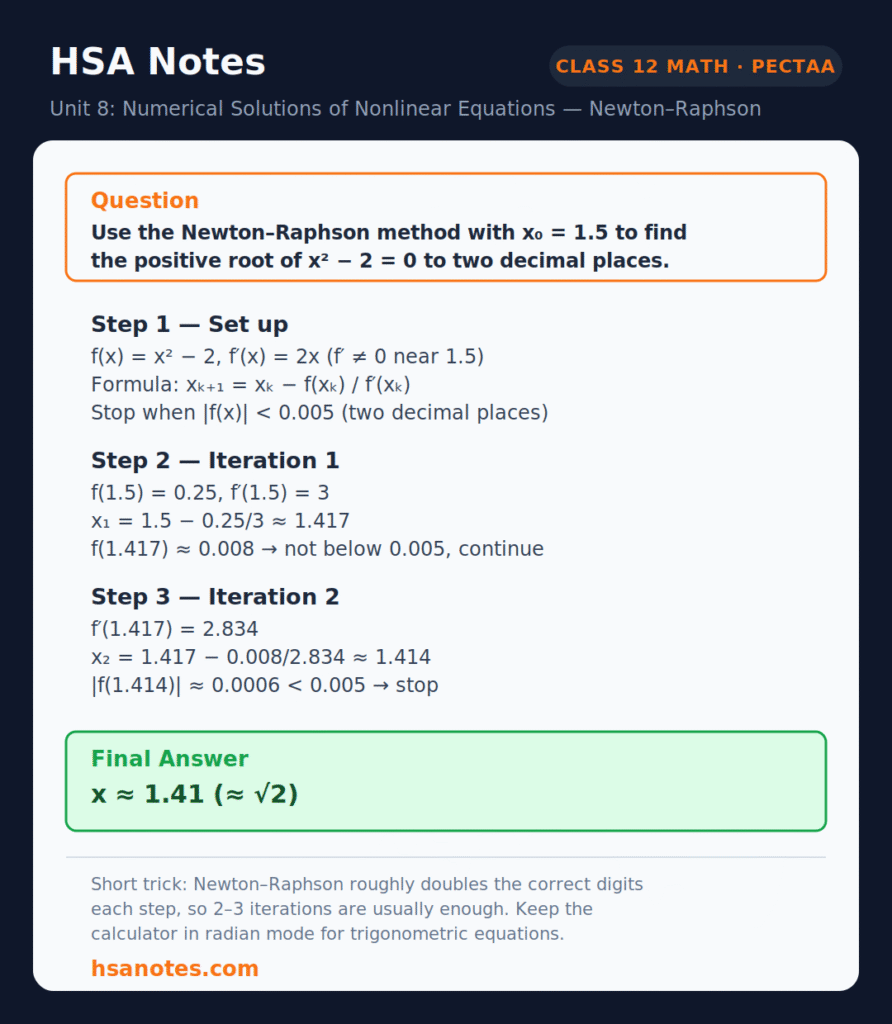
How to Study Unit 8
- Set your calculator to radian mode before any trigonometric equation, and fix the number of decimal places to match the required accuracy.
- Always show the sign-change check (f(a) and f(b) with opposite signs) before starting an iteration; examiners look for it.
- Write every iteration in a table (n, a, b, midpoint, f(midpoint)) for Bisection and Regula-Falsi so no step is missed.
- For Newton–Raphson, compute f′(x) first and confirm it is non-zero near your starting value.
- For the Trapezium Rule, write h = (b – a)/n and list all f(xᵢ) values before substituting into the formula.
Practice Questions – Unit 8
(Original practice problems for self-assessment. Attempt them after studying the unit, then check your working against the solved examples in your notes.)
Short Questions
- Define a root of the equation f(x) = 0 and state its geometric meaning.
- Show that f(x) = x³ + x – 1 has a root in the interval [0, 1].
- What condition must |f(c)| satisfy for a root c to be accurate to 3 decimal places?
- Write the Newton–Raphson formula and state the condition on f′(x) needed to use it.
- Write the Trapezium Rule formula for n equal subintervals of [a, b].
- Perform one step of the Bisection Method on f(x) = x² – 3 in [1, 2] and state the new interval.
Long Questions
- Use the Bisection Method to find a root of x³ – 2x – 5 = 0 in [2, 3], correct to two decimal places.
- Use the Regula-Falsi Method to find the root of x² – x – 1 = 0 in [1, 2], correct to two decimal places.
- Use the Newton–Raphson Method with x₀ = 0.5 to find the root of cos x – x = 0 correct to three decimal places.
- Use the Trapezium Rule with n = 4 to approximate ∫₀² x² dx, then compare with the exact value.
- Use the Trapezium Rule with h = 0.2 to approximate ∫₀¹ 1/(1 + x²) dx.
Applied Questions
- The equilibrium concentration x (moles per litre) of a substance satisfies x² + 0.3x – 0.1 = 0. Use the Bisection Method to find the positive value of x correct to two decimal places.
- The voltage x across a circuit component satisfies x³ – 3x – 4 = 0. Use the Newton–Raphson Method with x₀ = 2 to find x correct to three decimal places.
- Show that eˣ = 3x has a root in [0, 1] and find it to two decimal places using the Regula-Falsi Method.
- A car’s speed (m/s) is recorded every 2 seconds: t = 0, 2, 4, 6, 8 gives v = 0, 6, 10, 12, 13. Use the Trapezium Rule to estimate the distance travelled in 8 seconds.
These practice questions are written to reinforce Unit 8 concepts and are separate from the textbook’s own exercises. Use them for extra revision before attempting the board-style exercises in the unit.
About HSA Notes
HSA Notes is an educational resource platform providing free study materials for Pakistani students, covering FBISE, Punjab, Sindh, and KP Boards in line with the New Books System. Materials span grades 9–12 across Mathematics, Chemistry, Biology, Physics, Computer Science, English, and Urdu, all prepared in a consistent, easy-to-follow branded format.
Besides free unit-wise notes and solved exercises, HSA Notes also offers online classes for students who want structured, teacher-guided sessions alongside self-study, useful for learners who need concepts explained step by step or want doubt-solving support beyond what a PDF can provide. For online classes, contact: hsanotes48@gmail.com
Conclusion
Unit 8 Numerical Solutions of Nonlinear Equations gives students a dependable toolkit for problems that algebra alone cannot solve: locating roots graphically, refining them with Bisection, Regula-Falsi and Newton–Raphson, estimating integrals with the Trapezium Rule, and applying all of this to real situations in chemistry, medicine, electronics, and communication systems. Practising every iteration in a clear tabular format, alongside the questions above, and joining HSA Notes’ online classes for extra guidance where needed, will help students score confidently in this unit.
1 thought on “Unit 8: Class 12 Math PECTAA Notes New Book”