
Introduction
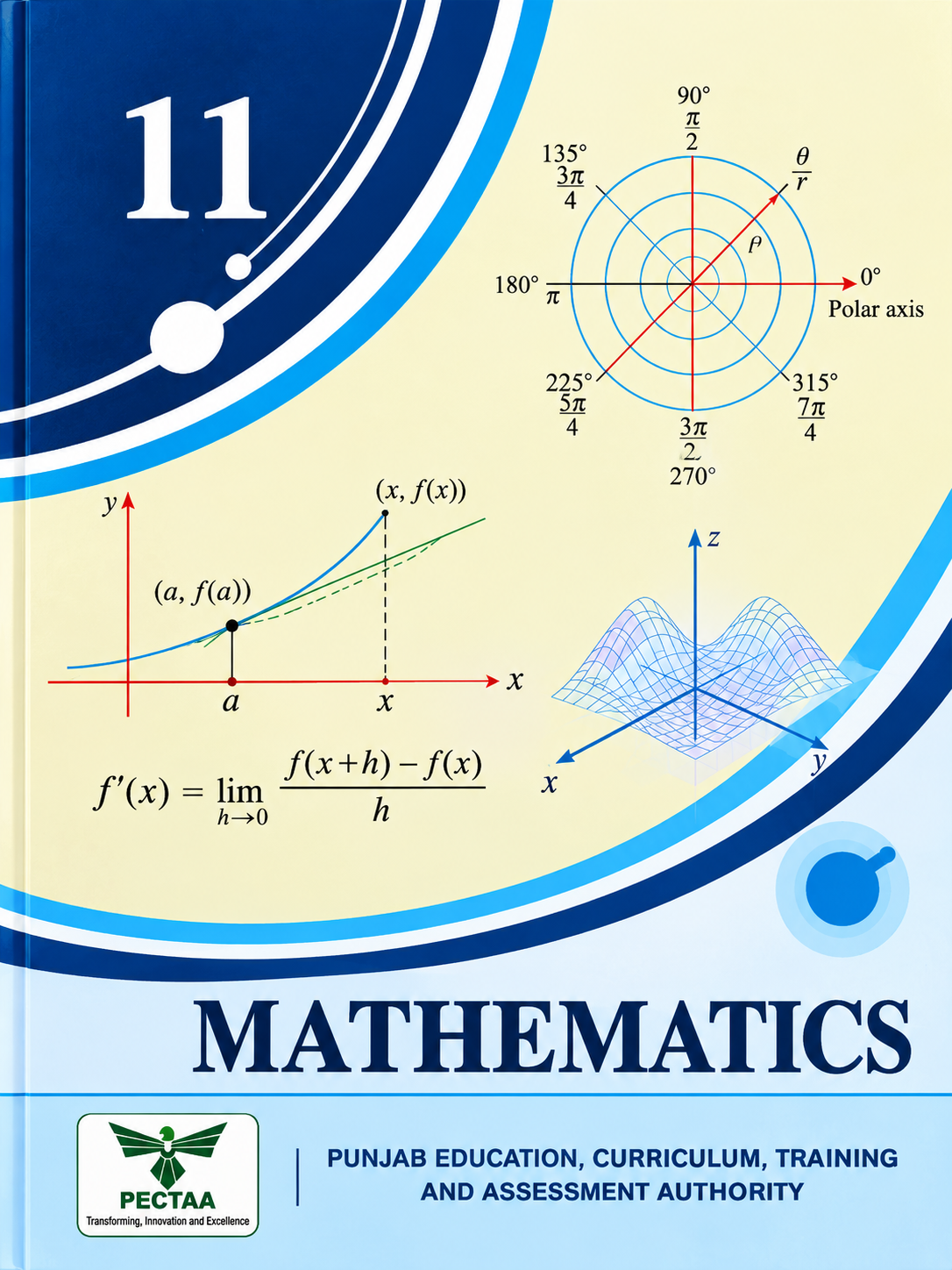
Struggling with Mathematics Class 11 under the new book for Punjab Boards? HSA Notes provides comprehensive, easy to understand solved notes for the latest PCTB Math book, aligned with publishers including PECTAA.
These notes cover all 14 units with step by step solutions, graphs, diagrams, methods, and answers for exercises and review exercises, covering every question and every part. Students from Bahawalpur, Dera Ghazi Khan, Faisalabad, Gujranwala, Lahore, Multan, Rawalpindi, Sahiwal, and Sargodha boards can get the PDF directly on the site for free reference, . Teachers, lecturers, and professionals will also find these resource
All 14 Units
For all units, notes include easy solutions, graphs, diagrams, and free sharing, view the PDF.
| No. | Unit | Link |
|---|---|---|
| 1 | Complex Numbers | Notes |
| 2 | Functions and Graphs | Notes |
| 3 | Theory of Quadratic Functions | Notes |
| 4 | Matrices and Determinants | Notes |
| 5 | Partial Fractions | Notes |
| 6 | Sequences and Series, | Notes |
| 7 | Permutations and Combinations | Notes |
| 8 | Mathematical Induction and Binomial Theorem | Notes |
| 9 | Division of Polynomials | Notes |
| 10 | Trigonometric Identities | Notes |
| 11 | Trigonometric Functions and their Graphs | Notes |
| 12 | Limit and Continuity | Notes |
| 13 | Differentiation | Notes |
| 14 | Vectors in Space | Notes |
Why Choose These Mathematics Class 11 Solved Notes?
Tailored for the Punjab Boards Class 11 Math new book syllabus, these notes break down complex concepts into simple explanations, and each unit’s PDF can be viewed directly to practice all questions.
- Complex Numbers
Introduces real and imaginary numbers and their standard forms.
Students learn operations, conjugates, modulus, and properties of complex numbers.
These concepts help solve equations that have no real number solutions. - Functions
Explains functions, domain, range, and different types of functions.
Students learn composition, inverse functions, and representations using graphs and formulas.
The unit develops the foundation for advanced algebra and calculus. - Quadratic Functions
Covers quadratic equations, roots, graphs, and their properties.
Students learn factorization, the quadratic formula, discriminant, vertex, and axis of symmetry.
These methods are used to solve algebraic and real life problems.
Official Youtube Channel : www.youtube.com/@PECTAAlearnersclub
- Matrices and Determinants
Introduces matrices and their arrangement in rows and columns.
Students learn matrix operations, determinants, inverses, and solving simultaneous equations.
Matrices are widely used in algebra, geometry, and applied mathematics. - Partial Fractions
Explains how complicated rational expressions can be separated into simpler fractions.
Students learn different cases of partial fractions and methods for finding unknown constants.
This technique makes algebraic expressions easier to simplify and solve. - Sequences and Series
Introduces ordered patterns of numbers and their general terms.
Students study arithmetic and geometric sequences and calculate sums of their terms.
The unit develops skills for recognizing patterns and solving numerical problems. - Permutations, Combinations and Probability
Explains different ways of arranging and selecting objects.
Students learn permutations, combinations, and their formulas before applying them to probability.
These concepts are useful for counting problems and situations involving uncertainty. - Mathematical Induction
Introduces mathematical induction as a method of proving mathematical statements.
Students learn the base case and inductive step to establish results for positive integers.
It is commonly used to prove formulas, inequalities, and divisibility results. - Polynomials
Covers polynomial expressions, division, factors, coefficients, and roots.
Students learn the Remainder Theorem and Factor Theorem to analyze polynomial equations.
These methods help simplify polynomials and find their factors and zeros. - Trigonometric Identities
Introduces important identities involving sine, cosine, tangent, and related ratios.
Students learn to simplify expressions and prove identities using standard formulas.
These skills are essential for solving advanced trigonometric problems. - Graphs of Trigonometric Functions
Explains the graphs of sine, cosine, tangent, and related functions.
Students study amplitude, period, maximum and minimum values, and transformations.
The unit helps students understand trigonometric functions visually. - Limits and Continuity
Introduces limits and explains the value a function approaches near a point.
Students learn different techniques for evaluating limits and understanding continuity.
These concepts provide the foundation for calculus and differentiation. - Differentiation
Introduces derivatives as the rate of change and slope of a curve.
Students learn differentiation rules and apply them to algebraic and trigonometric functions.
The unit also covers gradients, maxima, minima, and rates of change. - Vectors in Space
Introduces vectors and their representation in three dimensional space.
Students learn vector components, magnitude, direction, addition, subtraction, and scalar multiplication.
These concepts are useful in geometry, physics, engineering, and three dimensional mathematics.
How the Fourteen Units Fit Together
The syllabus opens with Complex Numbers, Functions and Graphs, and the Theory of Quadratic Functions, building the algebraic foundation used throughout the rest of the course.
Matrices and Determinants and Partial Fractions follow, before the syllabus moves into Sequences and Series, Permutations and Combinations, and Mathematical Induction and the Binomial Theorem, three units that share a common thread of pattern recognition and formal proof.
Division of Polynomials bridges back into algebra before the course shifts into trigonometry across three connected units, Trigonometric Identities, Trigonometric Functions and their Graphs, and eventually into calculus with Limit and Continuity and Differentiation.
The course closes with Vectors in Space, which draws on both the algebraic and geometric skills built across the earlier units.
Benefits for Punjab Boards Students, Teachers, Lecturers, and Experts
For Students: Simplify tough topics with step by step solutions, and view the PDF directly for exam preparation.
For Teachers and Lecturers: Use these notes as a teaching guide or answer key for classes.
For Professionals and Experts: Use these notes as a quick reference for advanced mathematics topics.
Join Our Online Classes
Need help with Class 11 Math? Enroll in Hamdard Science Academy’s online classes for full guidance across all 14 units.
Contact: hsanotes48@gmail.com
Frequently Asked Questions
How many units are covered in the Class 11 Mathematics new book? There are 14 units in total, starting with Complex Numbers and ending with Vectors in Space.
Which Punjab boards are these notes suitable for? These notes are suitable for students from Bahawalpur, Dera Ghazi Khan, Faisalabad, Gujranwala, Lahore, Multan, Rawalpindi, Sahiwal, and Sargodha boards, since all follow the same new book syllabus.
Do I need to download the PDF to view the notes? No, the PDF for each unit can be viewed directly on the site for free reference without downloading.
Are these notes useful for teachers as well as students? Yes, teachers and lecturers can use these solved notes as a teaching guide or answer key, and professionals can use them as a quick reference for advanced topics.
Conclusion
With all 14 units of the Class 11 Mathematics new book linked in one place, from Complex Numbers through to Vectors in Space, Punjab Boards students, teachers, and professionals have a complete, free reference for the entire syllabus. Explore each unit’s dedicated page for full step by step solutions, graphs, and diagrams, and reach out to Hamdard Science Academy for online class guidance whenever needed.
Best of luck for your Class 11 Mathematics exams!