
Introduction
Complete Guide | All Punjab Boards | Free PDF Study Resource
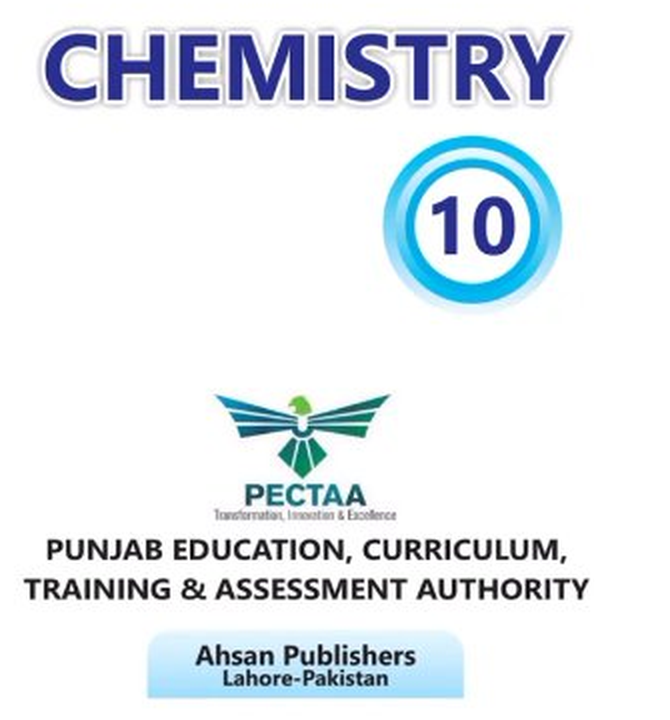
The 10th Class Chemistry Textbook (English Medium) 2025–2026 is based on the latest PECTAA curriculum designed for all Punjab Boards. This updated textbook focuses on conceptual understanding, scientific reasoning, and practical application of chemistry in real-life situations.
Chemistry is a fundamental science that explains the composition, structure, properties, and transformations of matter. The new curriculum emphasizes understanding chemical principles rather than memorization, enabling students to develop strong analytical and problem-solving skills.
This textbook is highly important for students preparing for careers in medical sciences, engineering, pharmacy, biotechnology, chemical industries, and research fields. It also builds a strong foundation for FSc-level chemistry and competitive examinations.
Students from all Punjab Boards including Lahore, Gujranwala, Faisalabad, Multan, Rawalpindi, Sargodha, Bahawalpur, DG Khan, and Sahiwal can use this book for exam preparation and conceptual learning.
About the 10th Class Chemistry Textbook (English Medium)
The English Medium Chemistry textbook is structured to develop a step-by-step understanding of chemical concepts. It starts from basic physical chemistry and gradually moves toward advanced topics such as organic chemistry and biochemistry.
Each chapter includes clear explanations, diagrams, chemical equations, and real-life applications. The textbook also emphasizes practical knowledge to help students understand laboratory experiments and industrial processes.
Detailed Chapter-wise Overview
Chapter 14: States of Matter and Phase Changes
This chapter explains the different states of matter—solid, liquid, and gas—and how substances change from one state to another.
Students study melting, freezing, boiling, condensation, evaporation, and sublimation. The kinetic molecular theory is used to explain particle behavior in different states.
Chapter 15: Stoichiometry
Stoichiometry deals with the quantitative relationships in chemical reactions.
Topics include mole concept, Avogadro’s number, balancing chemical equations, limiting reagents, and mass-volume calculations. Students learn how to perform chemical calculations accurately.
Chapter 16: Electrochemistry
This chapter explains the relationship between electricity and chemical reactions.
Students study oxidation-reduction reactions, galvanic cells, electrolytic cells, electrode potential, and applications such as batteries and electroplating.
Chapter 17: Reaction Kinetics
This chapter focuses on the rate of chemical reactions.
Students learn factors affecting reaction rates such as temperature, concentration, surface area, and catalysts. The concept of activation energy is also introduced.
Chapter 18: Salts
This chapter explains the formation, properties, and classification of salts.
It includes acid-base reactions, neutralization, and the importance of salts in industry, agriculture, and daily life.
Chapter 19: Nitrogen and Sulphur
This chapter covers the properties, compounds, and industrial importance of nitrogen and sulfur.
Students also learn about environmental impacts such as acid rain and nitrogen cycle.
Chapter 20: Water
This chapter explains the structure, properties, and importance of water.
It includes hardness of water, purification methods, and its role as a universal solvent in biological and industrial processes.
Water is the most essential, abundant inorganic compound on Earth, vital for all known forms of life. Made up of two hydrogen atoms and one oxygen atom (H₂O), it acts as the “universal solvent” in biological processes and exists naturally in liquid, solid, and gaseous states.
Chemical Formula: H₂O.
Density: Water is densest at 4 °C (which allows ice to float, insulating water bodies below).
Boiling Point: 100 °C at standard atmospheric pressure (sea level).
Universal Solvent: Because of its polar molecule structure, it dissolves more substances than any other liquid, serving as the foundation for metabolic and biological functions
Chapter 21: Organic Chemistry
This chapter introduces carbon compounds and their classification.
Students learn about bonding in carbon, functional groups, and basic organic reactions that form the foundation of organic chemistry.
Chapter 22: Hydrocarbons
This chapter explains compounds made of carbon and hydrogen.
It covers alkanes, alkenes, and alkynes along with their properties, reactions, and uses in fuels and industries.
Chapter 23: Monohydroxy Alkanes (Alcohols)
This chapter focuses on alcohols, their structure, properties, and uses.
Students study ethanol, methanol, oxidation reactions, and industrial applications.
Chapter 24: Carboxylic Acids
This chapter introduces organic acids containing the carboxyl group.
It includes their properties, preparation methods, reactions, and importance in food and chemical industries.
Chapter 25: Biochemistry
This chapter connects chemistry with biological systems.
Students study carbohydrates, proteins, lipids, enzymes, and nucleic acids, explaining their role in living organisms.
Chapter 26: Polymers
This chapter explains large molecules formed from repeating units called monomers.
Students study natural and synthetic polymers such as starch, proteins, plastics, and nylon, along with their applications.
Need Notes?
Importance of Chemistry
Chemistry plays a key role in understanding the natural world. It explains how substances interact and transform, forming the basis of many scientific and industrial fields.
This subject develops:
- Scientific thinking
- Analytical skills
- Problem-solving abilities
- Laboratory skills
- Understanding of industrial processes
Career Opportunities
Strong knowledge of chemistry helps students pursue careers in:
- Medicine (MBBS, BDS, Pharmacy)
- Chemical Engineering
- Biotechnology
- Environmental Sciences
- Industrial Research
- Food and Chemical Industries
Academic Importance
This textbook provides a strong foundation for FSc Pre-Medical and Pre-Engineering students. It helps students understand advanced chemistry concepts in higher studies and competitive exams.
Study Resources Available
HSANOTES.COM provides complete learning support:
- Chapter-wise notes
- Solved exercises
- MCQs and short questions
- Long questions
- Important definitions and formulas
- Numerical problems
- Model papers and guess papers
- PDF study material
Boards Covered
This textbook is suitable for all Punjab Boards:
- Lahore Board
- Gujranwala Board
- Faisalabad Board
- Multan Board
- Rawalpindi Board
- Sargodha Board
- Bahawalpur Board
- DG Khan Board
- Sahiwal Board
Conclusion
The 10th Class Chemistry Textbook (English Medium) 2025–2026 is a complete academic resource designed to strengthen conceptual understanding and scientific skills. It covers physical, inorganic, organic, and biochemistry in a structured way, preparing students for exams and future scientific careers.
Contact
HSANOTES.COM
Email: hsanotes48@gmail.com
DISCLAIMER
This material is shared strictly for educational, learning, and academic support purposes only.
All copyrights, trademarks, textbook content, and publication rights belong to their respective publishers, textbook boards, authors, and organizations.
HSA NOTES does not claim ownership of official textbook content. This material is provided to help students and teachers access educational resources easily and free of cost.
If any publisher or copyright owner has concerns regarding this material, they may contact us for review or necessary action.
1 thought on “Chemistry 10th New Book (EM) PECTAA PDF”