
Free PDF Download | All Punjab Boards
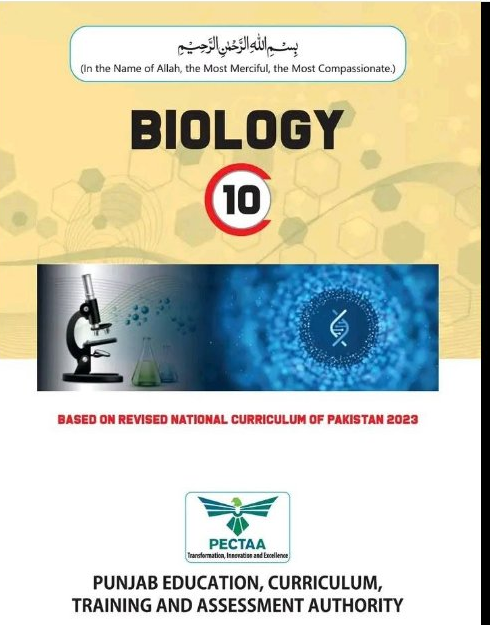
The 10th Class Biology Textbook (English Medium) 2025–2026 is based on the latest PECTAA curriculum implemented across Punjab Boards. This updated textbook is designed to improve conceptual understanding, scientific reasoning, and practical application of biological concepts among Matric students.
Students from all Punjab Boards including Lahore, Gujranwala, Faisalabad, Multan, Rawalpindi, Sargodha, Bahawalpur, DG Khan, and Sahiwal can use this book for exam preparation and conceptual clarity.
About 10th Class Biology Textbook (English Medium)
The new PECTAA Biology textbook focuses on making biological concepts more understandable through simplified English, labeled diagrams, real-life examples, and structured learning objectives.
This textbook is especially helpful for students preparing for board examinations as well as entry tests like MDCAT in the future.
Key Features of the New Biology Textbook
The 10th Class Biology textbook includes several updated features:
- Concept-based learning instead of rote memorization
- Clear English explanations with scientific terminology
- Well-labeled diagrams and illustrations
- Chapter summaries and key points
- Activity-based learning sections
- Real-life applications of biological concepts
- Updated content according to PECTAA syllabus
These features make the textbook highly effective for both classroom learning and self-study.
Detailed Chapters Overview (10th Class Biology Textbook)
The 10th Class Biology textbook (English Medium) is organized into ten well-structured chapters. Each chapter builds student understanding step-by-step, starting from basic human biology to advanced modern concepts like genetics and biotechnology.
Chapter 1: Human Digestive System
This chapter explains the complete process of nutrition in humans. It describes how food is ingested, broken down into simpler substances, and absorbed into the bloodstream for energy, growth, and repair.
Students learn about the structure and function of the alimentary canal and accessory organs such as the liver and pancreas. The role of enzymes in digestion is also discussed in detail.
Chapter 2: Human Respiratory System
This chapter focuses on the process of respiration and gas exchange in humans. It explains how oxygen is taken into the body and how carbon dioxide is removed.
Students study the structure of lungs, trachea, bronchi, and alveoli. The mechanism of inhalation and exhalation is described with pressure changes in the chest cavity.
Chapter 3: Human Circulatory System
This chapter explains how blood circulates throughout the body through the heart and blood vessels. It describes the structure of the heart, including chambers, valves, and blood flow pathways.
Students learn about arteries, veins, and capillaries and how oxygenated and deoxygenated blood is transported. The role of hemoglobin in oxygen transport is also included.
Chapter 4: Excretory System
This chapter describes how the body removes metabolic waste products to maintain internal balance.
It focuses on the structure and function of kidneys, ureters, bladder, and urethra. The nephron is explained as the basic unit of the kidney responsible for filtration and urine formation.
Chapter 5: Coordination and Control
This chapter explains how the human body responds to internal and external changes through the nervous system.
It describes neurons, brain, spinal cord, and peripheral nerves. The transmission of nerve impulses and reflex actions are explained in detail.
Chapter 6: Reproduction
This chapter explains how living organisms produce offspring and ensure continuation of life.
It covers male and female reproductive systems, gamete formation, fertilization, and embryonic development.
Chapter 7: Inheritance
This chapter introduces the principles of genetics and heredity.
It explains DNA, genes, and chromosomes and how traits are passed from parents to offspring.
Mendel’s laws of inheritance are discussed along with dominant and recessive traits. Genetic variation and mutations are also introduced as key factors in evolution.
Chapter 8: Biotechnology
This chapter covers modern applications of biology in science and industry.
It explains genetic engineering, recombinant DNA technology, cloning, and fermentation processes.
Students learn how biotechnology is used in agriculture (improving crops), medicine (insulin production), and environmental protection.
Chapter 9: Diseases and Immunity
This chapter explains how diseases occur and how the human body defends itself.
It introduces pathogens such as bacteria, viruses, fungi, and protozoa. Students study infectious and non-infectious diseases.
The immune system, antibodies, antigens, and vaccination are explained in detail. Preventive healthcare and hygiene practices are also emphasized.
Chapter 10: Evolution
This chapter explains how living organisms have changed over time.
It describes Darwin’s theory of natural selection and the process of adaptation.
Students learn how fossils provide evidence of evolution and how species develop new characteristics over generations.
Importance of Biology in Modern Education
Biology is one of the most important science subjects because it helps students understand life processes and living organisms. It provides a strong foundation for careers in medicine, biotechnology, agriculture, pharmacy, and environmental sciences.
Benefits of Studying 10th Class Biology
Students who perform well in biology gain several academic and career advantages:
- Strong preparation for FSc Pre-Medical
- Better performance in board examinations
- Foundation for medical entry tests (MDCAT)
- Opportunities in healthcare and life sciences
- Improved understanding of human health and diseases
Preparation for Higher Studies
The 10th class biology textbook serves as a bridge between school-level science and advanced biological studies. It prepares students for:
- FSc Pre-Medical
- MBBS and BDS
- Pharmacy
- Biotechnology
- Nursing and Allied Health Sciences
- Research-based science fields
The concepts learned in this textbook are essential for success in higher education.
Free PDF Download Information
This page is designed for students searching for:
The textbook provides complete chapter coverage, making it ideal for exam preparation, revision, and conceptual learning.
Students can use this resource for:
- Home study
- Exam preparation
- Classroom revision
- Concept strengthening
Need Notes? Just click.
Boards Covered
This textbook is applicable for all Punjab Boards:
- Lahore Board
- Gujranwala Board
- Faisalabad Board
- Multan Board
- Rawalpindi Board
- Sargodha Board
- Bahawalpur Board
- DG Khan Board
- Sahiwal Board
Study Resources Available
Along with the textbook, students can also access:
- Chapter-wise notes
- Solved exercises
- MCQs and short questions
- Long questions
- Important definitions
- Diagrams and labeling practice
- Model papers and guess papers
Contact Information
HSANOTES.COM
Email: hsanotes48@gmail.com
Final Note
The 10th Class Biology Textbook (English Medium) 2025–2026 is a complete academic resource designed to strengthen conceptual understanding and exam preparation. It provides a solid foundation for students aiming to pursue careers in medical and biological sciences.
DISCLAIMER
This material is shared strictly for educational, learning, and academic support purposes only.
All copyrights, trademarks, textbook content, and publication rights belong to their respective publishers, textbook boards, authors, and organizations.
HSA NOTES does not claim ownership of official textbook content. This material is provided to help students and teachers access educational resources easily and free of cost.
If any publisher or copyright owner has concerns regarding this material, they may contact us for review or necessary action.
1 thought on “Biology 10th New Book (EM) PECTAA PDF”