

Introduction
100% easy notes Unit 8, Inverse Trigonometric Functions & Graphs, from the New NBF Mathematics Book Class 12 FBISE 2024-25, complete with principal value tables, original graphs, and answers matching the FBISE marking scheme, prepared by HSA Notes.
🎓 Online Classes with Experienced Experts
Perfect for FBISE HSSC-II exams in April 2026, these notes are designed to help students score 90 plus marks with ease, and are equally useful for students and teachers at FBISE-affiliated institutions.
Unit 8 is shorter than the units around it but no less important, since a solid grip on principal values and inverse trig graphs is assumed throughout the rest of the course.
It spans three exercises plus a review exercise, moving from evaluating inverse trig expressions at standard angles, through sketching transformed inverse trig graphs, and finishing with identities, equations, and proofs involving inverse trig functions.
Because every later exercise depends on knowing the correct principal value range for each inverse function, getting comfortable with Exercise 8.1 first makes the rest of the unit go far more smoothly.
Exercise 8.1, Inverse Trig Evaluations (All Questions Solved)
- Exercise 8.1 Complete Solved + Principal Ranges
- Standard Angles & Trig Values, 0, π/6, π/4, π/3, π/2
- Principal Ranges for Each Inverse Function
- Q1(i–ix), Evaluating cos⁻¹, sin⁻¹, tan⁻¹, cot⁻¹, sec⁻¹, csc⁻¹
- Sum of Multiple Inverse Trig Values
Exercise 8.1 is where the principal value ranges are put into practice, and it’s the exercise that determines how comfortably students handle everything else in the unit.
The notes open with a quick-reference table of standard angles and their trig values, since almost every question reduces to recognizing a known ratio and then placing the angle correctly within the relevant principal range. Negative-value questions, like csc⁻¹(−√2) and csc⁻¹(−2), get particular attention, since choosing the wrong sign or the wrong branch is the most common mistake students make here.
Exercise 8.2, Graphs of Inverse Trig Functions
Full Solutions + Graphs
- Exercise 8.2 Complete Solutions
- Domain-Restricted and Transformed Inverse Trig Graphs
This exercise takes the basic inverse trig graphs and asks students to sketch transformed versions — compositions like Marcos(x²), arcsin(2x), or arccot(2x − 1) — each of which shifts, stretches, or restricts the domain in a different way.
Rather than sketching each graph from scratch, the notes show how to first work out the domain forced by the inner function, then map the standard inverse trig curve onto that restricted interval, a method that transfers directly to any similar transformation on the exam.
Exercise 8.3, Identities & Equations (100% Solved)
Full Solutions + Proofs
- Exercise 8.3 Identities + Proofs Solved
- Sum and Difference Identities for Inverse Trig Functions
- Solving Equations Involving Inverse Trig Expressions
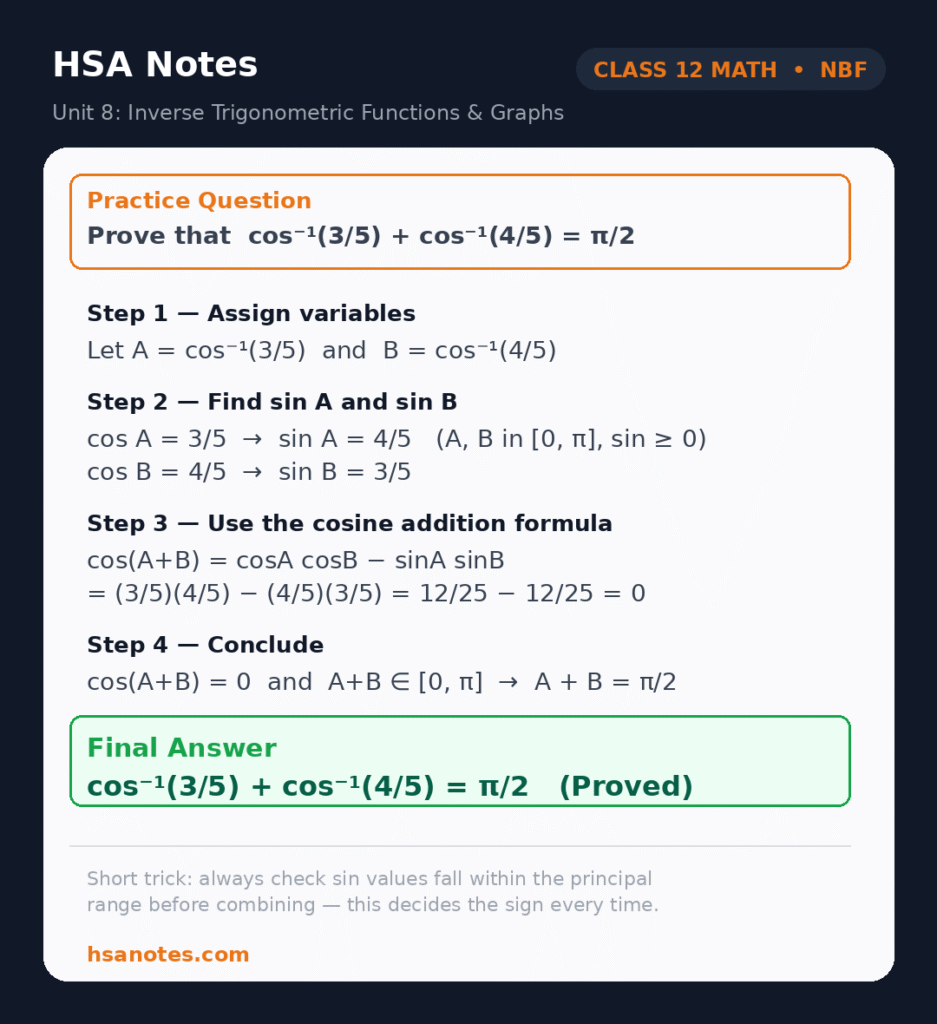
Exercise 8.3 is the longest and most demanding exercise in the unit, covering both identity proofs and equation-solving. The identity proofs — like sin⁻¹(1/3) + sin⁻¹(2√2/3) = π/2 or tan⁻¹(3/4) + tan⁻¹(1/7) = π/4 — are worked through using the standard addition formulas, with careful attention to when a result needs adjusting because it falls outside a principal range.
The equation-solving questions later in the exercise, several of which reduce to quadratics in tan⁻¹x or sin⁻¹x, are solved by substitution first and then checked against the valid domain, since not every algebraic solution turns out to be valid once the original restrictions are reapplied a check the notes never skip.
Sample Questions
From Exercise 8.1:
- Evaluate cos⁻¹(√3/2)
- Evaluate csc⁻¹(−√2)
- Evaluate tan⁻¹(1) + cos⁻¹(−1/2) + sin⁻¹(−1/2)
From Exercise 8.2:
4. State the domain and sketch the graph of y = arcsin(2x)
5. State the domain and sketch the graph of y = Marcos(2x − 1)
From Exercise 8.3:
6. Prove that cos⁻¹(3/5) + cos⁻¹(4/5) = π/2
7. Solve sin⁻¹(x − 1) = π/2
8. Solve 9 arcsin²(x) − u² = 0
Why This Unit Matters
Inverse trigonometric functions restore a single, well-defined output to functions that are otherwise many-to-one, and the principal value ranges introduced in Exercise 8.1 are what make that possible a concept that resurfaces anywhere inverse trig appears later in calculus or applied problems.
Exercise 8.3’s identity proofs and equations are consistently favored in FBISE long questions, since they test both algebraic manipulation and a genuine understanding of domain restrictions rather than mechanical substitution, making this exercise especially worth mastering before the board exam.
HSA Notes Features
- Complete solved exercises from 8.1 through 8.3, plus the review exercise
- Principal value tables and domain restrictions shown clearly for every question
- Original graphs included for every transformed inverse trig function
- Answers matching the FBISE marking scheme
- Full Unit 8 notes available to study online at hsanotes.com
Join Online Classes
Join HSA Notes online classes to strengthen your inverse trigonometry technique, and every other unit of Class 12 Math, with regular practice to help you aim for 90 plus marks in your FBISE HSSC-II board exam.
Contact: hsanotes48@gmail.com
Frequently Asked Questions
What is the principal value range of an inverse trig function?
It’s the restricted interval of output values assigned to each inverse trig function so it behaves as a true function rather than a multi-valued relation — for example, sin⁻¹x is restricted to [−π/2, π/2] and cos⁻¹x to [0, π].
Why do some inverse trig equations have no solution?
Because after solving algebraically, the resulting value may fall outside the principal range required by the original inverse function, which means it doesn’t actually satisfy the equation even though it solves the rearranged algebra.
How do you graph a transformed inverse trig function like Marcos(2x − 1)?
By first finding the domain forced by the inner expression so the argument stays within the original function’s valid input range, then mapping the standard inverse trig curve onto that restricted domain.
Are these notes aligned with the current FBISE NBF syllabus?
Yes, these notes are fully solved according to the New NBF Mathematics Book for Class 12, FBISE, 2024-25, and follow the official FBISE marking scheme.
Conclusion
With Unit 8, Inverse Trigonometric Functions & Graphs, fully solved from Exercise 8.1 through the review exercise, Class 12 FBISE students have a complete, exam-ready resource covering a compact but concept-heavy unit in the Math syllabus. Practice these solved exercises alongside past papers, and consider joining our online classes for guided, exam-focused preparation, to build the accuracy and confidence needed for your HSSC-II board exam.
Best of luck for your Class 12 Math exam!