
Introduction
100% solved Unit 7, Conic Section, from the New NBF Mathematics Book Class 12 FBISE 2026-27, complete with standard-form derivations, step-by-step methods, and answers matching the FBISE marking scheme, prepared by HSA Notes. Perfect for FBISE HSSC-II exams in April 2026, these notes are designed to help students score 90 plus marks with ease, and are equally useful for students and teachers at FBISE-affiliated institutions.
🎓 Online Classes with Experienced Experts
Unit 7 takes the introduction to conics from Unit 6 and develops it into a full, self-contained treatment of the circle, parabola, ellipse, and hyperbola.
Exercise 7.1, Equation of Circle (All Questions Solved)
- Exercise 7.1 Complete Solved + Equations
- Writing the Equation Given Center & Radius, Q1(i–iii)
- Converting General to Standard Form by Completing the Square, Q2(i–ii)
- Circles with Literal (Constant-Containing) Coefficients, Q2(iii)
- General Equation to Standard Form, Q3
Exercise 7.1 builds the foundation for the entire unit: given a center and radius, writing the equation directly, and, in reverse, taking a messy general equation and completing the square in both x and y to recover the center and radius.
The notes are especially careful with questions involving fractional centers or literal constants like a and b, since the algebra there is where marks are most often lost, showing every intermediate step rather than jumping straight to the standard form.
Exercise 7.2, Tangents & Normals to Conics
Full Solutions + Methods
- Exercise 7.2 Complete Solutions
- Tangent at a Point, Chord of Contact, Short Tricks
This exercise extends the tangent and normal ideas introduced in Unit 6 to the full range of conics covered here. The chord of contact the line joining the points of tangency from an external point is a concept that often confuses students on first exposure, so the notes build it up geometrically before presenting the formula, so it’s understood rather than just applied.
Exercises 7.3 to 7.10 + Review Exercise, Fully Solved
- Exercise 7.3 — Parabola Equations
- Exercise 7.4 — Ellipse & Foci
- Exercise 7.5 — Hyperbola & Asymptotes
- Exercise 7.6 — General Conic Equation
- Exercise 7.7 — Polar Equations of Conics
- Exercise 7.8 — Intersection of Conics
- Exercise 7.9 — Diameters & Chords
- Exercise 7.10 — Applications in Geometry
- Review Exercise, Unit 7 — MCQs and long questions, fully solved
These exercises work through each conic in turn, then bring them together. Exercises 7.3 through 7.5 cover the parabola, ellipse, and hyperbola individually, each with their standard forms, foci or asymptotes, and defining properties, illustrated with original figures so every feature has a clear geometric picture attached to it.
Exercise 7.6 then steps back to the general second-degree conic equation, showing how to identify which type of conic a given equation represents before analyzing it further a classification skill that shows up often in MCQs.
Exercise 7.7 introduces polar equations of conics, a less familiar representation that several students find the hardest part of the unit, so it’s solved with extra explanation of how the polar and Cartesian pictures relate. Exercises 7.8 and 7.9 close out the technical content with intersections, diameters, and chords, before Exercise 7.10 applies everything to broader geometric problems and the review exercise ties the whole unit together.
Sample Questions
From Exercise 7.1:
- Find the equation of the circle with center (3, −1) and radius 2.
- Convert x² + y² − 4x + 6y − 36 = 0 into standard form and state the center and radius.
From Exercise 7.2:
3. Find the equation of the tangent to the circle x² + y² = 25 at the point (3, 4).
From Exercise 7.3:
4. Find the equation of the parabola with vertex at the origin and directrix x = −2.
From Exercise 7.4:
5. Find the foci and eccentricity of the ellipse x²/25 + y²/9 = 1.
From Exercise 7.5:
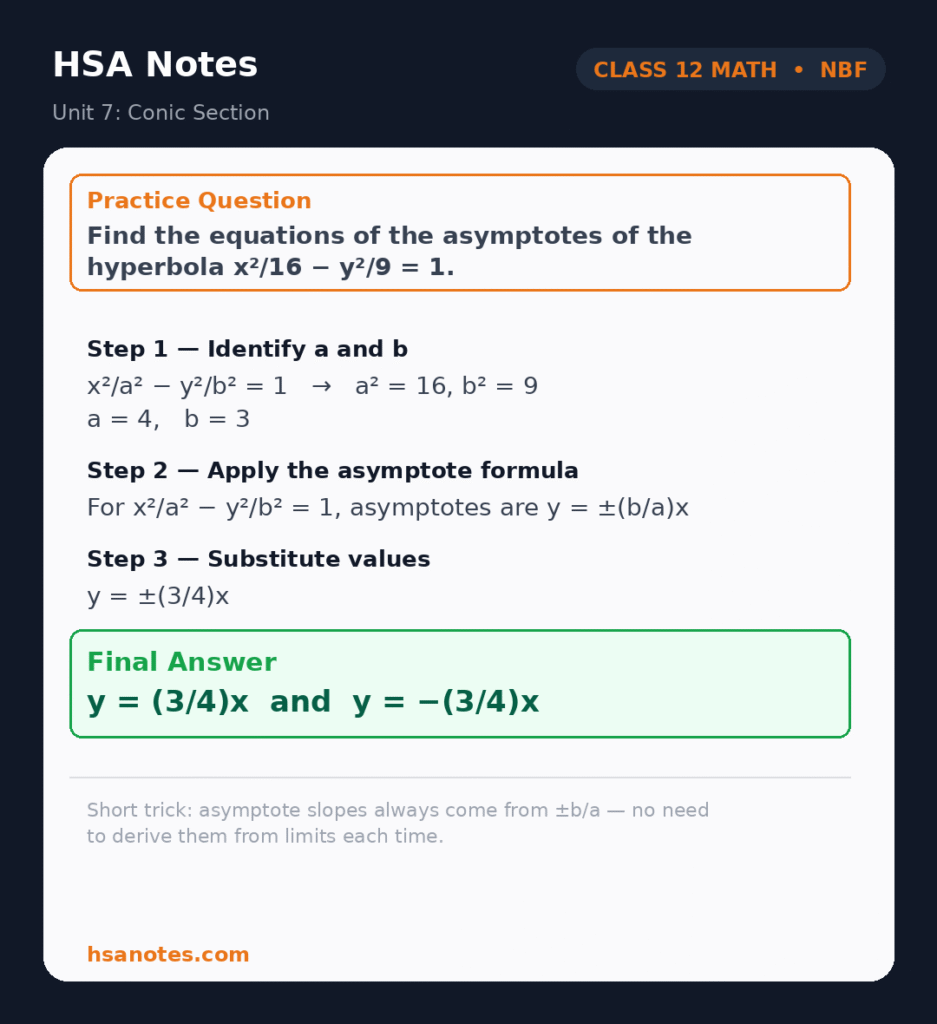
6. Find the equations of the asymptotes of the hyperbola x²/16 − y²/9 = 1.
From Exercise 7.6:
7. Identify the type of conic represented by 4x² + 9y² − 16x + 18y − 11 = 0.
Why This Unit Matters
Conic sections are one of the richest topics in the Class 12 syllabus, connecting algebra, geometry, and even the polar coordinate systems students will meet again later in their studies.
Completing the square and converting between general and standard form, practiced in Exercise 7.1, is a skill that resurfaces in every exercise that follows, so getting comfortable with it early makes the rest of the unit noticeably smoother.
Parabolas, ellipses, and hyperbolas, covered in Exercises 7.3 through 7.5, are consistently among the most heavily tested topics in FBISE’s Class 12 papers, making this one of the highest-value units to prepare thoroughly for the board exam.
HSA Notes Features
- Complete solved exercises from 7.1 through 7.10, plus the review exercise
- Standard-form derivations shown step by step for every conic
- Original figures included alongside the algebra
- Answers matching the FBISE marking scheme
- Full Unit 7 notes available to study online at hsanotes.com
Join Online Classes
Join HSA Notes online classes to strengthen your conic sections technique, and every other unit of Class 12 Math, with regular practice to help you aim for 90 plus marks in your FBISE HSSC-II board exam.
Contact: hsanotes48@gmail.com
Frequently Asked Questions
How do you convert a circle’s general equation into standard form?
By completing the square separately in the x-terms and the y-terms, which rewrites the equation as (x − h)² + (y − k)² = r², directly revealing the center (h, k) and radius r.
What’s the chord of contact of a conic?
It’s the line joining the two points where tangent lines from an external point touch the conic; its equation can be found directly from the conic’s equation without first finding the tangent points individually.
How do you tell which conic a general second-degree equation represents?
By examining the coefficients of x² and y² and the discriminant of the general conic equation — equal coefficients with the same sign typically indicate a circle, unequal coefficients of the same sign an ellipse, and opposite signs a hyperbola.
Are these notes aligned with the current FBISE NBF syllabus?
Yes, these notes are fully solved according to the New NBF Mathematics Book for Class 12, FBISE, 2024-25, and follow the official FBISE marking scheme.
Conclusion
With Unit 7, Conic Section, fully solved from Exercise 7.1 through the review exercise, Class 12 FBISE students have a complete, exam-ready resource covering the most extensive and heavily tested geometry unit in the Math syllabus. Practice these solved exercises alongside past papers, and consider joining our online classes for guided, exam-focused preparation, to build the accuracy and confidence needed for your HSSC-II board exam.
Best of luck for your Class 12 Math exam!