
Introduction
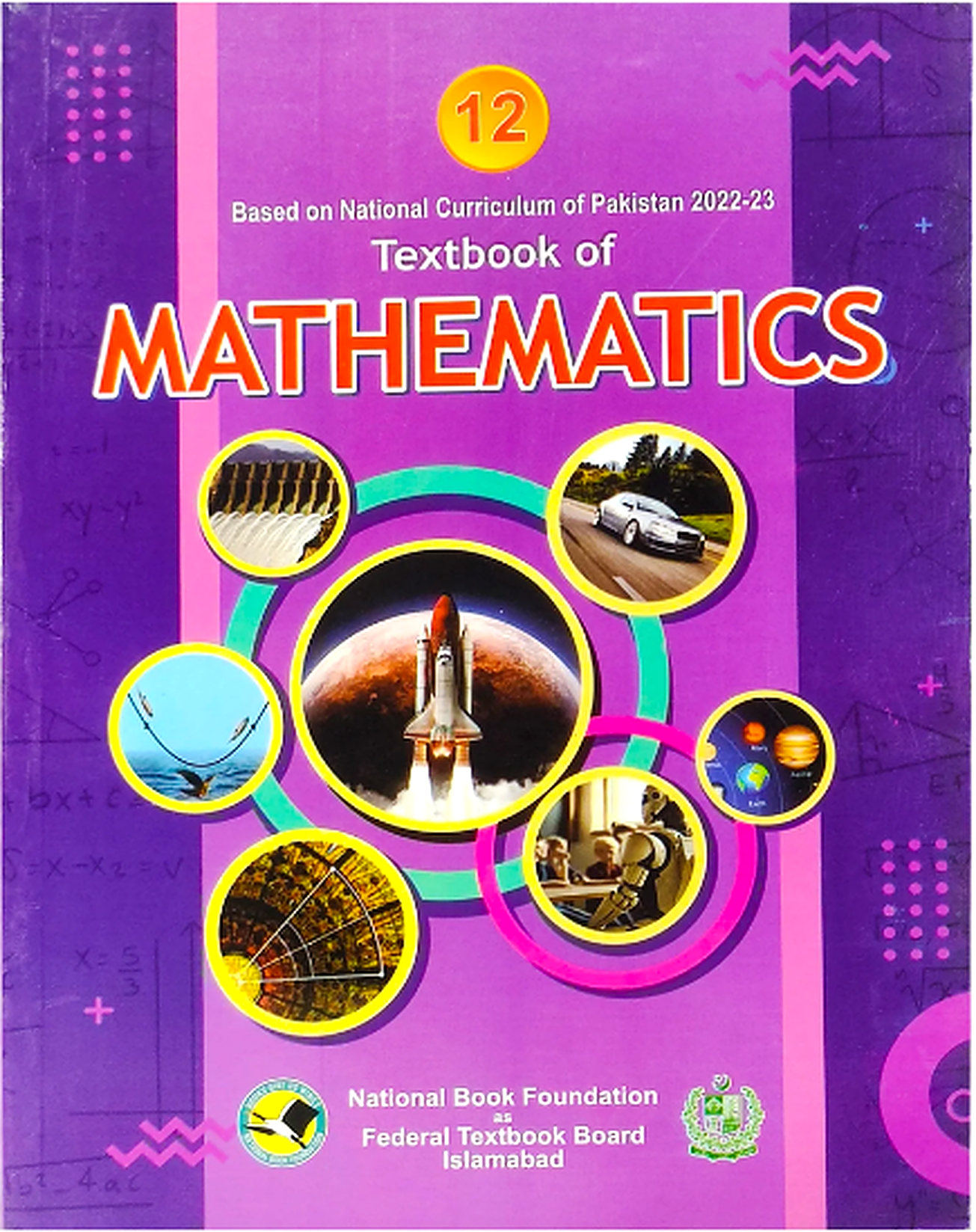
100% easy Unit 6, Analytical Geometry, from the New NBF Mathematics Book Class 12 FBISE 2026-27, complete with original figures, concurrency checks, and answers matching the FBISE marking scheme, prepared by HSA Notes.
🎓 Online Classes with Experienced Experts
Perfect for FBISE HSSC-II exams in April 2026, these notes are designed to help students score 90 plus marks with ease, and are equally useful for students and teachers at FBISE-affiliated institutions.
Exercise 6.1, Concurrent Lines & Angle Bisectors (All Questions Solved)
- Exercise 6.1 Complete Solved + Figures
- Identifying Concurrent Line Sets, Q1(i–ii)
- Verifying Concurrency by Solving Systems, Q2(i–ii)
- Finding an Unknown Constant for Concurrency, Q3
- Concurrency with the x-axis & Angle Bisector Check, Q4
- Homogeneous Equation for a Pair of Angle Bisectors, Q5
Exercise 6.1 opens the unit by testing whether three or more lines pass through a single point, a check that comes up repeatedly later whenever a geometric figure needs to be confirmed before further work is done on it.
The standard method solving any two of the lines simultaneously, then substituting into the third is shown step by step for every question, alongside the alternative determinant-based check, so students can use whichever approach they find faster on the exam. The angle bisector question at the end of the exercise introduces the homogeneous equation method, a technique that reappears when working with conics later in the unit.
Exercise 6.2, Equations of Lines
Full Solutions + Methods
- Exercise 6.2 Complete Solutions
- Point-Slope, Two-Point & Intercept Forms, Short Tricks
This exercise consolidates the different ways a straight line’s equation can be written, and, more importantly, how to recognize which form is fastest for a given problem.
Rather than treating point-slope, two-point, and intercept forms as separate topics to memorize, the notes show how each is really the same underlying relationship rearranged, which makes switching between them during a timed exam far more natural.
Exercises 6.3 to 6.10 + Review Exercise, Fully Solved
- Exercise 6.3 — Distance from a Point to a Line
- Review Exercise, Unit 6 — MCQs and long questions, fully solved
These exercises move from line geometry into the study of curves. Exercises 6.3 and 6.4 round out the toolkit for lines, covering perpendicular distance and the area enclosed by three lines, both of which are used constantly in the conic sections that follow.
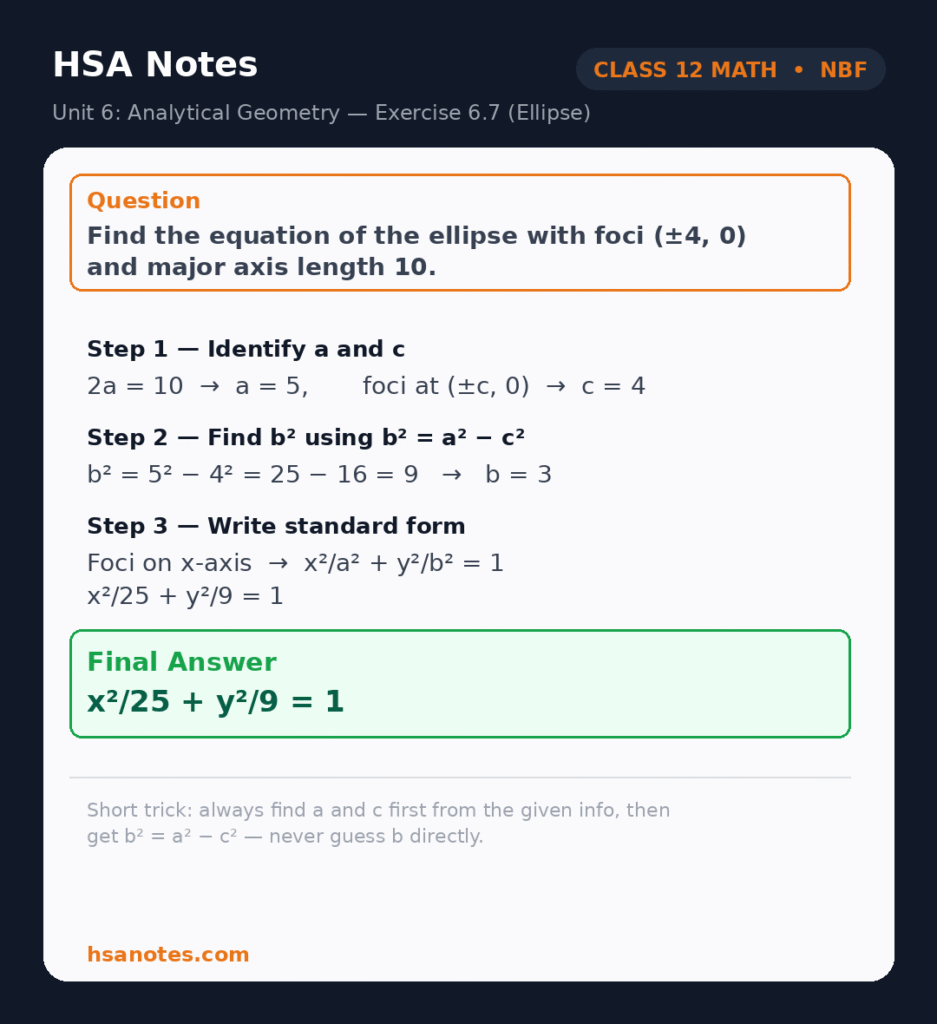
Exercise 6.5 introduces the general conic framework before Exercises 6.6 through 6.8 work through parabolas, ellipses, hyperbolas, and circles individually, each with the standard forms, key features like foci and directrices, and original figures so the shape being described is never left to imagination.
Exercise 6.9 then applies differentiation to these curves to find tangent and normal lines at a given point, tying this unit directly back to the calculus covered earlier in the course, and Exercise 6.10 closes with applied geometry problems before the review exercise consolidates everything into exam-style questions.
Sample Questions
From Exercise 6.1:
- Show that the lines 3x − 4y − 13 = 0, 8x − 11y − 33 = 0, and 2x − 3y − 7 = 0 are concurrent, and find the point of concurrency.
- Find the value of a for which the lines x + 2y − 4 = 0, ax − y − 1 = 0, and 4x + 5y − 13 = 0 are concurrent.
From Exercise 6.2:
3. Find the equation of the line passing through (2, 3) and (−1, 4).
From Exercise 6.3:
4. Find the distance from the point (3, −2) to the line 4x − 3y + 5 = 0.
Why This Unit Matters
Analytical geometry is where coordinate algebra becomes a tool for studying shape, turning questions about lines, angles, and curves into equations that can be solved directly.
Concurrency and angle bisector problems from Exercise 6.1 build the habit of verifying a geometric configuration algebraically rather than assuming it from a sketch, a skill that carries through the entire unit.
Conic sections, covered in Exercises 6.5 through 6.9, are consistently one of the most heavily tested topics in FBISE’s Class 12 papers, making thorough practice of the parabola, ellipse, hyperbola, and tangent-normal exercises especially valuable heading into the board exam.
HSA Notes Features
- Complete solved exercises from 6.1 through 6.10, plus the review exercise
- Original figures included alongside step-by-step working
- Concurrency checks and angle bisector methods shown in full
- Answers matching the FBISE marking scheme
- Full Unit 6 notes available to study online at hsanotes.com
Join Online Classes
Join HSA Notes online classes to strengthen your analytical geometry technique, and every other unit of Class 12 Math, with regular practice to help you aim for 90 plus marks in your FBISE HSSC-II board exam.
Contact: hsanotes48@gmail.com
Frequently Asked Questions
How do you check if three lines are concurrent?
Solve any two of the lines simultaneously to find their point of intersection, then substitute that point into the third line’s equation — if it satisfies the equation, all three lines are concurrent.
What’s the difference between the point-slope, two-point, and intercept forms of a line?
They’re different rearrangements of the same linear relationship, each convenient for different given information — point-slope when you have a point and a slope, two-point when you have two points, and intercept form when the x- and y-intercepts are known or easy to find.
How do tangents and normals to a conic connect to earlier calculus units?
The tangent line’s slope at a point on a curve is found using implicit differentiation, the same technique from Unit 2, and the normal line is simply the line perpendicular to that tangent at the same point.
Are these notes aligned with the current FBISE NBF syllabus?
Yes, these notes are fully solved according to the New NBF Mathematics Book for Class 12, FBISE, 2024-25, and follow the official FBISE marking scheme.
Conclusion
With Unit 6, Analytical Geometry, fully solved from Exercise 6.1 through the review exercise, Class 12 FBISE students have a complete, exam-ready resource covering one of the most figure-heavy and heavily tested units in the Math syllabus. Practice these solved exercises alongside past papers, and consider joining our online classes for guided, exam-focused preparation, to build the accuracy and confidence needed for your HSSC-II board exam.
Best of luck for your Class 12 Math exam!