
Introduction
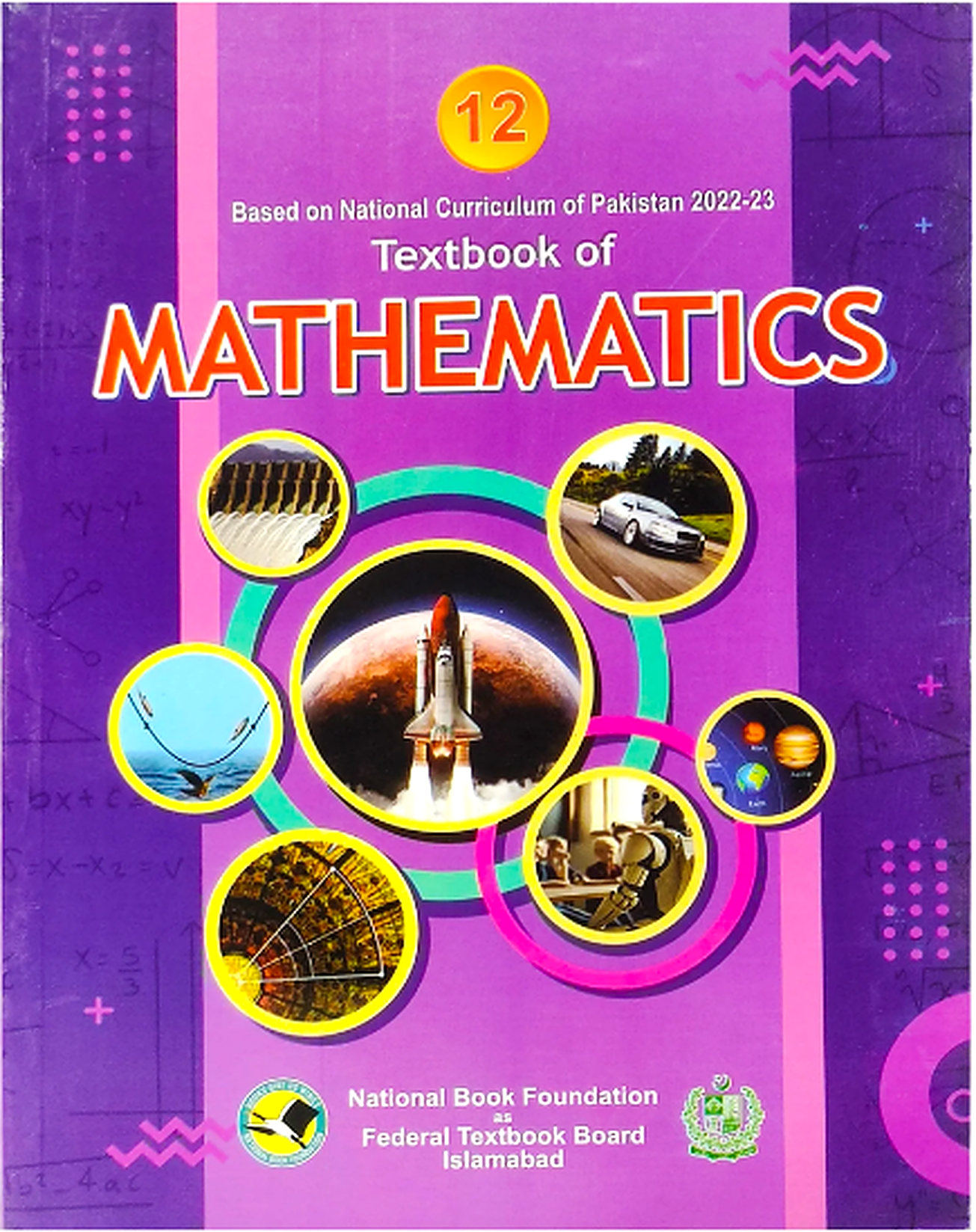
100% easy notes Unit 5, Kinematics of Motion in a Straight Line, from the New NBF Mathematics Book Class 12 FBISE 2026-27, complete with original graphs, velocity calculations, and answers matching the FBISE marking scheme, prepared by HSA Notes.
🎓 Online Classes with Experienced Experts
Perfect for FBISE HSSC-II exams in April 2026, these notes are designed to help students score 90 plus marks with ease, and are equally useful for students and teachers at FBISE-affiliated institutions.
Unit 5 moves the course from pure calculus into its physical applications, using derivatives and graphs to describe how objects move.
It’s the longest unit in the syllabus, spanning ten exercises plus a review exercise, starting with displacement-time graphs and building up through velocity, acceleration, the equations of motion, free fall, projectile motion, and circular motion topics like centripetal force, banking of roads, and the conical pendulum.
Because later exercises depend on graph-reading skills and sign conventions introduced early on, working through this unit in sequence rather than skipping to the more exam-favored topics like projectile motion helps avoid the sign errors that cost the most marks in this chapter.
Exercise 5.1, Displacement-Time Graphs (All Questions Solved)
- Exercise 5.1 Complete Solved + Graphs
- Stage-by-Stage Velocity Analysis, Multi-Part Journeys
- Average Velocity vs. Average Speed, Worked Comparisons
- Velocity-Time Graph Analysis
Exercise 5.1 is where most students first encounter the distinction between average velocity and average speed, and it’s a distinction the notes deliberately emphasize throughout, since a journey that returns to its starting point has zero average velocity even though the average speed is clearly not zero.
Multi-stage journey questions, where an object moves at different velocities across several segments, are broken down stage by stage before the overall average is computed, so the method generalizes to any similar question rather than just the ones shown.
Exercise 5.2, Velocity & Acceleration
Full Solutions + Formulas
- Exercise 5.2 Complete Solutions
- Instantaneous Velocity Calculation, Short Tricks
This exercise moves from average quantities to instantaneous ones, using differentiation to find velocity and acceleration at a specific moment rather than over an interval.
The notes connect this back to Unit 2’s derivative work directly, since instantaneous velocity is simply the derivative of displacement with respect to time a link that makes the calculation far more intuitive than treating it as a new formula to memorize.
Exercises 5.3 to 5.10 + Review Exercise, Fully Solved
- Exercise 5.3 — Equations of Motion
- Exercise 5.4 — Free Fall & Gravity
- Exercise 5.5 — Projectile Motion
- Exercise 5.6 — Uniform Circular Motion
- Exercise 5.7 — Centripetal Force
- Exercise 5.8 — Banking of Roads
- Exercise 5.9 — Conical Pendulum
- Exercise 5.10 — Applications in Real Life
- Review Exercise, Unit 5 — MCQs and long questions, fully solved
These exercises apply kinematics to progressively more specific physical situations. Exercise 5.3 covers the standard equations of motion, the algebraic backbone the rest of the unit builds on, while Exercise 5.4 applies them to objects falling under gravity.
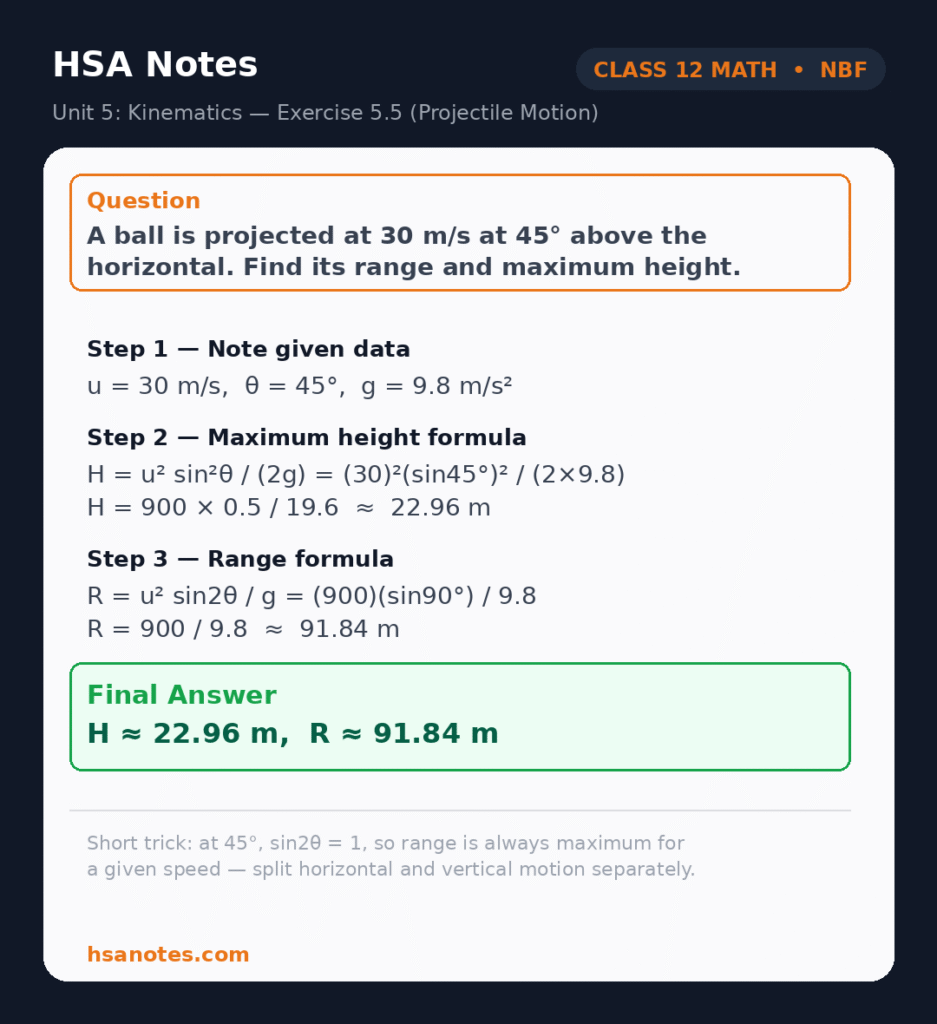
Exercise 5.5 tackles projectile motion, consistently one of the most heavily tested topics in this unit, by splitting motion into independent horizontal and vertical components before recombining them for range, height, and time of flight.
Exercises 5.6 through 5.9 then shift to circular motion uniform circular motion, centripetal force, banked roads, and the conical pendulum each building on the last, with diagrams included so the forces and angles involved are never left to guesswork.
Exercise 5.10 closes the unit by tying these ideas back to everyday examples, and the review exercise consolidates the full unit into exam-style MCQs and long questions.
Sample Questions
From Exercise 5.1:
- A cyclist travels at 15 km/h for the first stage, rests, then returns at 20 km/h. Find the average velocity and average speed for the whole journey.
From Exercise 5.2:
2. Given s(t) = 4t² − 3t + 2, find the instantaneous velocity and acceleration at t = 2.
From Exercise 5.3:
3. A car accelerates uniformly from rest at 5 m/s². Find its velocity and displacement after 8 seconds.
From Exercise 5.5:
4. A ball is projected at 30 m/s at an angle of 45° above the horizontal. Find its range and maximum height.
From Exercise 5.7:
5. A 2 kg mass moves in a circle of radius 0.5 m at 4 m/s. Find the centripetal force acting on it.
From Exercise 5.8:
6. Find the angle of banking required for a road of radius 100 m so that a car can travel at 20 m/s without relying on friction.
Why This Unit Matters
Kinematics is where calculus becomes tangible displacement, velocity, and acceleration are simply a function and its derivatives, applied to real motion.
Projectile motion and the circular motion topics covered in Exercises 5.5 through 5.9 are consistently among the highest-weightage areas in FBISE’s mechanics questions, and mastering the graph-reading skills from Exercise 5.1 early on makes every later exercise in the unit noticeably easier to follow. This unit also lays groundwork that carries directly into any further study of applied mathematics or physics beyond the FSc syllabus.
HSA Notes Features
- Complete solved exercises from 5.1 through 5.10, plus the review exercise
- Original graphs and diagrams included alongside step-by-step working
- Velocity and acceleration calculations shown with full method, not just answers
- Answers matching the FBISE marking scheme
- Full Unit 5 notes available to study online at hsanotes.com
Join Online Classes
Join HSA Notes online classes to strengthen your kinematics and mechanics technique, and every other unit of Class 12 Math, with regular practice to help you aim for 90 plus marks in your FBISE HSSC-II board exam.
Contact: hsanotes48@gmail.com
Frequently Asked Questions
What’s the difference between average velocity and average speed?
Average velocity is total displacement divided by total time and can be zero if the object returns to its starting point, while average speed is total distance traveled divided by total time and is always positive.
How do you solve projectile motion problems?
By splitting the motion into independent horizontal and vertical components, applying the standard equations of motion to each separately, and combining the results to find quantities like range, maximum height, and time of flight.
Why does banking of roads matter in circular motion?
Banking the road at the correct angle allows a vehicle to complete a turn at a given speed using the horizontal component of the normal force, reducing dependence on friction alone.
Are these notes aligned with the current FBISE NBF syllabus?
Yes, these notes are fully solved according to the New NBF Mathematics Book for Class 12, FBISE, 2024-25, and follow the official FBISE marking scheme.
Conclusion
With Unit 5, Kinematics of Motion in a Straight Line, fully solved from Exercise 5.1 through the review exercise, Class 12 FBISE students have a complete, exam-ready resource covering the longest and most application-heavy unit in the Math syllabus. Practice these solved exercises alongside past papers, and consider joining our online classes for guided, exam-focused preparation, to build the accuracy and confidence needed for your HSSC-II board exam.
Best of luck for your Class 12 Math exam!